
Post Date: December 10, 2025 |
Last Edited: December 10, 2025
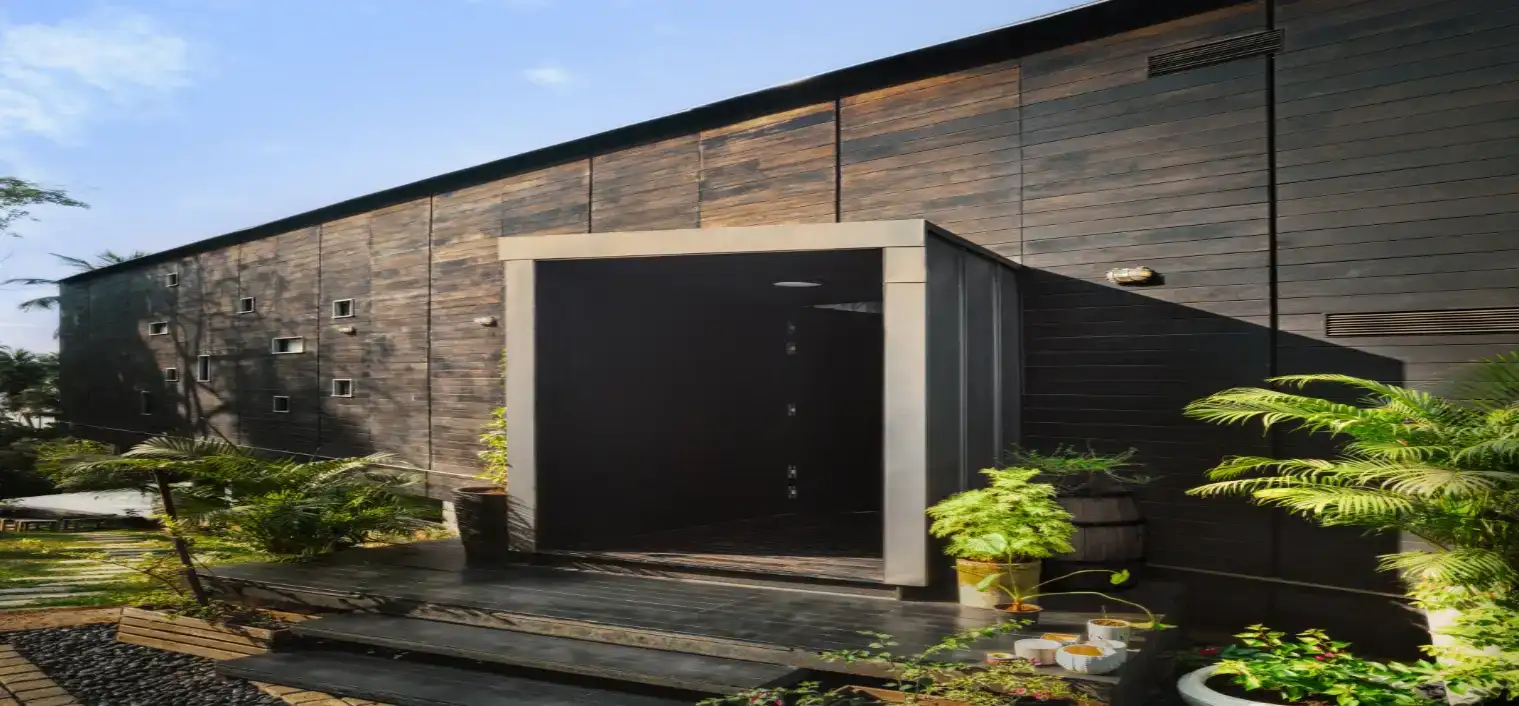
Framed in mass timber, a first in India, this house for a young techpreneur is wrapped in charred wood panels to blend into its forested surroundings. The negative impacts of concrete in mainstream construction can no longer be outrun. New projects, especially residences, can host small-scale experiments with innovative materials and technologies that optimize both construction and carbon emissions.

This sea-facing residence in the tranquil Goan village of Vagator is one such experiment, resulting in a focused and ordered home that pioneers the use of mass timber in India.
Perched at the highest point of a verdant, steeply sloped site, the house is oriented towards the Chapora River on the north, with views of the Arabian Sea to the northwest. To preserve the site’s slope and vegetation, it stands on a minimally invasive foundation of stilts and retaining walls. The raised ground floor reduces cut and fill while protecting the home from moisture and capillary action.
The client’s focused personality inspired the unidirectional built form—a single, linear block with a pitched roof tailored for Goa’s heavy monsoons. The superstructure comprises eleven glulam portal frames that define the central volume. Glulam, or glued laminated timber, is a form of mass timber known for its strength, structural integrity, and low carbon footprint, offering a sustainable alternative to concrete and steel construction.
Prefabricated entirely in New Delhi, the frames were assembled on-site in Goa, minimising wastage and enabling quick construction with minimal site damage. Artius supplied the premium glulam timber and completed the installation within 30 days. Precision-engineered post anchors secured the glulam frame to a concrete foundation, creating a robust, efficient, and striking structure.
Value-engineered for both economy and ecology, the complex structural system was simplified through drawings and details. This enabled smooth collaboration with engineering and manufacturing consultants, proving that mass timber can match the competitiveness of concrete construction. A deep understanding of the material ensured precise control over its use and promoted sustainable practices.
The home’s living spaces follow an open-plan layout within the linear block. The ground level uses minimal walls and retains an untouched external envelope. A double-height living area features a large glazed opening that brings in natural light and offers expansive landscape views, with a skylight along the roof ridge introducing additional light and further releasing hot air. The living area opens onto a floating metal deck overlooking the Arabian Sea. A light staircase leads to a mezzanine gallery that overlooks the living space and connects to the master bedroom.
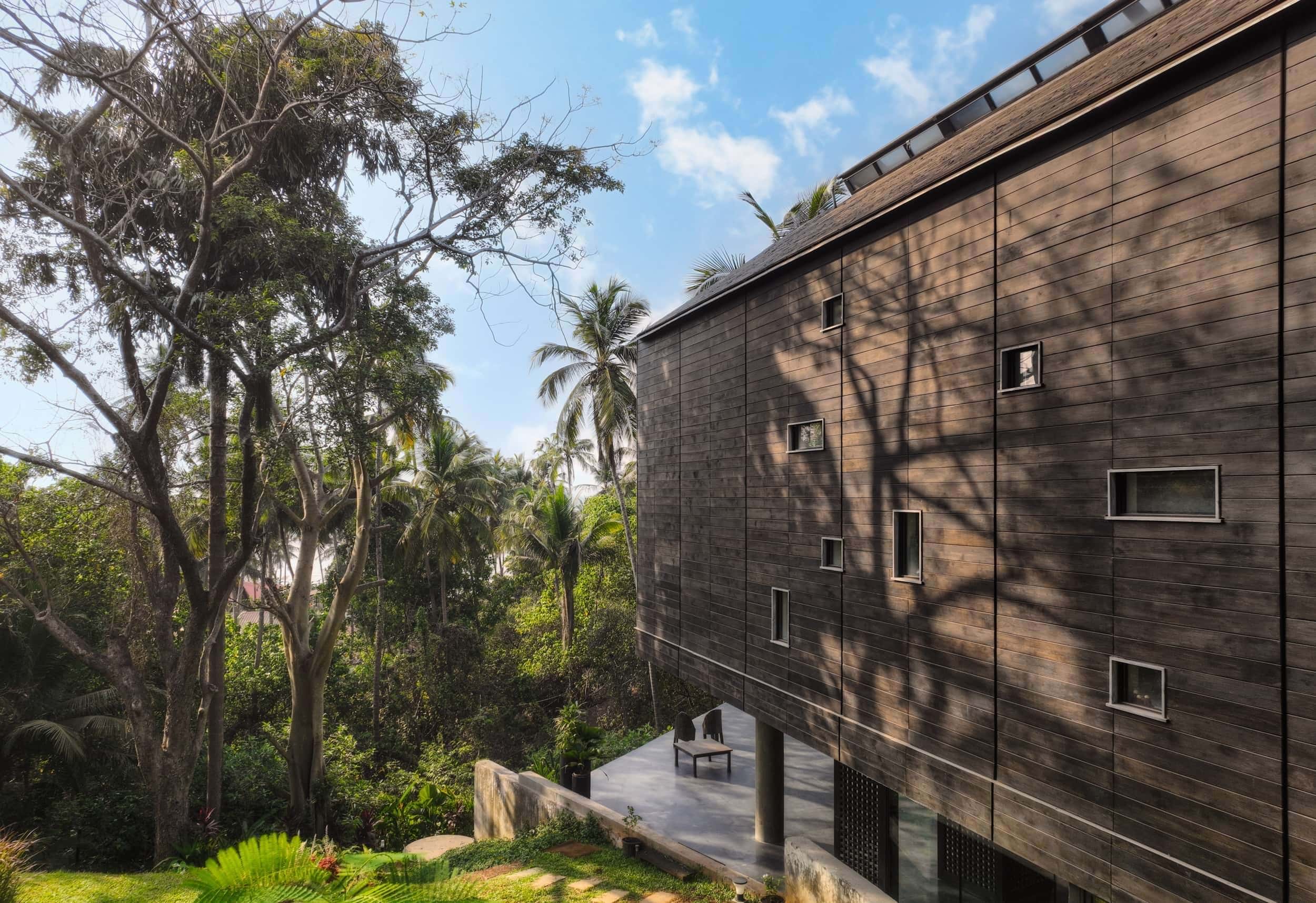
Breaking from the linear form, the kitchen and dining area project outwards as a deconstructed metal-clad volume. This space overlooks the pool on one side and a kitchen garden on the other, creating the feeling of being suspended in nature.
The refined interiors contrast the stark, charred timber exterior. Using the traditional Japanese technique of yakisugi, the timber is treated to enhance its durability and resistance to heat and moisture—an ideal response to Goa’s tropical climate. The resulting charcoal-grey façade both stands out and harmonises with the surrounding landscape. The kitchen and dining volume, clad in zinc, provides a striking visual counterpoint.
Nestled between Goa’s lush greenery and the sea, the home provides a peaceful retreat for its clients. It sets a new benchmark for sustainable residential design in India, combining unconventional materials and advanced technology to create a sustainable, forward-thinking dwelling.
Quick Facts:
|