
Post Date: April 8, 2026 |
Last Edited: July 29, 2026

The World Resources Institute estimates that buildings and their construction currently contribute around 17% of India’s greenhouse gas (GHG) emissions (World Resources Institute (02/01/2024) ‘India’s Shift to Low-Carbon Construction Must Not Leave Workers Behind’: https://www.wri.org/insights/india-just-transition-low-carbon-construction#:~:text=India%20aims%20to%20reduce%20the,the%20heart%20of%20climate%20action2World Bank Group (30/01/2024) ‘Gearing up for India’s Rapid Urban Transformation’: https://www.worldbank.org/en/news/opinion/2024/01/30/gearing-up-for-india-s-rapid-urban-transformation).
This is only set to rise as towns and cities across the country manage unprecedented demand for housing and infrastructure in the face of rapid urbanisation, with urban populations growing to an estimated 600 million by 2036—40% of the total population2. Beyond the environmental considerations, it is also vital that these new spaces deliver the safety, stability, comfort and longevity necessary for people to thrive truly. Incorporating occupier wellbeing into the design process can then, in turn, contribute towards IGBC, LEED and BREEAM credits for the project. Fire safety in buildings plays a critical, yet often under-recognised, role in meeting these aims.

Why Is Fire Safety Critical To Sustainable Development?
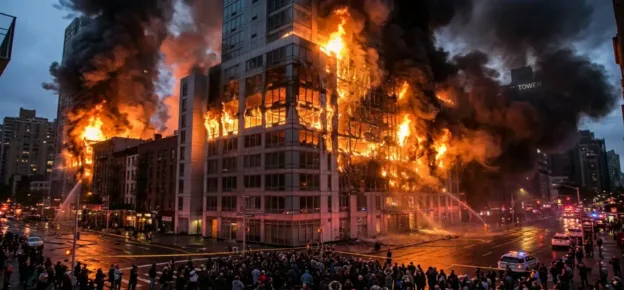
Fires represent one of the most severe stress tests a building can face, with consequences that extend far beyond immediate physical damage. Managing fire risk effectively, especially within the building envelope and structure, is therefore central to protecting the environmental, social and economic value embedded in our buildings.
- It Reduces The Risk Of Immediate Environmental Impacts: Fires release soot, aerosols and other pollutants into the air, while debris and gaseous deposits contaminate soil. Rainfall and runoff from firefighting efforts can carry these pollutants into surface and groundwater systems. Firefighting activities themselves carry impacts, from high water consumption to the fuel and emissions associated with emergency response, particularly those containing PFAS (per- and polyfluoroalkyl substances).
- It Prevents Lifecycle Disruption And Embodied Carbon Loss: A major fire can fundamentally alter a building’s lifecycle. Partial or total demolition, repair or refurbishment leads to the loss of significant embodied carbon. The environmental impact extends beyond damaged materials to include replacement manufacturing, transportation, construction activity and the machinery required to complete the work.
- It Limits The Social And Community Consequences Of Fire: Beyond building damage, fires carry severe social consequences. The human costs of injury, loss of life and enduring psychological effects are difficult to quantify, yet profoundly significant. For the individuals involved, medical treatment, lost income, temporary displacement and emotional recovery can also contribute to long-term economic strain.
- It Preserves Asset Value And Insurability: Economically, building fires can destroy asset value, disrupt business continuity and trigger costly reconstruction. Protecting the façade and structural envelope significantly limits damage, lowering insured losses and helping to quickly stabilise supply chains, tenant operations and investor confidence.
- Fire Safety Should Support Long-Term Functionality: In addition to preventing irreversible loss when things go wrong, buildings must also perform efficiently and safely during their typical operation to be considered truly environmentally and socially sustainable. User comfort and functionality are not only clear indicators of a successful design, but are key metrics often used in voluntary building standards such as IGBC, LEED and BREEAM.
Fire protection measures should also support these design aims, not trade against them. Within the building envelope, passive fire protection measures such as firestops and cavity barriers should not compromise key performance factors such as thermal efficiency or cause acoustic ‘weak spots’. These can result in occupiers having to compensate either through mechanical systems to manage temperature fluctuations—increasing energy use and associated carbon further—or experiencing increased stress and productivity dips due to unmanaged noise disrupting their activities.
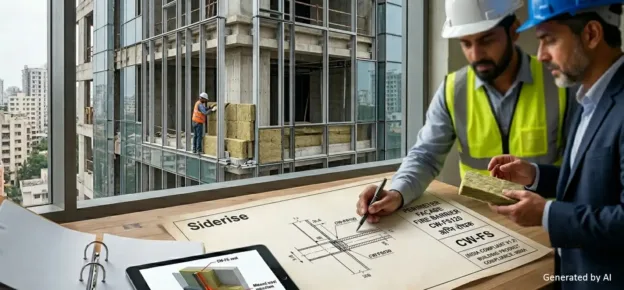
The spandrel zone is a clear example of a façade element required to perform multiple roles at once. It plays a critical part in fire containment at the slab edge, provides thermal insulation across the façade and delivers acoustic separation between floors. When spandrels are poorly designed, these functions can be undermined simultaneously, leading to thermal bridging, inter-floor noise transfer, façade hot spots and weakened fire stopping. In contrast, a tested, well-engineered spandrel solution using appropriate non-combustible insulation such as stone wool can deliver consistent performance across fire, thermal and acoustic requirements, ensuring safety, comfort and long-term façade reliability without compromise.
Evaluating Fire Safety Products And Their ESG Credentials
Of course, the fire safety products used to ensure this resilience must not detract from these priorities themselves. Environmental, social and governance (ESG) credentials are increasingly influencing construction product specifications, procurement and insurance decisions in India, particularly for complex or high-risk buildings.
For fire safety products, protecting life and property will always be the primary objective. However, considering their ESG credentials will not detract from this purpose. The fire safety sector’s focus on rigorous testing, detailed data collection, third-party verification and compliance with recognised standards aligns naturally with ESG reporting and performance improvement. Therefore, manufacturers of these products should undertake initiatives such as Life Cycle Assessments (LCAs) to enable transparent and comparable reporting of environmental impacts across product lifecycles through tools such as Environmental Product Declarations (EPDs).
Yet ESG goes beyond environmental data. Responsible sourcing standards such as BES 6001 (Framework standard for responsible sourcing) assess supply chain governance, ethical labour practices and site stewardship. Strong governance systems—including clear policies, compliance processes and independent assurance—help ensure that safety and sustainability commitments are consistently delivered, not just stated.
It is also important to consider the quality of support that surrounds these products. Products that are accompanied by clear specification guidance and robust installer training are far more likely to be installed the first time correctly, reducing material waste, rework and on-site errors that add unnecessary cost and carbon. At the same time, investing in training raises skill levels across the workforce, improving installation quality, safety and long-term career prospects for installers and contractors. This skills development delivers wider economic and social benefits, strengthening supply chains and creating more resilient project outcomes.
Safety Is Sustainable
Nearly 70% of the urban infrastructure needed by 2047—the centenary of Indian Independence—is yet to be built(IBID). This presents a real opportunity for the country to develop a built environment that leads the way in terms of both environmental stewardship and social value. This includes deploying effective fire risk management across all building types, supported by high-performance fire protection products that are engineered not only for safety and durability, but also with their wider impacts in mind.