
Post Date: May 4, 2026 |
Last Edited: May 4, 2026
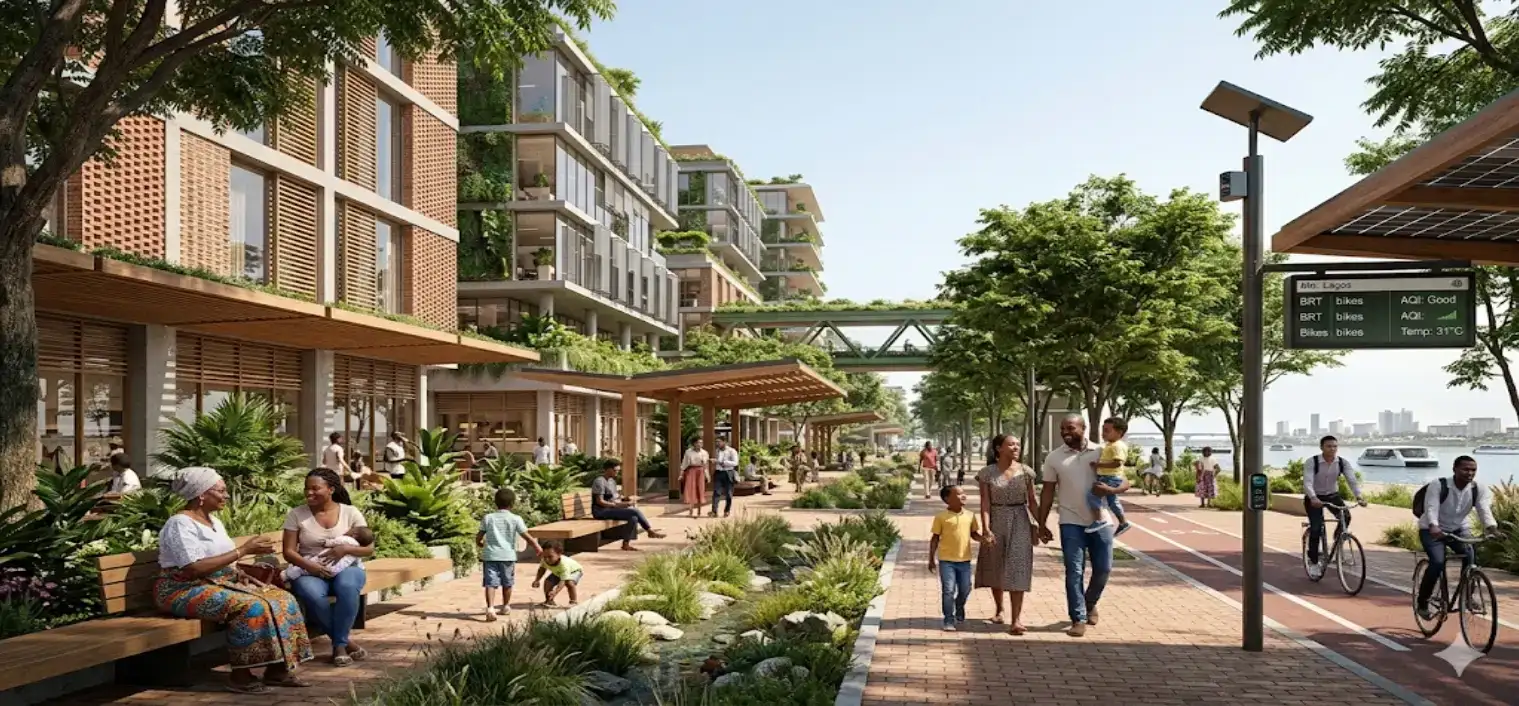
In an era marked by climate stress, rapid urbanisation, technological acceleration, and social fragmentation, the built environment must evolve beyond fragmented responses to interconnected challenges. Symbiature—the study and practice of the Humane, Green, and Smart (HuGS) framework—offers an integrated design paradigm aimed at fostering both human flourishing and planetary well-being. Building on architectural wisdom, ecological responsibility, and intelligently governed innovation, this paper presents Symbiature as a holistic approach to design, development, and systems thinking. It clarifies the theoretical foundations of HuGS, deepens the meaning of Smart as wisdom-guided intelligence, outlines practical applications across sectors, and argues for broader adoption of integrated design thinking in a world that increasingly demands it.
Introduction
The twenty-first century presents a convergence of crises and opportunities. Climate change, rapid urbanisation, resource pressure, social alienation, and accelerating technological disruption are reshaping the conditions under which we design and build. In this context, the built environment can no longer be approached through isolated lenses.
The scale of the challenge is well established. The buildings and construction sector accounted for 32 per cent of global energy demand and 34 per cent of global CO2 emissions in 2023, according to the latest global status reporting.1 The International Energy Agency also notes that buildings account for about 30 per cent of global final energy consumption, rising to 34 per cent when certain construction-related energy use is included.2 At the same time, housing and indoor environmental conditions directly affect health, thermal comfort, safety, accessibility, and quality of life.3
Traditional design paradigms, when treated too narrowly, are no longer sufficient. It is within this context that Symbiature emerges as a transformative design paradigm. Symbiature integrates three core pillars—Humane, Green, and Smart (HuGS)—to create environments that are regenerative, resilient, intelligent, and life-giving. It aligns with the global search for sustainability, resilience, equity, and climate responsibility, yet seeks to go further by insisting on a more symbiotic and integrated design ethic.
Theoretical Foundations Of Symbiature (HuGS)
What Is Symbiature?
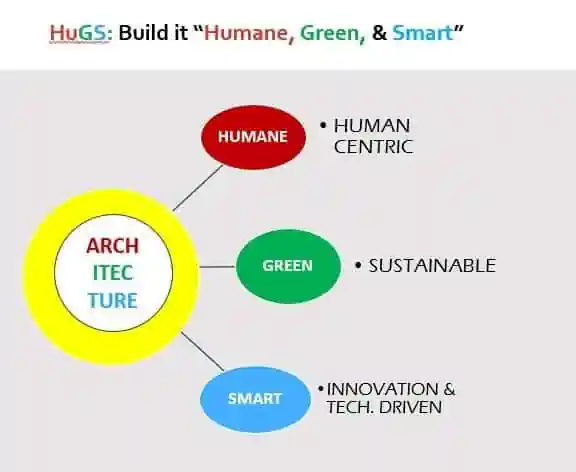
Symbiature is the study and practice of the HuGS framework—a holistic design approach that integrates Humane, Green, and Smart principles. As a study, Symbiature investigates the interdependence of these principles and their potential to reshape the built environment in ways that support human flourishing and planetary well-being. As a practice, it translates this framework into buildings, systems, communities, products, and development strategies that are more humane in experience, more ecologically responsible in impact, and more intelligently guided in operation and governance.
The term itself draws from the logic of symbiosis—mutually beneficial interdependence—while resonating with both nature and architecture. Symbiature, therefore, points towards a built environment in which human systems, natural systems, and technological systems are brought into a more life-giving relationship.
It is not merely a style. It is not a checklist. It is a way of seeing, thinking, designing, building, and governing with greater wholeness.
“Sustainable design practices such as passive design, efficient envelopes, renewable energy integration, and responsible material use are increasingly necessary rather than optional.” |
Humane Design
The Humane principle prioritises human dignity, well-being, comfort, inclusion, and meaningful experience. It asks whether environments support physical health, emotional balance, social interaction, beauty, accessibility, and the deeper quality of everyday life.
Research in biophilic and human-centred design continues to show that access to daylight, nature, well-considered spatial experience, and healthier indoor conditions can reduce stress and improve well-being.4 The World Health Organisation similarly links housing and indoor environmental conditions to significant health outcomes, including the effects of low and high indoor temperatures, injury hazards, crowding, and accessibility barriers.3 Symbiature builds on this understanding by insisting that design must not only solve technical problems but also nurture human flourishing.
Humane design is therefore not merely human-centred in a functional sense. It is human-centred in a fuller sense: it seeks to create spaces in which people can live, work, learn, heal, worship, and belong well.
Green Design
The Green principle addresses ecological stewardship, climate responsiveness, and regenerative responsibility. It asks whether a project works intelligently with energy, climate, water, materials, biodiversity, and lifecycle impact.
This remains imperative. The environmental burden of buildings is not incidental; it is structural. 1 2 Sustainable design practices such as passive design, efficient envelopes, renewable energy integration, and responsible material use are increasingly necessary rather than optional.
Symbiature extends this concern by drawing not only on conventional sustainability practice but also on biomimicry, vernacular adaptation, systems ecology, and regenerative thinking.
Green design, in this sense, is not simply about reducing harm. It increasingly points towards restoring balance, strengthening resilience, and aligning human development more responsibly with natural systems.
“Poorly conceived buildings intensify heat stress, energy waste, social alienation, and ecological harm. Better-designed environments can improve comfort, reduce energy demand, strengthen resilience, and support human well-being” |
Smart Design
The Smart principle is central to Symbiature, but it requires a more mature interpretation than is often assumed. Smart certainly includes technology, innovation, digital tools, intelligent systems, data analytics, AI, IoT, automation, and performance optimisation. Such tools can improve efficiency, responsiveness, and coordination in buildings and cities.5 However, Symbiature insists that Smart must be understood more deeply through the lens of sophos and sapientia—wisdom, prudence, and discerning intelligence. In other words, Smart is not technology for its own sake; it is wisdom-governed intelligence.
This is a crucial distinction. Technology can optimise systems, but it cannot by itself determine what is good. Data can inform decision-making, but it cannot replace judgment. Automation can improve efficiency, but it cannot independently guarantee human dignity or ecological responsibility.
In Symbiature, Smart is therefore both a pillar and an enabler. As a pillar, it acknowledges the central role of innovation and intelligent systems in contemporary design. As an enabler, it acts as a catalytic meta-system—helping to integrate, coordinate, accelerate, and restrain the Humane and Green dimensions so that the whole remains balanced and beneficial.
Smart, rightly understood, is not merely digital capacity. It is intelligence under wisdom.
Synthesis: Symbiature As Evolutionary Integration
Symbiature synthesises Humane, Green, and Smart principles into a coherent operational whole that moves beyond fragmented design paradigms. It builds on the wisdom of historical and contemporary design traditions—organic architecture, biophilia, vernacular adaptation, ecological design, systems thinking, and digital innovation—without reducing itself to any one of them. Its distinctiveness lies in integration.
- A humane building that ignores ecology is incomplete.
- A green building that ignores people is deficient.
- A smart building that lacks wisdom can become merely efficient dysfunction.
Symbiature asks how the built environment can embody a mutually beneficial relationship among people, communities, technology, and the Earth. It sees buildings not as isolated objects but as nodes within wider networks of energy, climate, culture, mobility, economy, ecology, and human experience.
These systems view matters. A façade is not merely a surface; it is part of environmental intelligence. A street is not merely a circulation space; it is part of civic life. A home is not merely a shelter; it is part of human formation. A campus is not merely infrastructure; it is part of memory, culture, and future-making.
Applications Across Industries
While originating in architecture and the built environment, the HuGS framework has relevance across multiple sectors because it addresses systems, relationships, and decision-making more broadly.
Urban Planning: HuGS can support resilient, adaptive cities that integrate green infrastructure, public health, energy systems, and humane public space. UN-Habitat’s World Cities Report 2024 reinforces the urgency of climate-responsive and systems-oriented urban action.6
Real Estate and Construction: Developers can pursue better-performing and more responsible projects through passive design, efficient envelopes, low-carbon materials, renewable energy systems, and intelligent building management.1 2
Healthcare and Education: Humane, biophilic, and well-coordinated environments can improve recovery, concentration, comfort, and the quality of care and learning.4
Manufacturing and Technology: Circular economy principles, ethical innovation, and intelligently governed production systems can align with HuGS by reducing waste and supporting more sustainable forms of development.7
Institutional and Community Development: HuGS provides a useful framework for shaping campuses, civic facilities, religious spaces, and community infrastructure that are socially meaningful, environmentally responsible, and intelligently governed.
The Urgency For Global Adoption
Unchecked urbanisation, climate degradation, resource pressure, and technological acceleration demand a shift towards more integrated design thinking. The case for adoption is not merely philosophical; it is practical.
Poorly conceived buildings intensify heat stress, energy waste, social alienation, and ecological harm. Better-designed environments can improve comfort, reduce energy demand, strengthen resilience, and support human well-being. 1 2 3 International frameworks such as the 2030 Agenda for Sustainable Development reinforce the need for development approaches that are environmentally responsible, socially inclusive, and systemically coordinated.8
This is especially significant for Africa. The continent’s urban future will be shaped by choices made now about housing, infrastructure, public space, energy systems, and institutional development.6 Africa does not need borrowed solutions alone. It needs frameworks that are climate-aware, culturally grounded, economically realistic, and intelligently future-facing. Symbiature is relevant because it offers not a single technical solution but a design paradigm capable of holding multiple priorities together.
A Call To Action
The transformation envisioned by Symbiature requires collective commitment. Governments and Policymakers: Integrate HuGS principles into building regulations, urban policy, climate strategy, and development standards.
Industry Leaders and Investors: Support research, pilot projects, and scalable innovations that embody humane, green, and smart integration.
Architects, Engineers, and Designers: Move beyond fragmented responses and adopt HuGS as a guiding framework for more integrated practice.
Communities and Institutions: Advocate for developments that support dignity, stewardship, resilience, and long-term flourishing.
The built environment will continue to shape the future. The question is whether it will do so in ways that are extractive and fragmented or in ways that are regenerative and symbiotic.
Conclusion
Symbiature is not merely a design philosophy. It is an evolving paradigm that seeks to redefine the relationship between humans, nature, and technology. By integrating the Humane, Green, and Smart dimensions of design into one coherent whole, Symbiature offers a path towards environments that are not only efficient or innovative but deeply life-giving. It invites us to design with greater dignity, build with greater responsibility, and innovate with greater wisdom.
If our cities, buildings, campuses, workplaces, homes, and communities are to become places where human flourishing and planetary well-being are not exceptional but normative, then our design thinking must become more integrated, more ethical, and more symbiotic.
References
|