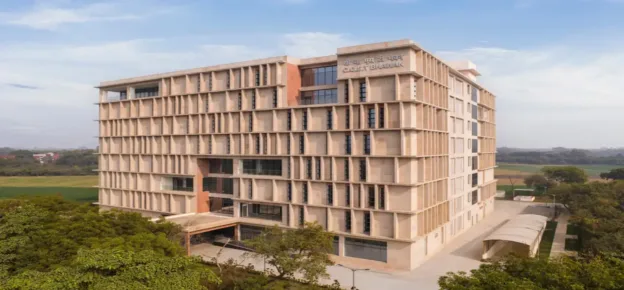

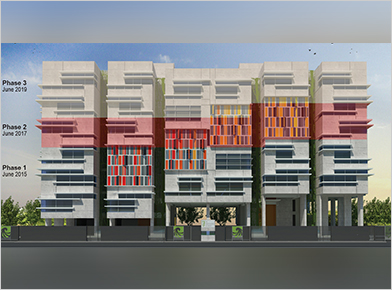
The client brief was to design a K-12 school in one of the Mumbai suburbs. The key challenge was to construct the building in three phases and to ensure a non-rigid environment.
The fact that the Green Acres Academy was going to be built in a phased manner over 5 to 8 years presented an opportunity to design a building that grows.
The very high land rates in Mumbai, coupled with regressive building regulations, made it very challenging to introduce un-programmed spaces beyond the design program. It also implied a vertical school building. The challenge was to create a horizontal feel within the vertical environment.
Green Acres Design Concept
A child enters a school as a toddler and leaves as a teenager. It was important that the design remains valid for generations of children. It was also important that a school went beyond the 3 dimensions of space and catered to the 4th dimension of time.
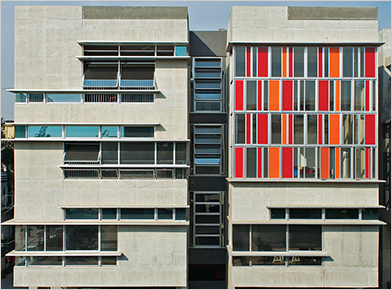
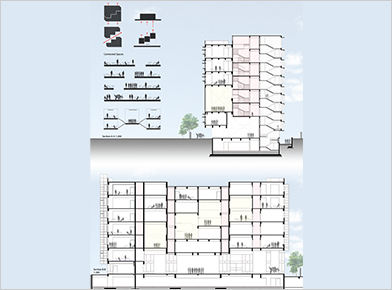
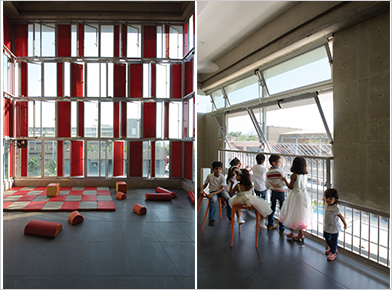
The central block was conceived as a column-free space that housed the common facilities like laboratories, library, etc., allowing flexibility to adapt to changing functional requirements. For the left and right wings, the column structure followed the classroom grid. Together, it ensured the minimal cost of structural design. Further, a split level was created by staggering the central bay level by 4’-0. This ensured that two floors of classrooms could access common activities. The connecting staircase was planned not just as a means to access the levels but also allow children and teachers to pause, sit and synergise in an informal manner. The playful design and the colour treatment emphasised the informality of the space.
The fact that a staircase is free of FSI in Mumbai helped generate the additional space required for 5 divisions per standard to make the financial model viable. Strategically widened corridors, created pauses that further encouraged unplanned interaction.For an education building, the minimum clear floor height as per the regulations was 3.6 meters. This allowed for providing 3 toilets between two floors and allowing some freer floor space.
Green Acres Facade Concept
Following the Principles of Passive Climate Control
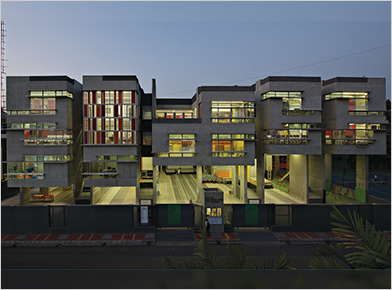
 We innovated to balance environmental requirements with building bye-laws, and created a striking design feature, lengthened windows at different heights.
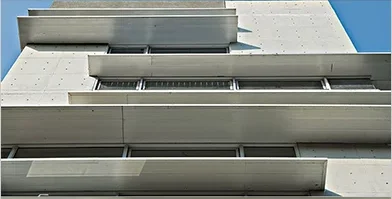
The façade design concept was based on the principles of passive climate control to optimise the use of natural light and ventilation by scientifically capturing and guiding wind through corridors and natural sunlight through the light shelves. The light shelf directly improves illumination levels inside the room by 10-15 per cent as compared to a window without a light shelf.
The light shelves were an innovation that took advantage of the
building bye laws that permitted only up to 750 mm deep horizontal projections free of FSI to reflect glare-free sunlight deep into the classroom and provide a cost-effective visual feature on the façade. The 3 bands of windows allow for bringing in the light and wind and offering views as desired. The light shelves enable natural light to penetrate deep inside the rooms.
The ribbon windows made casting of RCC chajjas a cumbersome process. So four 6” long hollow box Al. sections were connected with tongue and groove joints to create the horizontal light shelves. A safety railing was worked out as an integral part of the window system.
The double-height windows were designed to enhance the per
section of the volume. The opaque-coloured glass was introduced in the double-height volumes to reduce the area of clear glass and cut the amount of light penetrating into the interiors.
Exposed concrete, with its allusions to timelessness, ruggedness, neutrality and honesty of expression, became the clear choice as backdrop. Silver anodised aluminium windows and light shelves complemented the exposed concrete.
The entire colour wheel palette was selectively introduced in the interiors as well as on the façade as an inexpensive method of infusing life and vibrancy.
The double-height windows were designed to open alternately to create varying rhythms when open. 30 per cent of opaque coloured glass usage ensured optimal light penetration as well as created an interesting pattern. Four different types of glass colours were used in the façade: Classroom/academic area window – Asahi reflective glass – Enhanced lime (top pane); Enhanced aura (bottom pane); Enhanced down (Middle Pane).
The three different shades of the glass were selected for each window at different level based on the reflection and UV value. The top-level window was meant to enable maximum penetration of light and hence the glass was selected accordingly.For the corridor, staircase and other allied areas enhanced down shade was used.
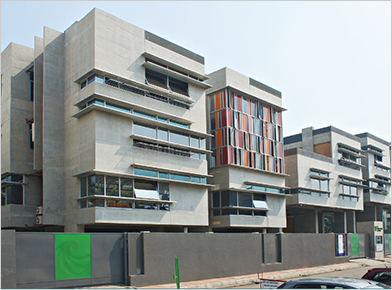
We faced a lot of challenges in while finalizing the façade material palette. Exposed concrete was the first thing that came in our mind, but Mumbai rains and the quality of sand had to be sorted out before we could pin down on exposed concrete. The chemicals in concrete react with the rain water creating a thin moss-like film. This happens only during the first rain. We located a transparent coating that could be applied to the exposed exterior concrete and prevent the chemical reaction. Sand issue was sorted out by getting specialized rendering agencies form Gujarat to clean and finish the surface post-construction.
For the Aluminium Chajjas, a number of options were co
nsidered, including ACP, high pressure laminates, and solid Al. Sheet, etc. But eventually we settled for inexpensive and sleek aluminium chajjas. Four 6-inch-long hollow box Al. sections were connected with tongue and groove joints to create the horizontal light shelves.
Pivoted windows/using levers to operate the upper windows was a big challenge. Levers were introduced later due to the requirement raised by the operations team. Making corrections in our assumptions and incorporating the changes demanded by the users was one of the biggest challenges.
Hi-wall split indoor units on inverter-based technology were the most economical option for air-conditioning, and the channels to run the piping were seamlessly integrated in the structural design. Similarly, light grooves were introduced in the beams to house the lights so that the light fixtures became an integral part of the structure.
QUICK FACTS
- Project: The Green Acres Academy
- Location: Chembur, Mumbai
- Architect: Tushar Desai Associates, Mumbai
- Developers: Apurva Natvar Parikh Group
- Consultants: Services- Sheth Techno Consultants Pvt. Ltd; Structure- Multi Media Consultants Environmental- VK:e Environment
- Windows: Giriraj Fenestration Engineering Pvt. Ltd; Doors: Vinod Vishwakarma
- Materials for Façade: Exposed RCC, Silver Anodised Aluminium Windows, Chajjas – Silver Anodised Aluminium Windows, Glass – Asahi reflective glass, Paint for exposed RCC – Krisna concare – Acrylic TRS, Other Wall surfaces – Asian Paints
- Cost of project: 30 crores
- Commencement date: 2012 (Design Phase)
- Year of completion: Phase 1- June 2015, Phase 2- June 2017, Phase 3- June 2019
- Photography credits: Photographix India