
One-Part Dry-Fit Stone Wool Lamella Firestops For Practical And Robust Perimeter Void Fire Protection In Curtain Walls
Robust compartmentation, supported by a fit-for-purpose perimeter fire seal solution, is fundamental to effective passive fire protection in glazed façade systems – and is legally mandated in many jurisdictions worldwide.
To prevent vertical fire spread, firestops installed at the slab edge extend the fire resistance of the compartment floor to the rear of the façade. These solutions typically fall into two main types: one-part dry-fit systems and two-part safing-and-sealant systems.
- Two-Part Wet-Seal Systems: Traditional approaches to firestopping at the façade/floor slab require the installation to be carried out in two separate stages. The first step involves manually rotating and compressing generic mineral wool safing insulation material (in lieu of material tested to ASTM E2307 and EN 1364-4 solutions typically using a 25, 33 and 50% compression factor) before installing it within the movement gap at the perimeter construction joint. The second step involves applying a wet compound such as mastic, spray ablative, or fire-rated silicone over the top of the insulation to create a weather and smoke-leakage-resistant seal once cured.
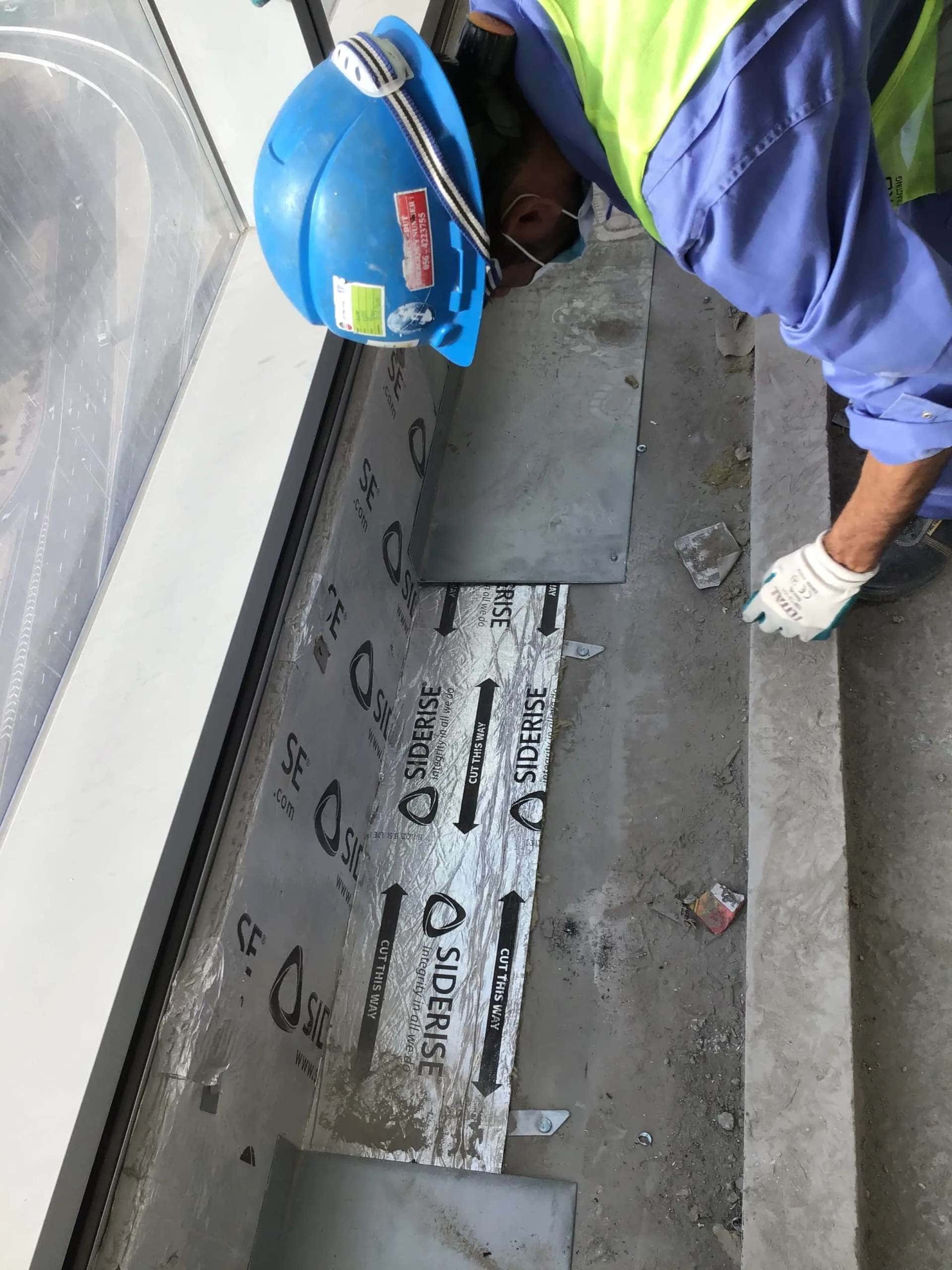
- One-Part Dry-Fit Systems: These systems feature factory-engineered pre-compressed stone wool lamella insulation with foil facings applied to the cut surfaces of the fibres to firmly retain the ‘built-in pre-compression’ in place. Designed and tested to provide a robust fire and smoke seal in the perimeter void between the façade and compartment floor, without the need for an additional sealant, they are installed in a single-fit with further manual compression of either 10 or 20% for a tight fit.
Moreover, unlike the wet seal of two-part systems, one-part dry-fit firestops can be ordered pre-cut to suit the cavity width and can be supplied as part of a complete system package from a single manufacturer with spandrel insulation, mullion and transom fire protection, plus ancillary components. In addition, these parts are often tested together in multiple test scenarios and third-party certified as an advanced perimeter fire containment system for a more holistic approach to passive fire protection in the spandrel zone.
Each of these approaches results in different characteristics when it comes to fire performance, resilience and durability, application conditions and consistency, installation accuracy and efficiency, repeatability and inspection.
-
Firestop Resilience, Durability And Fire Performance
Non-combustible mineral wool safing used for firestopping must be durable enough to accommodate the stresses imposed by façade and floor slab movement from the transfer of live and environmental loads. Otherwise, there is a risk that it will fail in the event of fire.
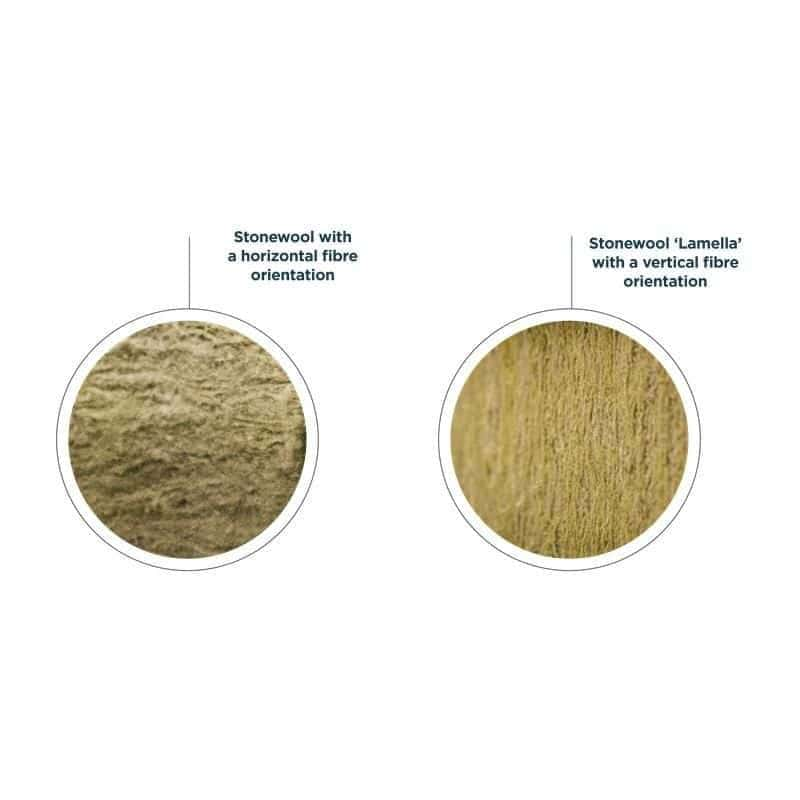
The safing insulation component of two-part firestop systems typically comprises standard mineral wool insulation with horizontally oriented fibres, which run parallel to the floor slab when installed. A common installation error is the fibres not being rotated (perpendicular to the floor) before being installed. Whilst this 90° or transverse alignment offers stability, continual exposure to building/façade movement makes the material more susceptible to degradation along its length, resulting in the fibre structure breaking down.
This means that the ability of the safing material to recover from repeated compression cycles in-service is reduced. This can lead to the firestop no longer maintaining the compression fit, increasing the risk of a gap forming between the product and the façade over time. Should this occur, the perimeter seal could fail prematurely, resulting in loss of compartmentation.
Furthermore, to ensure that two-part wet-seal systems comply with the criteria of any third-party approvals or listings published by the sealant manufacturer, the safety insulation product should always be the same as that used which was in the certified, tested system. To use substitution products risks undermining the specified fire resistance performance.
Meanwhile, one-part firestops with a stone wool Lamella composition comprise vertically oriented fibres that run perpendicular to the substrate when installed. Products with a vertical fibre orientation are highly compressible and flexible laterally (across their width), which enables them to overcome challenges presented by curved and inclined façades, and to accommodate the dynamic movement of the curtain wall or floor in service.
Due to the unique structure of lamella firestops, they are able to maintain their ability to recover throughout their design life without disintegrating, provided they are installed in line with manufacturer recommendations. This is demonstrated through extensive age and movement cycling testing. Considering there is no substitution of the tested material at the site, as is prevalent with the two-part wet seal applications, this means that the seal is continuously maintained throughout the lifetime of the building and for the required fire resistance period in the event of a fire.
When exposed to fire, the foil facing is designed to delaminate from the stone wool Lamella core, allowing the built-in pre-compression to be released. This enables the product to expand and maintain its compression fit and integrity, even under the greater thermal stresses caused by the fire load that leads to façade and floor slab deflection.
Both system types can be tested to UL 2079 for air leakage at ambient and elevated temperatures post movement cycling, determined as the L-rating, to simulate smoke movement through compartmentation in buildings. Leakage testing can assist authorities in determining the suitability of firestopping systems for the protection of floor openings and smoke barriers for the purpose of restricting the movement of smoke in accordance with the NFPA (National Fire Protection Association) 101 Life Safety Code. The difference between two-part wet seal systems and one-part dry-fit systems is that the latter does not rely on a wet seal to provide an adequate L rating.
-
Application Conditions, Consistency And Installation Efficiency:
The wet seal compound in two-part systems is moisture-sensitive and temperature-dependent during application and curing. It must be applied in dry conditions and controlled environments – which can be a challenge during hot summer months and monsoon season – otherwise adhesion, curing, design life and product integrity may be adversely affected. In most cases, the maximum application temperature is typically limited to 40°C as high heat can cause rapid skinning or premature curing, making tooling difficult and reducing adhesion. Similarly, exposure to rain, running or standing water, or high humidity can lead to washout or uneven curing.
Storage conditions for wet seal firestop compounds are just as important as application conditions because they directly affect product performance and shelf life. Most manufacturers require sealants to be stored between 5 and 25°C, which in turn requires on-site air-conditioned storage facilities in regions prone to inclement weather. Improper storage can reduce workability if the sealant has thickened, shorten open time and curing consistency, and compromise the fire rating performance due to chemical degradation.
Since wet sealants rely on direct contact with the substrate, surfaces must be clean, dry, and free of dust, grease, oil, or other contaminants. Dust or debris creates a barrier that can weaken bonding and lead to gaps or peeling over time, whilst contaminated surfaces can cause voids or uneven curing.
Furthermore, the wet-film thickness must be applied consistently to achieve the required dry-film thickness, as thickness variation due to human error can risk compromising the slab edge fire seal. Wet spray firestop systems require specialist equipment for appropriate application, such as pumps, mixers and nozzles. Transporting and setting up heavy spray rigs on high-rise sites can be time-consuming, while tight slab-edge zones often lack room for bulky equipment, especially when façade works are concurrent.
This installer-driven and weather-dependent approach can make it challenging to achieve a replicable level of quality across whole buildings of multiple storeys, creating bottlenecks.
In contrast, one-part dry-fit firestops are not weather or temperature-sensitive and do not require any specialist application equipment. There are no curing times, wet or dry-film thickness complications, or complex compression calculations.
Their straightforward installation approach, including a standardised compression percentage, can streamline the installation process and help reduce the risk of human error. They also provide greater freedom to the installer in areas where access to the firestop zone is difficult after the façade is installed. Dry-fit firestops can also be installed before the façade, including from the soffit.
Ease Of Inspection
With two-part systems, once the compound is applied, verifying the correct dry-film thickness, adhesion, and safing orientation and compression becomes difficult without destructive testing or a two-stage inspection. Alternatively, when dry-fit, one-part firestops are installed, visual inspections are sufficient. The wrinkling of the foil makes it very easy to confirm if they have been installed correctly without disturbing the installation. Their dry-fit application also makes it easier to judge bracket locations and distances, and tight jointing to ensure a continuation of the fire performance around the perimeter.
This can not only help to ensure a safer building but also reduce additional costs and lost time associated with remedial works.
The One Choice For Safer Curtain Walls
While traditional two-part systems have long been used, they present challenges in terms of durability, installation complexity, and inspection reliability. One-part firestops that have been engineered and tested to key standards, such as EN 1364-4, ASTM E2874 and IS 18190, offer a reliable alternative. By delivering uniform compression, accommodating façade and building movement, and enabling straightforward visual inspection, one-part systems support more efficient construction practices and help achieve consistent fire resistance performance on every floor and on every project.