

uPVC windows are no longer the novelty these days as more and more companies are coming and generating awareness about its benefits for the consumer. At WFM, we have discussed at length the product and how it co-exists and often even outperforms the conventional aluminium and wood windows. As the market is evolving and the consumer is getting more inquisitive, there has been an onslaught of national and international brands entering and serving this ever-growing market. While there are various brands present, there’s one brand that we all recognise with much ado.
Kommerling India is a success story internationally that has been running for more than 100 years. Kommerling is a brand with tradition under the huge umbrella of Profine Group. The company was established as a trading organisation in 1897 by Karl Kommerling. The company started the production of PVC roller shutters in 1957, and the extrusion of window profiles and PVC sheets was started in 1967.
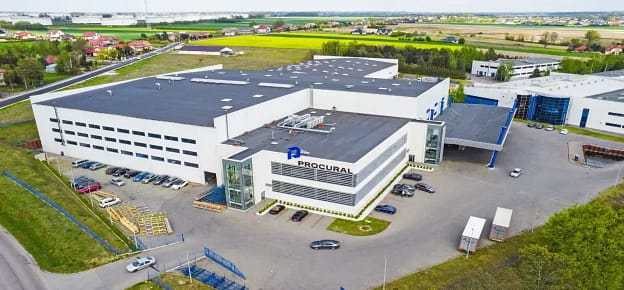
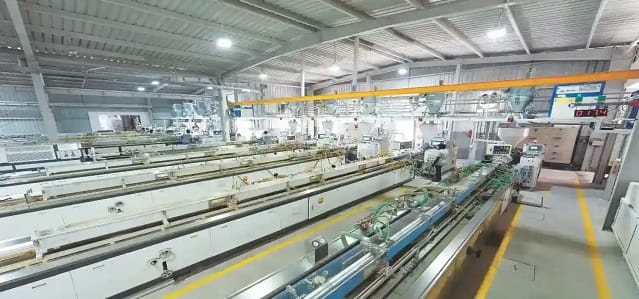
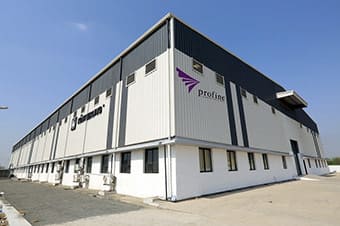
Although the brand has been present in India since 2000, seeing the immense market potential that India has to offer, Profine India Window Technology started the state-of-the-art extrusion facility in India in 2013 in Vadodara, Gujarat. The company also manufactures UPVC windows in Vadodara and supplies them to various countries.
During our recent interaction with the Profine group owner & CEO Dr. Peter Mrosik and Mr Robert Thiroff, who’s the combined Managing director for Profine in various countries of the world including India, North America, Australia, China and the UK, WFM sought insight into the history of the company, the thought process behind the brand establishment in India and their approach to satisfying the tough Indian consumer.
Excerpts: Could you please tell us something about yourself?
Dr Mrosik: I am an entrepreneur. I have worked in different kinds of industries. Got various chances to invest in many companies, and I made some money out of that. I invested a big portion of this money in Profine as I believed in this industry. I also have a private life, am a father of four children and am pleased to have a private life as well as having a business of which I am a proud owner.
What is HT Troplast, and how different is it from Profine?
Dr Mrosik: Essentially, there is no difference. The head company is HT Troplast, and the operative group is Profine. So it is essentially the same.
What are the other group companies?
Dr Mrosik: There are about 75 Profine groups or companies all over the world. One of them is Profine India Window Technology Pvt. Ltd here in India, and a lot of other companies in about 48 different countries.
What was it about the Kuraray Arcapita group buying Profine? Was it a result of insolvency?
Dr Mrosik: No. Profine was a healthy group at the time I took it over. However, operatively, it could have been developed in a better way. That’s the reason I personally bought it. And from that point on, I got a chance to develop it into what you see today.
Profine is still owned by a VC Firm, or is it an individual entity?
Dr Mrosik: During the last decade, Profine was owned by financial investors. This was changed 2 years ago. In person, Peter Mrosik, bought the company, and I own 100% shares of the profile group. That means I am personally following a long-term strategy. The key difference between a financial investor and me is that a financial investor buys a company in order to sell the company. And I bought the company in order to develop it on a long-term basis. My aim is a strategic one and a long-term one.
And this is the reason you’re also the CEO of the company and are involved in day-to-day activities?
Dr Mrosik: This is the reason I want to be in the line, and my ambition is to develop the business in the right way. I have invested several million in different types of categories. I want to be the product innovation leader that we are today, but I want to follow a clear strategy inlaying the brand and product innovation, and for that, we have a plan for 10 years. We want to regionalise the business and also internationalise the business. In this line, we invested heavily in India, which is a very important market for us. India is a developing and prospering country, and we have a very good manager here, Mr Farid Khan, who is taking care of our Indian activities. I am quite happy to see the development here in this market.
Please elaborate on the premium brands and how you position them in India.
Dr Mrosik: We are heavily investing in brand building, and that’s a uniform trend you’d see in the case of Profine worldwide. As you might know, Profine is the roof brand, but the main brands are KBE, Trocal and Kommerling. They have a worldwide presence, and Kommerling, I would say, is the most recognised brand internationally. I am more than happy to announce that in the last year, Kommerling has now committed to India with its own extrusion plant.
What prompted you to start a Profine extrusion in India, when China already had an extrusion?
Dr Mrosik: It is quite easy. Making a commitment to the market means you have to invest money in it. Customers are recognising it. Looking at a market from a distance, shipping products from another country doesn’t work. It’s not a commitment. Commitment means we want to employ people, we want to invest money, and we want to start local production. From all that I see now, it has been the right decision. The business is picking up, and we are further investing in the Indian market. We have 4 extrusion lines as of now, and it’s going to rapidly increase. We are currently looking at acquiring more land and expanding thereon.
I happened to meet a Chinese friend from the window industry. He mentioned, “Most of the German profiles getting extruded in China are not of the same quality, and there is a tangible difference in what’s being manufactured there and in Germany”
Why is it so? Are the same manufacturing standards not followed in a subsidiary?
Dr Mrosik: We are currently about to harmonise the quality. Setting quality standards is one of the main agendas. Don’t forget that there might be a different set of requirements in certain markets might be different. I understand that the Indian market is a very high-quality and brand-oriented market, and this is the reason why we are investing in India in our own production plant. And you will notice that the quality of the products manufactured here is best in class. You’ll notice the gloss and other things are unmatched.
What is the edge that Kommerling as a brand has over others globally and in India? We know you market your product exceptionally; your booth here in this exhibition (Fensterbaufrontale, Nürnberg, Germany) is a statement in itself. So, what drives this out-of-the-box brand placement?
Dr Mrosik: First of all, Kommerling is a traditional brand. But it moves on with time. Kommerling is a future-oriented brand. Enlightenment with the people, customer clubs, and working with architects at their invitation, all this and a mix of different measures which we took in order to make Kommerling the world’s most recognisable brand, places us ahead of every other competitor of ours.
It is said that the majority of European companies tweak their systems to match the local Indian standards. How is it the case with you? Or do you plan to maintain the same quality?
Dr Mrosik: There is one thing, the necessity of adoption. Every market builds differently. We will certainly take care of this. There is, however, no compromise in quality. Kommerling is known to be the highest and best in-class system, and we are recognised for our brand value. In no situation are we going to dilute that. We are treading, keeping the brand in our hearts. We know what the culture of Kommerling is, and that has to be kept alive in every respective country.
What is the secret behind this undeterred and conquer-all demeanour?
Dr Mrosik: First of all, I told you about the strategy of the company, but you know it’s all about the team. The team includes customers, too. If you don’t have customers who are loyal to you, who trust you, then you would be nobody, nothing. And so is it with the team. We at Kommerling have the best team, and nobody can reach us. This is the team spirit that has driven us in the past two years, and I am proud to be a part of this team.
Taking the discussion further, we interacted with Mr Robert Thiroff, who is the Managing Director for Profine India, along with leading the group in various other emerging markets, viz. North America, the Philippines, Vietnam, China, etc., as well.
Mr Thiroff, please explain how you perceive the Indian market for uPVC and your role in developing this challenging market.
Mr Thiroff: It’s a delight that we started a production facility in India last year. India is a dynamic country that understands performance and energy efficiency. I have been in the industry for the past 6 years, and it’s a delight to interact with people who understand quality and opportunity in uPVC windows. I would say this is just the start, and we are continuing to evaluate the market. I am very passionate about this company, and this is something that is developing in a very professional and dynamic way. It was hard the way it has evolved from being a one-man show to an organisation with a team.
People here are looking for high performance and energy efficiency, and we are glad we identified the opportunity that India has offered us. It’s a very dynamic and fast-moving country. We have signed many new customers – some large and some small. We believe we need to invest in the knowledge, convincing the architects and real estate companies that PVC is an alternative to aluminium and timber. So it’s an investment and a long-term one at that. When we came to India, although I was expecting fast-paced and energetic people, the kind of research they do, their approach, which is not restricted to the local suppliers only, floored me. The companies make hefty investments in machinery, and they are well informed about the global trends and availability.
If you look at the product range, here the range is the widest. There is double glazing as well as single glazing, which seems so far the most popular choice. I see it changing very fast as the acceptance and requirement for double glazing is increasing. There is a definite similarity in the Indian and UK markets. There is a lot of demand for outward opening. I find India very architectural, very design-oriented. People here are very colourful. I see a trend of the replacement market coming fast to India, and also that of the coloured profiles.
What is your strategy for fighting this issue of quality over price, which is the most gruelling concern as regards with Indian market?
Mr Thiroff: Education. Education for government ministers, the press and dealing with fabricators with care is the way to go. It’s about how you deal with the people. You can sell to winners, or you can sell for short-term gains. Once you invest the right money and instil the right principles in the partners’ company, the road is set. I meet too many people with short-term views, and I can make quick money selling compromised stuff. I don’t want that. The Indian market is different from others. Here you see windows on the 25th floor and higher. And when I see the corroded screws with which they’re installed, the reinforcement coming out from the corners, it surprises me. People are not using the right fixing material. So, we need to go slower. We have to organise PVC awareness drives. Explain the difference between the right and wrong products.
Home is one’s life’s biggest investment, so why would you want to compromise?
At Kommerling, we don’t compromise on the material or the machinery. When you have a quality manual made for India in Germany, and you adhere to quality standards, your customers appreciate that. Price is always a driver – that’s everywhere in the world. But when you don’t compromise on price and deliver consistent quality, which is time-tested, and there are various customers who are satisfied, and the windows don’t fall through, you are accepted, and so is your price. If you have a standard, it should be the same standard in all the markets in which you are present. You can’t keep on bringing the price down and expect the same quality. And you can’t have one quality for one country and a different one for another. In this policy, we trust and that trust stands by for India as well.
You mentioned tall structures – India is coming up with a lot of high rises. Traditionally, it’s believed that uPVC windows can’t be used beyond a certain building height. Do you have solutions for that?
Mr Thiroff: You need to evaluate each project separately. You need to invest in good people. We have technology, designers here in Germany, who can simulate wind loads, drainage arrangements, etc., and they’ve been doing so for markets like the USA for Hurricanes, Canada and Russia, where temperatures go below minus 50 degrees. So, all these fall within our experience zone. We are not fazed by the tall structures. If there is a tall structure, you need to have the right glass and the right fixing program; you need to address the safety issues in terms of installation as well as during the prolonged usage of the window. So it’s not just limited to the profile engineering alone, which, by the way, we are leaders in. We train our fabricators for everything and give a full guarantee to the consumer.
India traditionally is a casement market, but we’re now moving to sliding, patios, corner openings, etc. So what’s your plan with respect to extruding these systems in India? Do you see this shift, and has there been a demand?
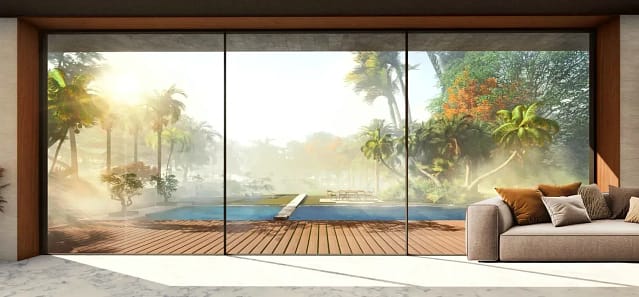
Every country has a different product portfolio, and you correctly said India is traditionally a casement market. This will be a product that will always be produced here. But there is a market for sliding windows with fly screens so this will also be extruded here. Along with this, you’re right, there is a shift. There are beautiful apartments, villas, condominiums and bungalows that are coming up in various parts of the country. People want more light, less noise, huge open spaces and good performance. So, the demand for patios, smart lifts and slides is rising. We are already selling these products in India. And as a long-term investment plan, we will also extrude these products here. Sometimes, you know it takes 20 years to develop a footprint of a product in a country. In India, we can sell everything from a complete German range. India is open to all the product portfolios. And as the demand increases, we will invest in dies and extrude them here. Also, we are planning to have more lines in addition to the four extrusion presses that we already have. So in times to come, we will extrude everything here (laughs).
We’re told that you are also exporting to Brazil from India. Is that the reason you want to expand – To cater to other emerging markets?
Mr Thiroff: That’s an added value. The main thing is that the country should be able to stand on its own two feet. The reason why Brazil is buying from here is that they believe the quality is very high. So that’s a bonus. But you can’t expect Brazil to keep on buying from India because it will have a plant of its own in future. So the main focus of the Indian plant is the Indian market and Indian customers.
Finally, what is your strategy to succeed in this extraordinary market of India?
It’s going to be a slow process for us. We want to grow organically. From a 20 Million company to a 100-million one, we want to take each step at a time. We want to have a fabricator in each state, customers in every area and impeccable service to complement the brilliant product. When I retire, I want to look back and say, “See, that’s what we achieved in India”. We will take our time and develop the market. India is a great place and values the right product; we are very positive.