


Noise is a variety of unwanted sounds, especially loud ones that disturb people’s peace. Pollution of various kinds has affected the environment and humans for a long time. Noise pollution has its own effect on our health and well-being. With life getting more stressful and strenuous, one looks forward to spending some quiet time, be it at an office or at home. The presence of excessive sound or noise breaks down the tranquil environment and brings harm to humans as well as the health of animals. Noise pollution can especially be experienced by people living in metros. Noise caused by vehicles, industry, construction and blaring music is not only annoying but also creates serious health issues like deafness, cardiac disturbances, sleeplessness, headache, irregular blood pressure, and tension.
Noise, to a certain extent, can be controlled in the house and office through proper installation of windows and doors. The question arises whether it can be achieved or not. This is very technical, and here are some ways to achieve the expected noise reduction.
Key requirements:
- The window fabricator has to understand the customer demand.
- The definition of an exact decibel level to be achieved should be agreed upon by both parties.
Practical advice:
Never talk about the percentage of noise reduction without the following
- Specifying the exact noise reduction to be achieved and
- The usage of a decibel meter.
Points to keep in mind:
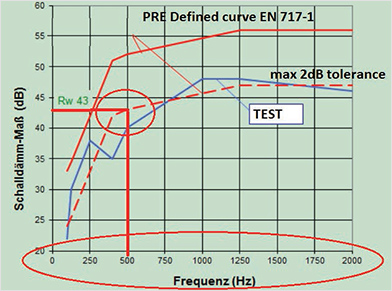
- Be aware that the noise reduction in decibels provided by the glass industry are parameter tested as per EN 717-1
- Make a practical site visit and check the actual/ typical noise surrounding with a decibel meter
- Make your final proposal of the right glass/window combination after considering all those points.
Point 1
Why will a percentage lead you into trouble?
It will always be as per the opinion of the customer. Maybe your personal hearing loss is already there due to whatever reason, where the customer will hear sharper than you, and your personal feeling of less noise or an achieved good reduction is not as per the feeling of the customer.
Two different opinions without decibel measurement cannot be evaluated, and in the end, we have to reach the satisfaction level of the customer.
Point 2
During the actual Noise test as per EN 717-1, the test is done at a testing institute or even at a site with specified equipment and for the complete frequency range from zero Hz to 2000Hz and a predefined noise curve. Wherever the line crosses at 500 Hz, the decibel level of noise reduction is fixed (at this particular curve, it is 43 decibels of noise reduction).
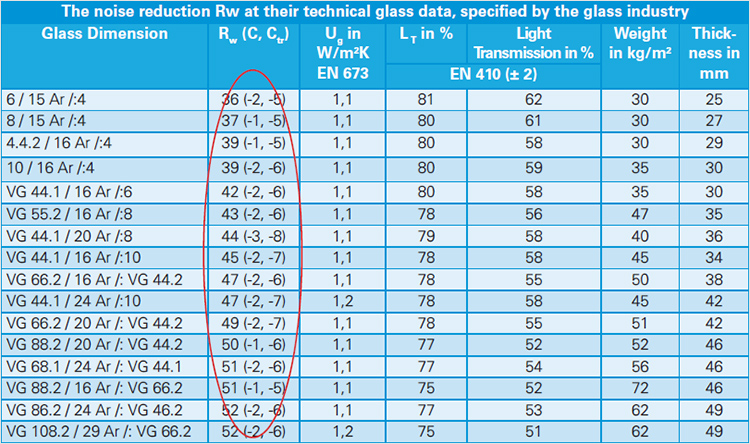
According to the test result, the glass industry specifies the noise reduction Rw in their technical glass data. For a window fabricator and a consumer, it will not be of any practical use since both (customer & fabricator) may not be able to understand how it has actually reached the certified noise reduction. Further, it is also of no value since the customer will expect a predefined noise level in their room. Both sets of data can be added or subtracted.
For example: Using the first glass of the attached glass list 6/15Ar/4 with Rw 36dB, and considering a particular project with an outside actual noise level of 76 dB, the above-specified glass combination will never provide a 36dB actual noise reduction reaching to 40dB noise level inside the room. Since, as already clarified, the frequencies tested as per EN717-1 and the actual noise frequency at the consumer building are surely not the same.
Practical site visit needed
- We all have smartphones now, and decibel meters are available as an application, free of cost.
This freely available tool will protect both parties – sellers and buyers, because we can predefine an approximate
- Inner noise level, which we would like to reach and
- We can check the current (typical) maximum outer noise.
Based on this result /understanding, the right glass and window combination can be chosen. To make a customer aware, we can further give a comparison of the noise level of other products.
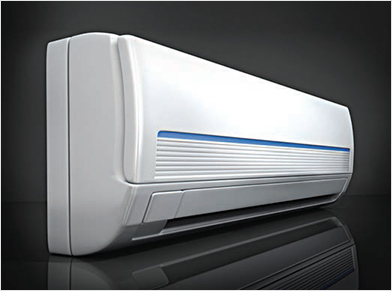
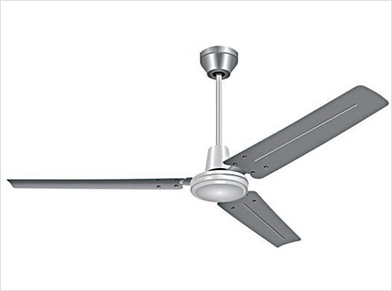
It will be understood by a customer that if the internal room noise level created by an AC or sealing fan is close to 50 / 55db, it will not be necessary to invest a heavy amount in reducing the outer noise level coming via the windows, since it is much lower than the noise created inside the room.
But, for northern areas of India, it is essential to inform the customer that during the winter months, when no ACs or fans are running, the noise from the road will be of the same dB level of 50 a b / 55 dB, in case the noise reduction was agreed upon up to this level.
It is important to understand the fact that the right choice of glass does not guarantee the performance of the overall window system.
It will always be the combination of the following points that assures the desired effects:
- Glass
- Frame material
- Design of the window
- Sealing (gasket) between the frame and shutters
- Sealing between the wall and the window frame (PU form and tapes)
| Points to be taken care of while proposing the right design to achieve the agreed noise reduction | |
| Sliding Windows | No countable noise reduction |
| Sliding windows with Insulated glass | A better glass combination will not improve the overall performance since the Sealant Brushes do not stop the noise |
| Doors | Have to have a multipoint lock and a bottom profile |
| Floating Mullion | Production/locking has to be very precise; otherwise, there will always be a big risk that the proposed noise reduction will not be achieved |
| Slide and Fold | Production/locking has to be very precise; otherwise, there will always be a big risk that the proposed noise reduction will not be achieved |
| Coupling Joints | Couplers to be avoided/ mechanical joints to be avoided/Noise bridges are there between all the coupling joints |
| Weak points at the site | Window AC installed inside a wall, Wooden doors inside the room next to our windows, Structure or curtain wall glazing next to our windows, slim brick walls of around 4 inches |
While taking care of all the above-specified points, a great acoustic performance was actually achieved.