
Post Date: August 13, 2026 |
Last Edited: August 13, 2026
Key Highlights
|
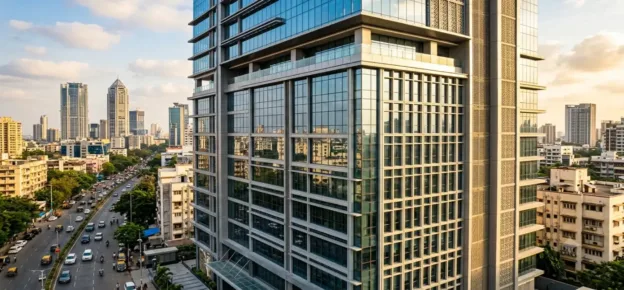
In Indian construction, windows are still too often selected backwards. The elevation is frozen, the façade language is admired, and only then does someone ask what the glass should be. That sequence is exactly the problem. Windows are no longer decorative openings in a wall. They are performance-critical parts of the building envelope, and once they are chosen poorly, the building can remain locked into unnecessary heat gain, glare, discomfort, and avoidable electricity use for decades. In a country where buildings already consume more than 30% of total electricity and cooling demand is set to rise sharply, that is not a styling mistake; it is an operational liability.
The first principle, therefore, is simple: window selection must begin with usage, not appearance. A residence, hospital, airport terminal, hotel, corporate office, and institutional building do not ask the same questions of fenestration. Some need quietness, some need glare-free daylight, some need long spans and durable hardware, and some must balance visual openness with tight environmental control. Even Indian green-building frameworks reflect this reality by assigning different daylight expectations to offices, healthcare, hospitality, institutional buildings, and transit terminals. Good fenestration strategy is not generic; it is program-specific from day one.
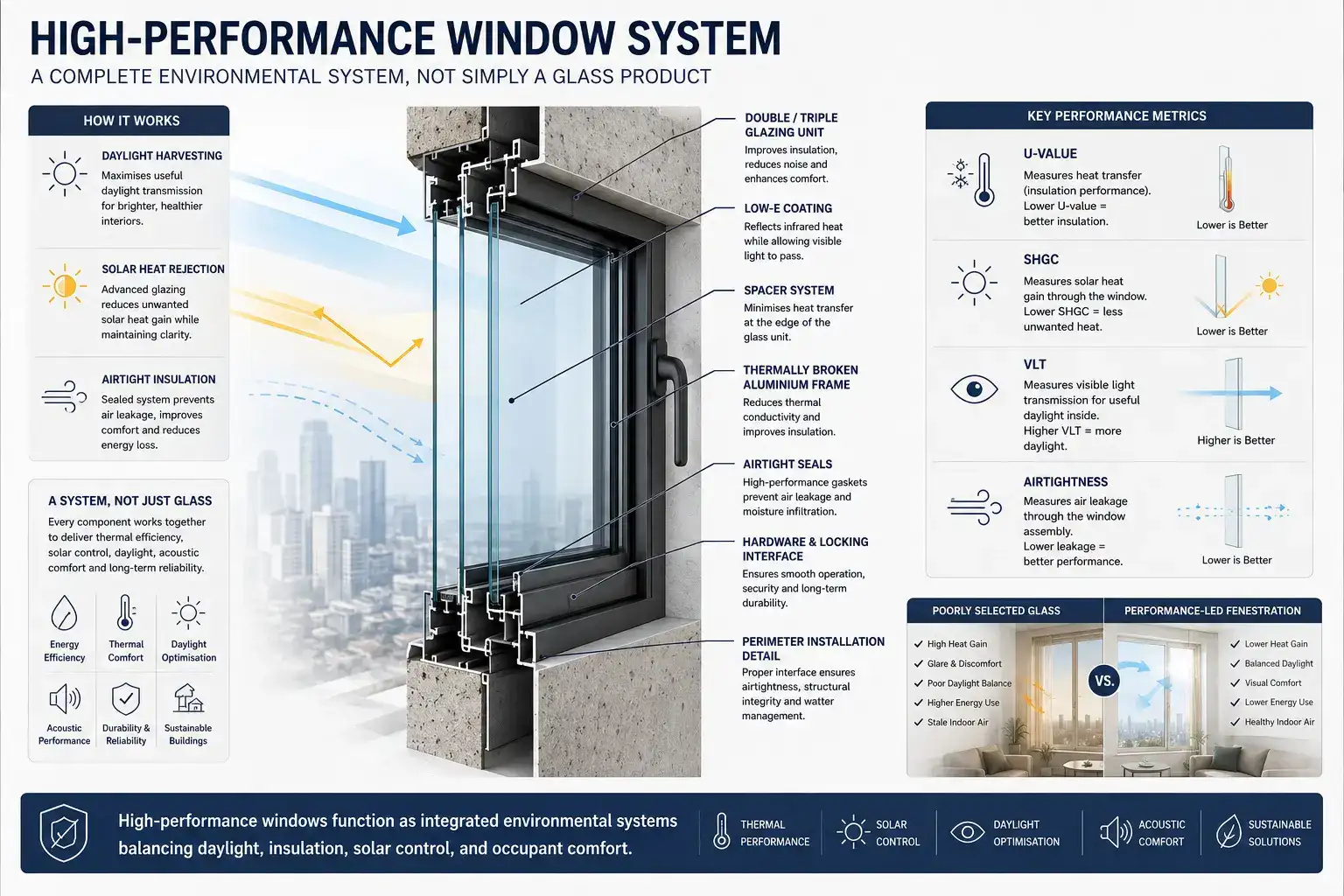
This is why a high-performance window has to be understood as a system, not a glass choice. The system includes glazing, frame, spacer, seals, hardware, perimeter detailing, and installation interface. The four metrics that matter most are whole-window U-value, SHGC, VLT, and airtightness. U-value measures non-solar heat transfer, so lower values mean better insulation. SHGC measures how much solar radiation enters as heat, so lower values are typically better in cooling-dominated conditions. VLT tells us how much useful daylight enters the room. Airtightness measures leakage, and leakage can quietly destroy the performance promised on paper. Crucially, both ECBC and NFRC-style rating logic focus on assembled performance, not just centre-of-glass numbers.
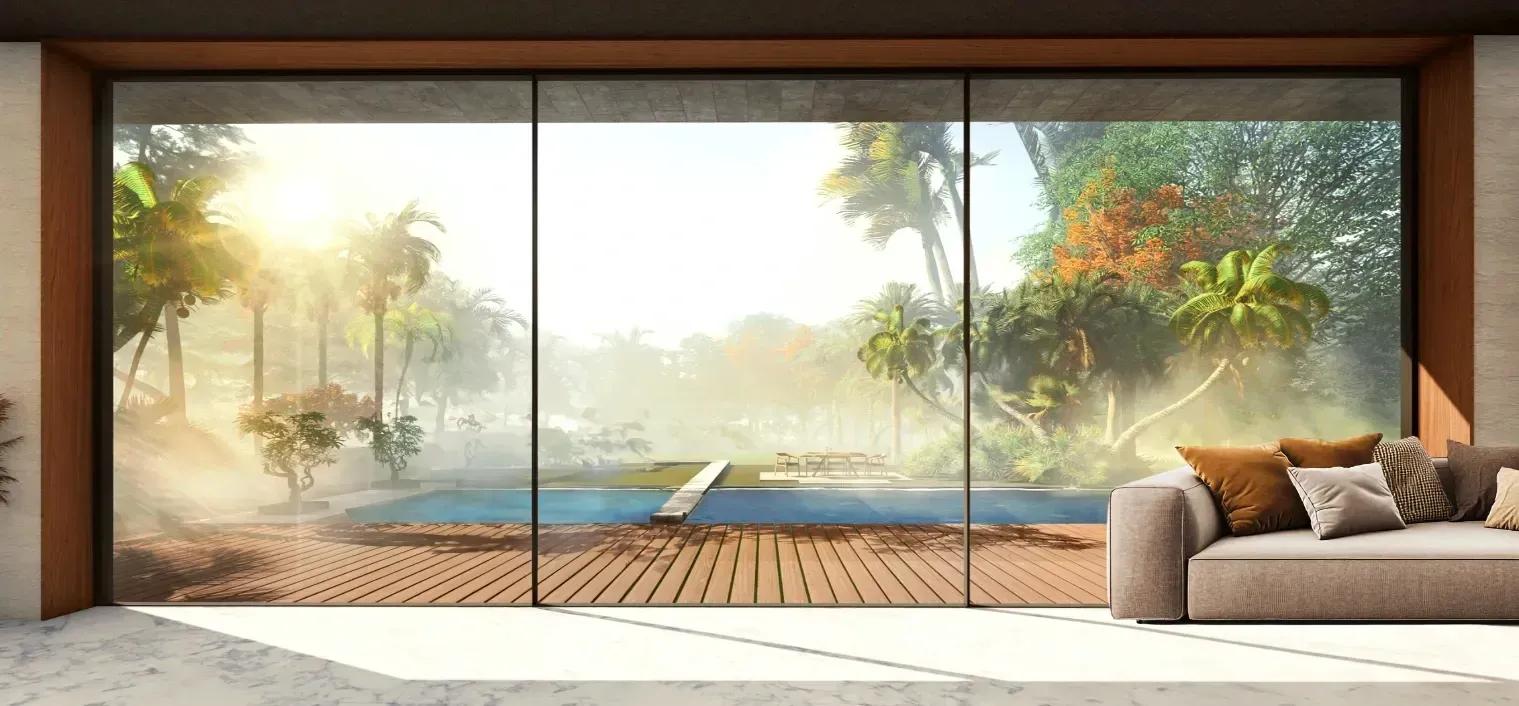
In practice, VLT and SHGC must always be read together. The objective is not dark glass. The objective is selective glass that admits as much useful daylight as possible while rejecting as much unwanted heat as possible. High performance is achieved when daylight is harvested without turning the façade into a heat collector.
For most mainstream Indian projects, the real workhorse solution today is not exotic technology but a well-specified insulated glazing unit: double glazing with a climate-appropriate low-E coating, a well-selected cavity, inert gas fill where justified, warm-edge spacers, and a thermally appropriate frame. This is where the industry also needs more honesty. Double glazing by itself is not “high performance.” It becomes high performance only when coatings, spacers, gas fills, and framing are engineered together.
Low-E coatings are especially important because they reduce heat transfer through the glazing while still allowing daylight, and spectrally selective variants are designed specifically to cut non-visible infrared heat while preserving useful light.
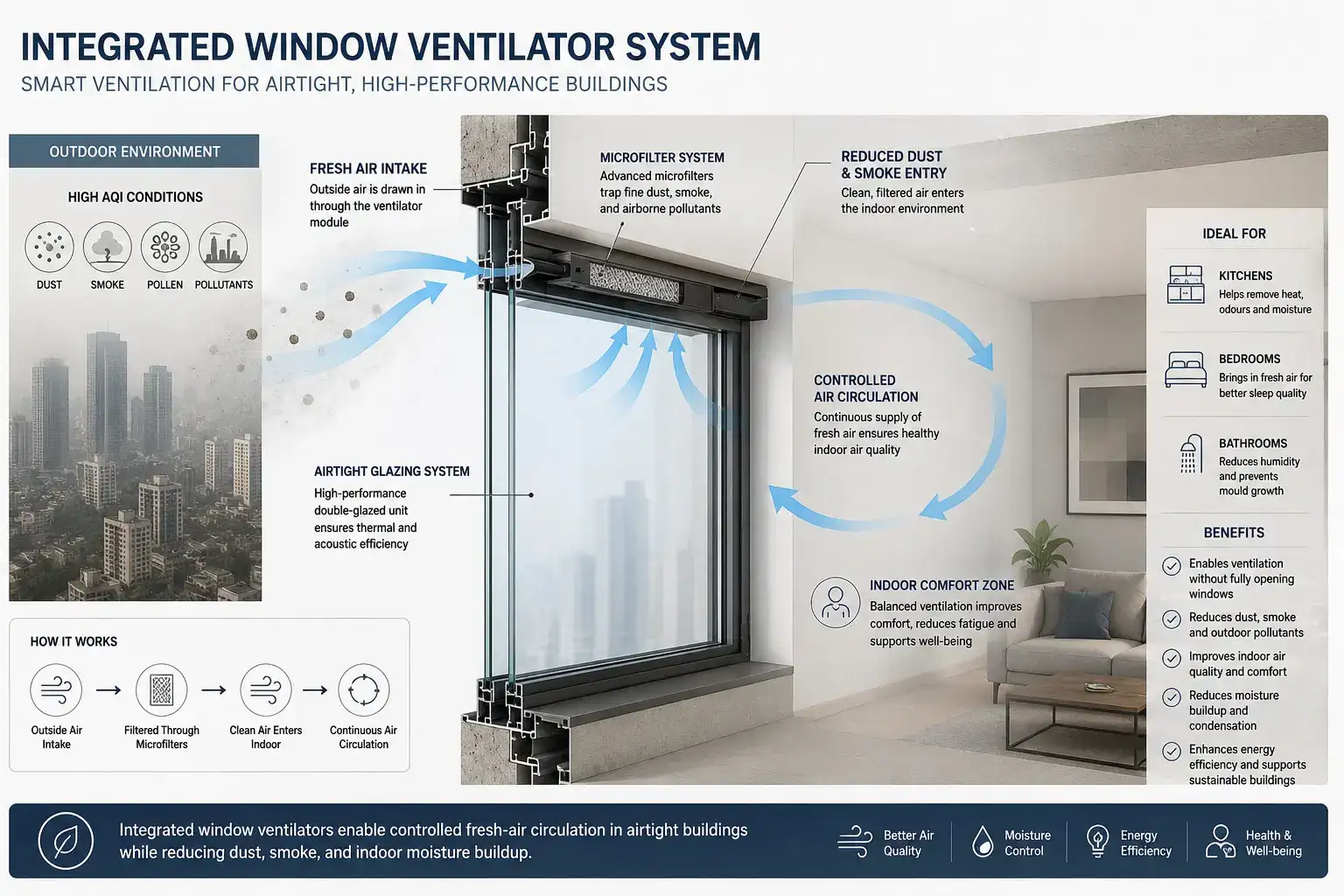
Another important development in modern fenestration is the growing relevance of integrated window ventilators, particularly in airtight homes, offices, and high-rise buildings. As contemporary building envelopes become increasingly sealed for thermal efficiency and acoustic control, maintaining healthy indoor air circulation has emerged as a critical challenge. Window ventilators offer a balanced solution by enabling controlled fresh-air movement without fully opening the glazing system. In densely populated metropolitan regions with consistently high AQI levels, advanced ventilator systems equipped with microfilters can also help reduce the ingress of dust, smoke, and airborne pollutants. Their application is especially beneficial in kitchens, bedrooms, and moisture-prone zones where continuous airflow helps minimise humidity buildup, condensation, and stale indoor air while improving overall occupant comfort and indoor environmental quality.
An equally important addition to modern high-performance fenestration systems is the use of Blinds within the Window Panel for enhanced thermal and daylight control, along with Privacy. Their cellular structure traps air within internal pockets, helping reduce heat transfer and improve indoor thermal comfort. In high solar – exposure conditions, honeycomb blinds also assist in glare reduction and lowering cooling loads by minimising unwanted heat gain while maintaining controlled natural daylight within occupied spaces.
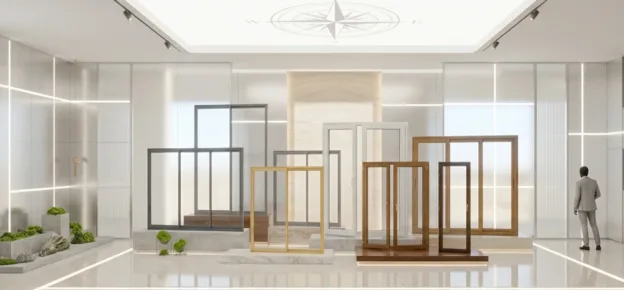
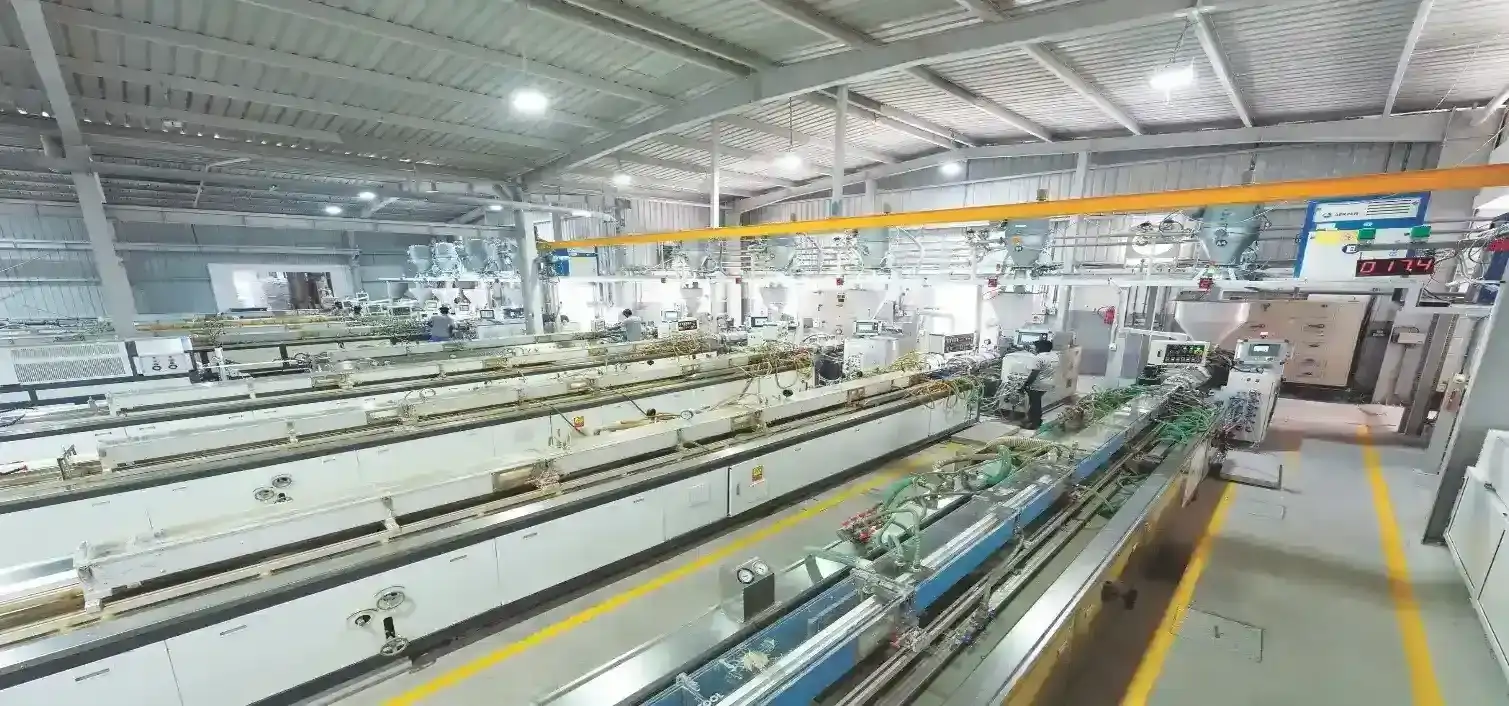
Frame choice matters just as much as glass choice. Aluminium remains indispensable wherever large spans, slender sightlines, durability, and façade integration are required, but uninsulated metal frames conduct heat rapidly and should not be treated lightly in a performance discussion. Thermally broken aluminium interrupts that conductive path and is essential for meaningful envelope performance. uPVC systems remain strong contenders where thermal performance, moisture resistance, and value engineering matter, especially when multi-chamber sections and proper reinforcement are used. Wood and wood-aluminium hybrids can also be thermally strong and environmentally attractive in the right applications. Life-cycle studies consistently show that frame material significantly affects window embodied impacts. None of this works properly if passive design is treated as an afterthought. In India, glass cannot be discussed without climate and orientation. ECBC’s logic is explicit: prescriptive WWR is capped at 40%, minimum VLT is 0.27, and SHGC requirements tighten for non-north façades in composite, hot-dry, warm-humid, and temperate zones. For latitudes above 15°N, north-facing fenestration can be treated more generously than east, west, and other exposed orientations. The lesson is obvious. Preserve useful north light where possible. Defend east and west aggressively with geometry. Use overhangs, fins, shadow, and façade depth before trying to solve everything with a darker coating. The best façade engineers reduce the solar problem first and fine-tune the glazing second.
The Indian market, however, still faces a more stubborn problem than technology: decision quality. Too many projects are driven by aesthetic-first thinking, shallow comparisons, and centre-pane claims that ignore the frame, spacer, seal, and installation. Cost sensitivity is real, but so are false economies. A badly detailed “premium” window can underperform more severely than a modest but well-integrated system. Field evidence shows why.
Performance failures regularly occur through interfaces, water penetration, excessive air leakage, and thermal bridges at the window-to-wall transition. Some thermal-bridging guidance shows that details routinely ignored in design, including flashing around window openings, can underestimate total wall heat flow by 20% to 70%. In other words, the drawing detail can undo the specification sheet.
That is why execution discipline has to be part of the energy conversation. Mock-ups, air- and water-tightness testing, sealant compatibility, gasket continuity, perimeter flashing, and interface inspection are not procurement formalities; they are performance work.
UL’s field-performance guidance notes that the interface between the window system and the adjacent wall assembly is often the most critical part of the installation and may never have been validated in laboratory testing. If the industry wants better-performing buildings, it has to stop treating installation as a downstream activity and start treating it as part of fenestration engineering itself.
The future, then, is not more glass. It is smarter glass, better frames, tighter installation, climate-responsive geometry, and digital evaluation of performance before construction.
India’s own cooling roadmap calls for climate-appropriate envelopes, stronger code adoption, and even the development of a windows energy-labelling programme. Research momentum around electrochromic systems and smart-window technologies is also rising. The industry should read that signal correctly. The next generation of façades will not be judged by visual excess, but by intelligent performance over the life of the building.
The best window is not the most dramatic one on elevation. It is the one that quietly keeps heat out, daylight useful, air leakage low, and occupants comfortable year after year.