
Post Date: June 24, 2015 |
Last Edited: February 23, 2026

The enormous economic and population growth worldwide over the last four decades has together driven the impacts that threaten the health and well-being of our communities and nations. To name a few – ozone depletion, climate change, fouling of natural resources and extensive loss of biodiversity and habitat.
Amidst this, one word that drives all activities across the globe in today’s time and age is Sustainability. Ranging from ecosystems to buildings, from commercial buildings to urban habitats, you name it, and it strives to be sustainable. Leaders in business, government, academia, public interest organisations, and communities are responding with innovative new solutions to sustainability. Large corporations, as well as small businesses, are progressing beyond simple regulatory compliance in favour of more proactive roles in finding solutions to sustainability issues.
The Indian building and construction industry is not far behind in this race run for the cause. “For most urban projects, there are design charettes where a sustainability consultant, a structural consultant, an architect and a client get together and lay down the blueprint for the building, which is conceived to be the epitome of sustainable methods and processes”, says Mr K.R. Suresh, Regional Director – Axis Façades
Each component of a building contributes to achieving the much sought-after sustainability, and so does the building envelope. The building skin affects both the appearance and performance of a building like no other building system. Façade and fenestration in a building are thus of paramount importance when considering issues of green building and sustainable design.
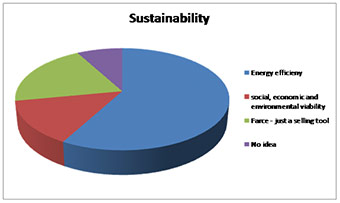
WFM conducted a survey where they asked the general public or end user what they understood by sustainability. The following pie chart describes their views:
The results of the survey are as follows:
- 58% of the respondents feel sustainability corresponds to Energy Efficiency
- 20% believe it’s no more than a marketing gimmick
- 8% of the respondents have no idea as to what sustainability actually means
- 14% agree that Sustainability is the essence of Social, Economic and Environmental viability – also described as the three pillars of sustainability.
(The respondents comprise the internet users who choose to participate in the poll only, and not the general public)
There are a number of design drivers that account for developing and executing a high-performance, sustainable façade vis-à-vis
 water – [rain, humidity, condensation],
- Air – [wind, ventilation],
- Sound – [desired, undesired],
- Light – [Sunlight, artificial],
- View – [Public & Private],
- heat – [solar radiation, air temperature],
- fire – [flames, heat, smoke],
- Pollution, security, safety, explosions, etc.
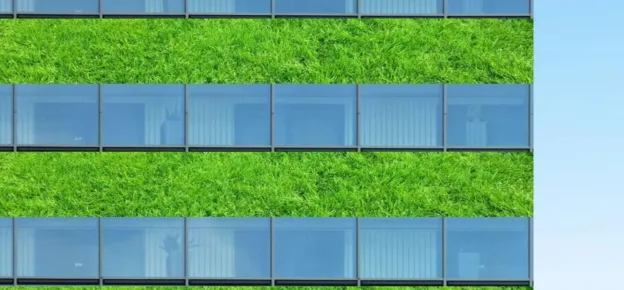
A sustainable façade is one that considers all these and still does not imbalance the environment, social equity and economic viability in the long run. There are various ways to enhance environmental gains and make a façade sustainable, ranging from low-cost passive systems to phenomenally expensive dynamic ones.
Passive methods
 Optimised form/orientation – where the building’s axis is aligned after analysing the sun path diagram for that specific zone, and the façade is angled to a certain degree so as to minimise the heat gain.
- Natural ventilation.
- Solar shading through basic structural shading ornaments on the envelope.
- Maximise daylighting at the same time while minimising glare.
- Evaporative cooling and thermal banking.
- Strategically planted trees for window shading and roof plantation, etc.
Technological Intervention:
“These are one-time smart moves taken in order to enhance building performance by selecting the high-performance façade components and technologies and integrating them into the building design”
– says Sharanjit Singh – CMD, GSC Glass
- High-performance insulated glazing – with especially selective low-E glass.
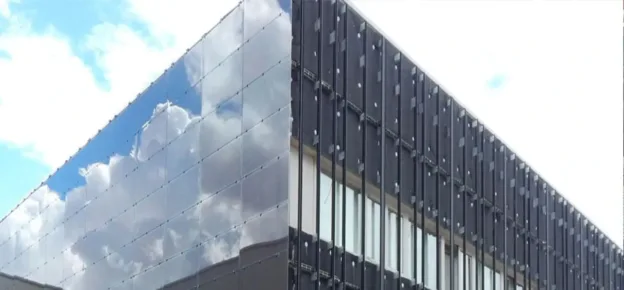
- Double skin façade – this emergent technology is finding increased application in building projects where the attributes of transparent facades are desired, yet the performance of the building skin is paramount. These sophisticated facade designs can compensate for the inherently poor insulating properties of glass. In addition to providing a thermal barrier, the systems can also provide an effective means of ventilation and often involve shading devices for the control of solar penetration and glare.
- BIPV – Building-integrated photo-voltaic (BIPV) is an increasingly popular approach for using the building skin as a means to harvest solar energy
Dynamic Methods:
- Heat Recovery Equipment
- Sensors and Actuators – that respond to conditions like fire, smoke and inhabitation or lack of it
- Responsive shading – dynamic louvres, photochromic shading devices which respond to the position of the solar position and help in light shelving, as well as to enable deep penetration of sunlight deep into the building
A sustainable façade helps in reduced consumption of resources and lowers the carbon footprint of the buildings.
WFM confronted leading stakeholders from the industry, ranging from architects, developers, consultants and so on, and asked them how they perceive sustainability and what measures they take to ensure that the window system or façade of their building will positively contribute to making their building eternally sustainable. We got various interesting responses:
Excerpts:-
“Sustainability has become much more relevant now with the increase in the sheer scale of the projects with the advent of various options available today,” says Architect Raman Sikka of Sikka Associates. As per him, good planning was the key 15 years ago and now as well.
Now it’s being demanded that the building be sustainable and energy efficient. For instance, in the Commonwealth Games village, all the residential high-rises were specified to be GRIHA-rated. The windows for each of them were designed considering the same.
“Strategising the whole process properly and doing the right things at the right time and the right place is the key to the whole sustainable story,” says Architect Alok Kumar, Chief Architect, DLF Limited
Mr Vasudevan from Chintels reiterates that, depending on the market conditions and demands, they incorporate sustainable development practices. Their residential development – International City in Gurgaon, which is a joint venture with Sobha, is one such example.
Kangkan Chakraborty, President of Projects from Vatika group, which was responsible for changing the face of NCR, maintains that they go the extra mile while designing and specifying engineered façade for their commercial buildings.
“Sustainability goes beyond thermal efficiency. The building has to be viable; every building is different and has its own sustainability requirements. Orientation, location, application of the building, comfort of the occupants – all these have to be considered, new innovations to be devised and tested in order to validate them. The façade needs to be evaluated on all aspects – comfort level, energy, orientation, daylighting, heat island effect and overall running and maintenance cycles and should eventually minimise the cost of running the building. Then only it can be deemed sustainable”. – KR Suresh
To all these views, there was a counter view, which is worth mentioning here:
The most sustainable building is one without windows. We are creating a problem, and then we are solving it by creating more sustainable windows and façades.
The most sustainable place to live is a cave. But at the same time windows and façade bring in much-needed air and light. There is a symbolic modern-ness about glass façades. So the need of the times is to design them so that they don’t pose a threat to our already depleting resources. The most important thing is to design windows where they matter. For the Indian climate, having windows on the north façade makes sense. Having windows on the west doesn’t make sense. Use of DGUs wherever required, speciality films, etc., are the measures worth considering and adopting?
– says Architect Gopinath Akalkotkar, Managing Leader, Stantec Consultants.
In the words of Mahesh Arumugam, Director, Meinhardt Façade Consultants, a façade is an element that interacts with all other elements of a building. It acts as a skin between the interior and the exterior. It has to be designed in a sustainable way so as to allow maximum natural ventilation and natural lighting.
A building Façade is normally designed for a minimum of 25 years and aims for up to 50 years. All recyclable materials should be used – aluminium, Glass. The chemicals and coatings should be VOC-free and should blend with the natural environment. The design should keep in view the maintenance requirements that will come up in the lifespan of the façade, vis-à-vis cleaning, repair for the normal wear and tear, etc.
Thus, we see sustainability is not just a myth or a marketing gimmick. There have been various qualitative studies that have identified that sustainable practices by the firms have, in turn, provided a few financial benefits to them in the long run. Environmental performance produces financial gain for the building subsequently.
A lot has changed in the past decade in India – the client is more aware, and the industry has evolved, but as the basic rule of physics says, an ideal can’t be achieved. There are design challenges, conflicting requirements, quality, cost and time balancing, problems with implementation and even if all this goes well, there are performance inefficiencies. It is a long path to be tread on.
REFERENCES:
- Journal of Industrial Ecology – Stern School of Business
- A sustainable technical system for ventilated façades
- Avellaneda, J.M. González, A. Carbonnel & D. López
- Departament Construccions Arquitectòniques 1. Universitat Politècnica de Catalunya
- ZAK – World of Façades