
Post Date: July 27, 2026 |
Last Edited: July 27, 2026
Integrating Design, Remediation, Fire Strategy and Emergency Response in a Changing Global Environment
Key Highlights
|
As a retired operational fire officer and now operating in the Fire and Life Safety community. I look at the built environment challenges in a holistic manner, like incidents involving façades with an operational officer viewpoint; this I try to convey to design and construction organisations alike. Over recent years, the industry has witnessed several significant façade fire incidents globally. These incidents fundamentally changed how regulators, designers, fire engineers, emergency responders and building owners view façade systems. The focus has rightly shifted from simply asking whether a building “complies” to determining whether it is genuinely safe under real incident conditions. I often use the statement that “Buildings are safe until we put people in them”; well, this is true providing the design and construction are completed as required, but it is often people’s behaviours that compromise the design intent.
The façade of a building is no longer simply an architectural statement or environmental envelope. Across the UAE and internationally, façades are now recognised as one of the most critical components influencing Fire & Life Safety, operational resilience and emergency response effectiveness.

This Distinction: The Important
A building may achieve technical compliance on paper yet still create severe operational challenges during a real fire. Equally, a facade system may satisfy isolated material classifications while still contributing to rapid fire spread when considered as part of the complete external wall assembly.
The industry has therefore entered a new era, one where façade fire safety must integrate:
- Design.
- Material selection.
- Operational firefighting considerations.
- Human behaviour.
- Fire strategy.
- Building safety regulation.
- Remediation.
- Inspection and maintenance.
- Emergency response planning.
Ultimately, façade safety can no longer be viewed as a specialist design issue alone. It is now a whole-life operational and resilience issue.
The UAE Perspective – Progress Through Experience
The UAE has made significant progress in façade fire safety through successive revisions of the UAE Fire & Life Safety Code of Practice. With the learning culture within the region, authorities examined incidents of fire and introduced learning with increasingly robust controls relating to combustible cladding systems, cavity barriers, fire stopping and façade testing requirements.
The revised UAE code significantly restricted the use of combustible façade systems, particularly on medium and high-rise buildings, while promoting tested, certified and traceable façade assemblies.
This evolution reflects an important industry lesson:
Fire does not recognise design intent. It only reacts to fuel, oxygen, geometry, wind conditions and system weaknesses.
Modern façades are highly engineered systems incorporating:
- Cladding panels
- Insulation
- Ventilated cavities
- Vapour barriers
- Curtain wall assemblies
- Fixing systems
- Architectural projections
- Solar shading systems
- Balconies and decorative features.
Each element can influence fire behaviour.
The challenge is that individual products may perform adequately in isolation yet behave very differently when combined within a complete façade assembly.
This is why the move toward full-system testing is so important.
The Global Shift Toward Whole-System Safety
Internationally, façade fire safety has evolved beyond simple reaction-to-fire classifications toward large-scale system performance assessment.
Testing methodologies such as:
- NFPA 285
- BS 8414
- EN 13501
Large-scale façade propagation testing now plays a critical role in understanding:
- Vertical fire spread
- Flame propagation
- Cavity fire development
- Smoke production
- Thermal behaviour
- Structural integrity
- Fire re-entry potential.
This shift recognises a simple operational reality:
Fire exploits system weaknesses, not regulatory wording.
The importance of cavity barriers, perimeter fire stopping and slab-edge protection has therefore become increasingly understood. Hidden fire spread within façade cavities remains one of the greatest risks within modern construction. Poorly installed or interrupted fire stopping can allow fire to bypass compartmentation entirely, leading to rapid multi-floor involvement.
From an emergency response perspective, this can dramatically alter:
- Evacuation timelines
- Firefighter tactics
- Incident command requirements
- Resource escalation
- Rescue operations
- External exclusion zones.
PAS 2030 and PAS 2035 – Sustainability Must Not Create New Risks
An interesting development within the global building safety discussion is the growing importance of retrofit standards such as British Standards Institution PAS 2030 and PAS 2035.
Although these standards were primarily introduced to improve energy efficiency retrofit quality, they also introduced a critically important principle:
Buildings must be understood as complete systems.
PAS 2035 promotes a whole-building assessment approach considering:
- Existing construction
- Occupancy
- Ventilation
- Moisture
- Fire safety
- Long-term performance
- Unintended consequences.
This is especially relevant where:
- External wall insulation systems are added
- Ventilated façades are retrofitted
- Existing cavity arrangements are altered
- Fire stopping is disturbed
- Combustible insulation materials are introduced.
Globally, the drive toward sustainability and net-zero carbon targets is accelerating rapidly. However, energy efficiency improvements must never compromise life safety.
History has shown us that unintended consequences often emerge where disciplines operate independently.
Fire safety, sustainability and operational resilience must therefore remain integrated throughout the building lifecycle; this concept falls within the responsibility of designers, installers, Project Managers and Building/Facility Management teams to ensure the compatibility, continuity and integrity of the building’s Fire and Life Safety.
Regulation, Residual Risk And The Law Of Unintended Consequences
The impact of new building safety regulation on the sector cannot be understated. Across many jurisdictions, the response to façade fire incidents and broader building safety failures has rightly led to changes in legislation, increased scrutiny, stronger accountability and enhanced regulatory controls. One of the recurring challenges within safety-critical industries is that regulations, while developed with best intentions, can consequently create secondary pressures.
These reforms have undoubtedly improved awareness, competency expectations and life safety considerations. However, there also remains the important elements of proportionality, societal risk and the potential for unintended consequences.
In the residential sector, for example, increasing regulatory obligations relating to remediation, fire wardens, evacuation management, inspection regimes and stakeholder accountability are significantly altering the economic and operational landscape.
Additional scrutiny on stakeholders has understandably increased caution throughout parts of the market. This can create a negative effect on investment, development activity and housing delivery.
This is not an argument against regulation; far from it, the lessons learned globally demonstrate clearly why stronger building safety governance, competency and accountability are necessary.
However, it is equally important to recognise that there is inherent risk within the built environment and this risk can never be fully mitigated. Every building, regardless of design, construction or management, contains some degree of residual risk.
Societal Risk
Society balances risk across sectors including transportation, healthcare, energy, infrastructure and construction. Therefore, it is an unrealistic expectation of zero risk, but to understand and ensure that risk is reduced to a level that is understood, proportionate, manageable and apportioned across society.
Over-regulation, particularly where fragmented, inconsistent or disproportionate, can unintentionally create wider societal challenges:
- Reduced investment.
- Delayed remediation.
- Increased housing costs.
- Slower construction delivery.
- Reduced accommodation availability.
- Greater economic pressure on communities.
This becomes particularly relevant as many countries attempt to simultaneously address:
- Housing shortages,
- Urban growth,
- Sustainability targets,
- Retrofit programmes,
- And increasingly complex building safety requirements.
The challenge for regulators, industry leaders and fire safety professionals is therefore to strike an appropriate balance between:
- Life safety,
- Operational resilience,
- Economic viability,
- Societal need,
- And realistic risk reduction.
The goal should never be to reduce safety standards.
Rather, it should be to ensure that regulations remain evidence-based, proportionate, operationally realistic and capable of delivering genuine improvements in building safety without unintentionally restricting societal benefits they are intended to support.
Perhaps most importantly, this requires continuous collaboration between regulators, designers, fire engineers, operational responders, property owners and communities.
Because effective building safety is rarely achieved through regulation alone.
It is achieved through competence, communication, proportionality and shared responsibility.
The UK Building Safety Regime – A New Era Of Accountability
The UK’s post-Grenfell regulatory reforms introduced one of the most significant building safety transformations in decades.
The:
- Building Safety Act 2022
- Fire Safety Act 2021
- Enhanced Building Regulations
- Introduction of the Building Safety Regulator
Collectively signalled a move toward continuous building safety accountability rather than simple handover compliance.
Key themes now include:
- The Golden Thread of information
- Competence
- Resident engagement
- Lifecycle safety management
- Accountable Persons
- Change control
- Continuous risk assessment.
Importantly, these reforms have global relevance and recognise that building safety is not achieved at completion; it must be continuously managed throughout occupation, refurbishment and remediation.

Façade Remediation – One Of The Largest Building Safety Challenges
Façade remediation programmes are now occurring across many countries, involving the removal and replacement of unsafe cladding systems and associated fire safety deficiencies.
However, remediation itself introduces significant operational risk.
Many remediation projects occur while buildings remain occupied, creating complex interfaces between:
- Construction activities
- Residents
- Fire safety systems
- Temporary evacuation arrangements
- Emergency response operations.
Remediation may involve:
- Cladding replacement
- New insulation systems
- Installation of cavity barriers
- Upgraded fire stopping
- Balcony modifications
- Structural investigations
- Fire alarm enhancements
Yet remediation is not purely an engineering exercise. It requires:
- Dynamic risk assessment
- Resident and Stakeholder engagement and communication.
- Temporary mitigation measures
- Hot works controls
- Emergency planning
- Firefighter operational awareness
- Multi-agency coordination.
This is where operational fire service experience becomes invaluable. A remediation project can significantly alter:
- Access arrangements – both normal and emergency operations
- Fire loading
- Escape routes
- Water supplies
- Smoke movement
- Firefighter tactics
These changing risks must use the concept of Dynamic Risk Assessment and be continuously managed throughout the remediation process, adapting to the changing risk profiles.
Fire Strategy And Emergency Response Must Be Integrated
One of the recurring challenges within the industry is the separation of design compliance from operational reality.
Too often, emergency response is referenced within fire strategies but not genuinely integrated into the design process. This leaves operational responders managing the consequences, often with incomplete information available to support operational tactical and command decisions.
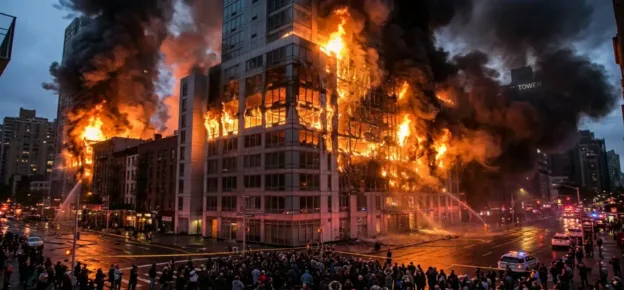
Façade fires create unique operational challenges:
- Rapid vertical fire spread
- Wind-driven flame behaviour
- Falling debris hazards
- External fire re-entry
- Complex evacuation management
- Smoke plume recirculation
- Compromised aerial appliance positioning
- Public realm impacts.
These incidents can escalate extremely quickly into major multi-agency emergencies.
This is why façade fire safety must consider:
- Firefighter access
- Water supply resilience
- Command & control arrangements
- Emergency communications
- Evacuation strategy
- Refuge arrangements
- External assembly point safety
- Incident escalation planning.
The operational environment should support and be included proactively in the design environment.
As I have often stated: “A building is safe until we put people in it.”
Human behaviour, stress, communication and operational decision-making all influence the real outcome of an incident.
Competence And Collaboration Are Essential
Perhaps the greatest lesson globally is the importance of competence and collaboration.
Safe façade delivery requires meaningful engagement between:
- Architects
- Fire engineers
- Façade specialists
- Structural engineers
- Contractors
- Facilities management teams
- Emergency planners
- Civil Defence and fire services
- Regulatory authorities.
No single discipline can solve façade fire safety independently.
The most successful projects are those where operational realities are considered early within concept design, maintained throughout construction and continually reviewed during occupation.
With the increasing complexity of modern buildings, the importance of sector competence within the fire engineering profession becomes paramount; there is a growing argument that the profession should move toward greater formal recognition, competency assurance and protection of title.
Fire engineering decisions directly affect life safety, evacuation, firefighter operations, resilience and public confidence. Yet internationally, the term “Fire Engineer” is not consistently recognised, protected or regulated as are other safety-critical professions.
This is not about restricting innovation or limiting multidisciplinary collaboration. It is about ensuring that individuals making critical life safety decisions possess the appropriate qualifications, operational understanding, experience and professional accountability necessary for such responsibility. Sector competence must sit at the centre of modern building safety.
Conclusion – Beyond Compliance
The global façade fire safety landscape has changed fundamentally. Façades are no longer simply architectural features. They are critical life safety systems that directly influence fire behaviour, evacuation, firefighter operations and building resilience. As our cities continue to grow vertically and sustainability demands accelerate, the challenge for the industry is to ensure that innovation never outpaces safety.
Buildings are not ultimately judged by how they perform on drawings or within presentations. It is when these designs are compromised that buildings are judged by how they perform on a day of failure.
The UAE Fire & Life Safety Code, PAS 2030, PAS 2035, UK Building Safety reforms and international remediation programmes all reinforce the same message:
Compliance alone is no longer enough.
Buildings must be:
- Safe
- Operable
- Resilient
- Maintainable
- Understandable
Capable of supporting effective emergency response throughout their lifecycle. Façade fire safety in the UAE has evolved dramatically in response to both global and regional lessons. The UAE Fire & Life Safety Code now demands far greater accountability in material selection, tested assemblies, cavity protection and lifecycle compliance.
However, true façade fire safety goes beyond compliance alone.
It requires:
- Integrated fire strategy thinking
- Robust testing and certification
- Operational understanding
- Emergency response planning
- Continuous inspection and maintenance
- Cross-disciplinary collaboration.
A façade should not simply look impressive.
Ultimately, a building is not truly safe because it complies with a code. It is safe when its design, operation, emergency response capability and human behaviour considerations work together effectively under the pressures of a real incident.