
Post Date: August 4, 2026 |
Last Edited: August 4, 2026

Key Highlights
|
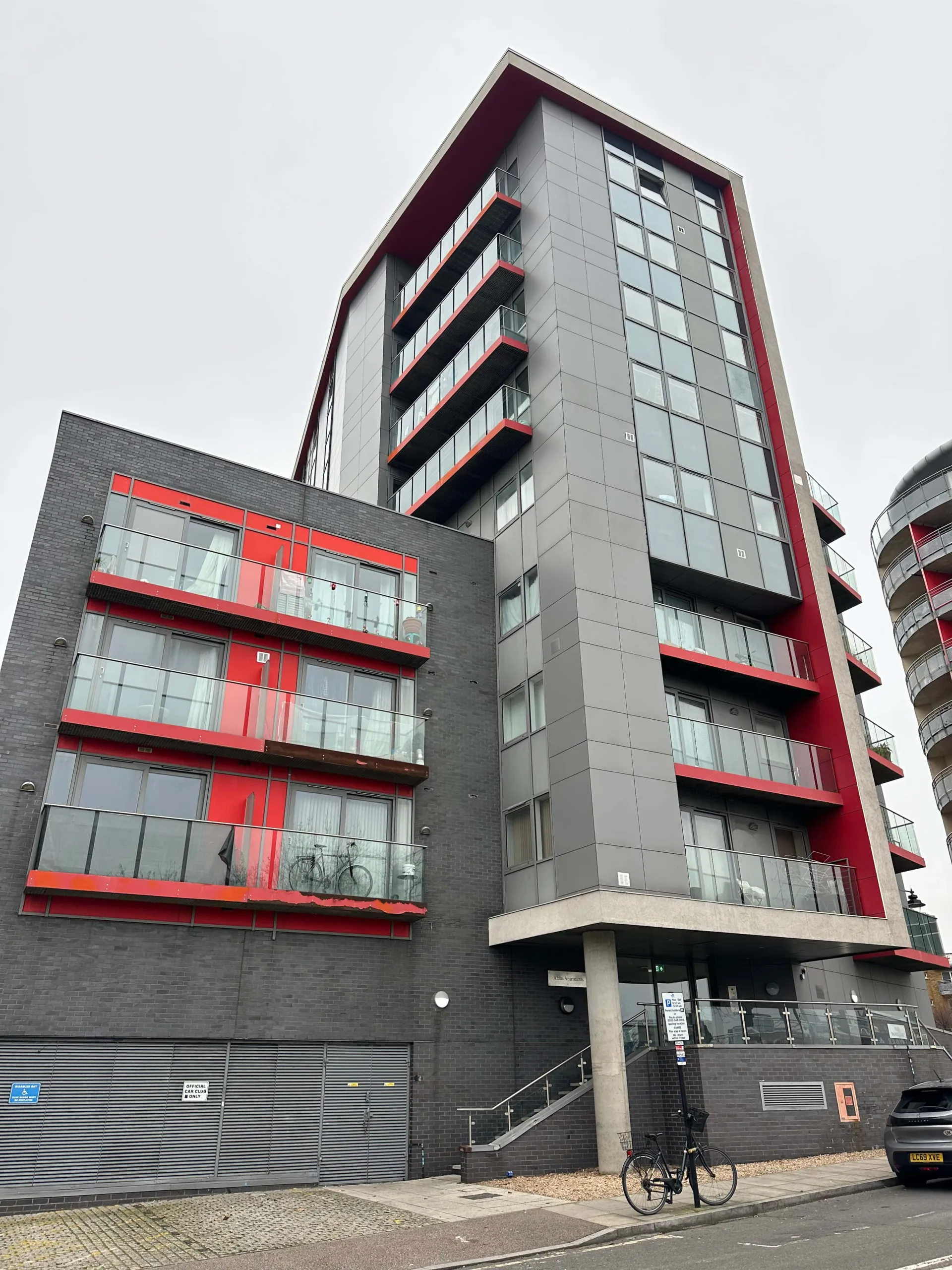
Two façade fire risk assessments. Same building typology. Different conclusions.
This is not an isolated occurrence. It is a recurring issue across jurisdictions where façade fire risk is assessed without a consistent framework for evidence, inspection, and reasoning.
Façade fire risk is, in many cases, not assessed in a structured sense at all. It is interpreted. Outcomes are shaped as much by the assessor’s approach as by the building itself.
As building envelopes become more complex, and as scrutiny from regulators, insurers, and funders increases, this reliance on interpretation is no longer tenable.
A Structured Approach: The UK Position
The UK has sought to address this inconsistency through the introduction of PAS 9980:2022, a risk-based methodology for the assessment of external wall construction in existing buildings.
PAS 9980 does not remove professional judgement. It structures it.
The framework sets out:
- Defined stages of assessment;
- Consideration of building-specific risk factors;
- Expectations for inspection and supporting information;
- A transparent route to a risk outcome.
Crucially, it sits within a broader regulatory and commercial ecosystem, including the Regulatory Reform (Fire Safety) Order 2005 (as amended by the Fire Safety Act 2021), the Building Safety Act 2022, lender requirements, and emerging expectations from the Building Safety Regulator for higher-risk buildings.
Façade fire risk assessments are not standalone documents. They form part of a wider evidential chain supporting compliance, investment, insurance, and occupancy.
The framework is not without limitations. Variability in application persists, particularly where:
- Inspection scope is constrained;
- Competence expectations are inconsistent;
- Evidential inputs are incomplete.
There are also ongoing debates around the appropriate extent of intrusive investigations necessary to understand façade risk, the treatment of certain façade systems and construction typologies, and the weighting of fire engineering analyses relative to observed construction.
However, the distinction remains: a common methodology exists. Assessments can be interrogated, understood, and compared.
As PAS 9980 progresses through its current revision cycle, there is a clear opportunity to strengthen consistency further, particularly in relation to the appropriate extent of intrusive investigations, competence expectations, and evidential clarity.
Why Methodology Matters
The consequences of inconsistency are not theoretical.
Where façade fire risk is assessed without structure:
- Remediation strategies become misaligned with actual risk;
- Similar buildings receive materially different recommendations;
- Lender and insurance outcomes diverge;
- Regulatory submissions are delayed or rejected.
These are not purely technical failures. They are evidential ones.
A façade fire risk assessment must do more than reach a conclusion. It must demonstrate:
- What has been inspected;
- What information has been relied upon;
- How risk factors have been considered;
- Why a particular outcome has been reached.
Without this, the assessment cannot be reliably used.
A conclusion, however carefully reached, has limited value if it cannot be interrogated, evidenced, or replicated. Increasingly, this is the threshold against which assessments are judged.
From Compliance To Risk Understanding
In many jurisdictions, façade fire safety remains anchored in compliance-based approaches:
- Material classification (e.g. Euroclass ratings);
- System testing (e.g. BS 8414 and BR 135, the BRE performance criteria used to evaluate BS 8414 test results);
- Prescriptive code requirements.
These are essential components of façade design. However, they do not, in isolation, determine risk in existing buildings.
A system may have been designed to meet a particular test standard, but:
- Construction may differ from design;
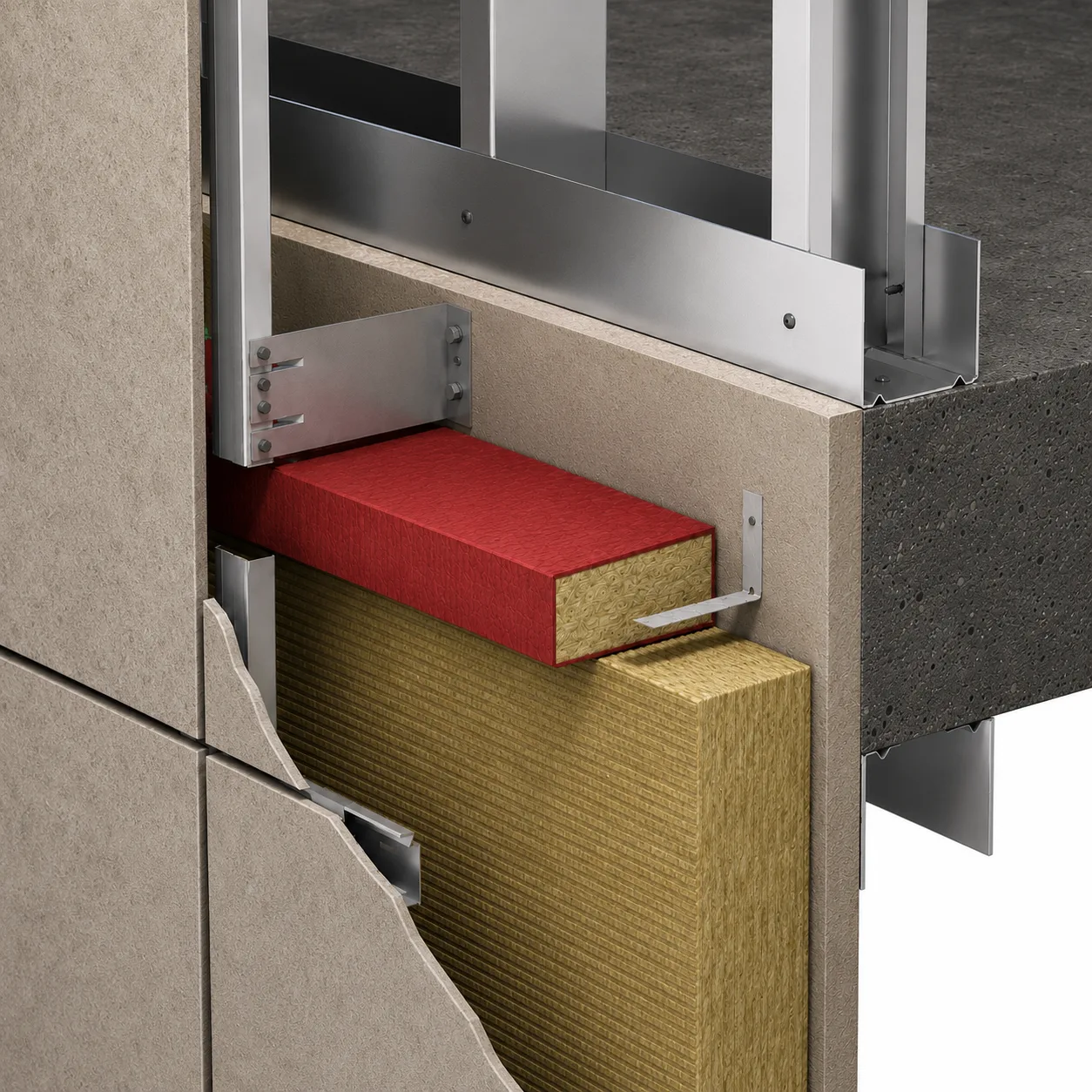
- Cavity barriers may be absent, incorrectly installed, or discontinuous;
- Façade interfaces (e.g. spandrels, window perimeters) may introduce vulnerabilities;
- Materials may have been substituted over time.
The result is that compliance does not necessarily equate to performance.
Risk must be understood in the context of the building as it exists, not as it was intended.

International Context: Complexity Without Consistency
Outside the UK, façade fire safety is often addressed through a combination of regulation, testing, and project-specific fire engineering. While each has a role, few jurisdictions have adopted a structured methodology for assessing risk in existing buildings, particularly where information is incomplete, or systems are complex.
This creates a reliance on professional judgement without a consistent framework for how that judgement should be applied. The result is variability, not only between assessors, but across entire portfolios.
Comparable jurisdictions illustrate this gap. Australia’s response to the Lacrosse (2014) and Neo200 (2019) fires has driven extensive state-led cladding audit and remediation programmes, supported by increasingly structured government-led risk assessment pathways. However, a consistent methodology for retrospective fire risk assessment of existing façades has not been formalised nationally. Singapore continues to rely on prescriptive compliance and system testing for façade design approval, with limited centralised guidance for retrospective fire-safety assessment of in-service buildings.
In each case, the absence of a structured, evidence-led assessment framework limits the ability to consistently understand and benchmark risk.
UAE: Exposure And Operational Reality
The United Arab Emirates provides a clear example of this challenge.
The building stock includes a significant number of high-rise residential towers with complex façade systems combining aluminium composite materials, insulation materials, cavities, and architectural features. Their fire behaviour is determined by how those components interact in service, including detailing, installation, and subsequent alteration, rather than by the performance or classification of any single component in isolation.
A range of evacuation strategies is adopted, including simultaneous evacuation for many residential high-rise buildings. However, operational realities must be considered alongside design intent.
Frequent false alarms can condition occupants not to evacuate as intended, undermining the effectiveness of the evacuation strategy on which the building relies.
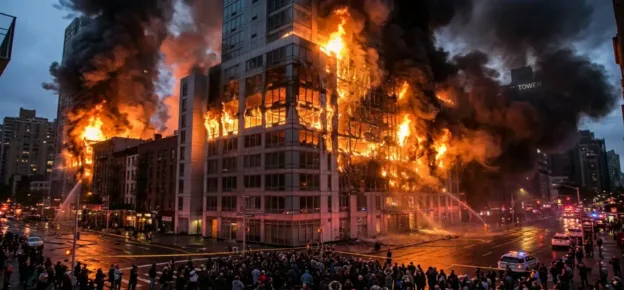
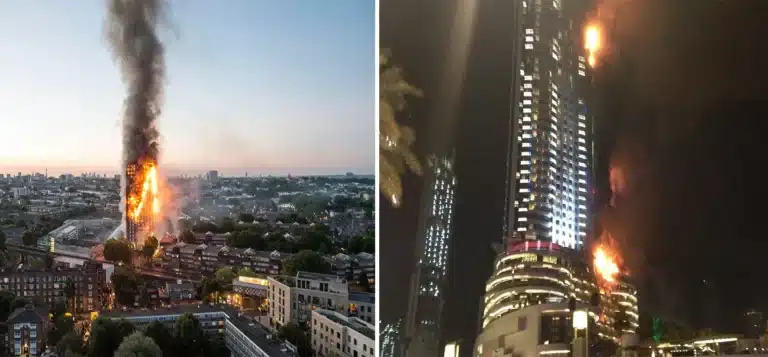
A number of façade fires, including those at Torch Tower (2015 and 2017), Address Downtown (2015), and Sulafa Tower (2016), have demonstrated how rapidly external fire spread can occur where system-level vulnerabilities exist, particularly where combustible façade components interact with deficiencies in cavity barriers, detailing, or compartmentation.
These incidents reinforce that façade fire performance is determined by system behaviour.
It is not defined by material classification or design compliance alone, but by the interaction between:
- System configuration and detailing;
- Quality of installation;
- Subsequent alteration and maintenance;
- Occupancy and evacuation behaviour.
In this context, individual product certification and prescriptive compliance alone are insufficient. Façade fire performance must be assessed at system level.
What Good Looks Like: A Structured Assessment In Practice
A structured, evidence-based assessment changes outcomes. On a recent high-rise residential building with a complex façade system incorporating multiple materials and interfaces, an initial desktop review concluded that extensive remediation was required based on material classification alone.
A subsequent structured assessment, adopting a PAS 9980-style approach, involved:
- Targeted intrusive inspections to confirm cavity barrier presence and continuity;
- Review of as-built and manufacturer information;
- Assessment of façade geometry and fire spread pathways;
- Consideration of occupancy and evacuation strategy.
The outcome differed materially.
Rather than wholesale replacement, the risk was determined to be driven by specific localised defects, including discontinuities in cavity barriers and detailing at slab edges. Remediation was therefore targeted and proportionate, resulting in an order-of-magnitude reduction in the scope of façade intervention compared to the initial recommendation.
The difference was not in professional capability, but in methodology.
Competence: A Critical Variable
Methodology alone is not sufficient without appropriate competence.
Façade fire risk assessment sits at the intersection of:
- Fire engineering;
- Façade design and construction;
- Fire dynamics;
- Building regulations and standards.
PAS 9980:2022 recognises that façade fire risk assessment requires specialist competence. The assessment of external wall systems sits at the intersection of fire engineering, façade design and construction, fire dynamics, and building regulations, and is not interchangeable with general fire risk assessment.
Professional frameworks and competency routes recognise this distinction, including the Institution of Fire Engineers’ Fire Risk Assessors and Auditors Register. However, demonstrable competence in complex façade fire risk assessment is not consistently evidenced across markets.
Few practitioners hold deep expertise across all four domains, while the evidence base, particularly for modified or legacy façade systems, continues to evolve, making continuing professional development essential rather than optional.
Without clearly defined expectations for competence and robust evidential standards, even structured methodologies risk inconsistent application.
Insurance, Lending, And The Role Of Evidence
The impact of façade fire risk assessment extends beyond life safety.
Insurance and lending decisions are increasingly influenced by the quality of evidence supporting risk assessments.
In the UK, the EWS1 process highlighted how the absence of a consistent methodology created uncertainty across portfolios. The introduction of PAS 9980 has begun to address this by providing a framework that lenders and insurers can understand and rely upon.
This principle applies equally in international contexts.
Where assessments are structured, transparent, and evidence-based, they support:
- More consistent underwriting decisions;
- Clearer valuation positions;
- Improved confidence across stakeholders.
Where they are not, uncertainty persists.
In markets without a recognised methodology, valuations can be discounted or qualified pending clarification of façade risk, creating knock-on effects for refinancing, insurance placement, and transaction activity.

Towards A Structured, Evidence-Based Approach
The intention is not to suggest that any single methodology should be adopted universally. Regulatory and construction contexts differ.
However, there are clear principles that underpin effective façade fire risk assessment:
- Defined inputs: clear expectations around inspection, documentation, and testing
- Competence: Demonstrable expertise in façade systems, fire behaviour, and relevant standards
- Transparency: A documented process showing how conclusions have been reached
- Consistency: A framework enabling comparison across buildings
- Auditability: The ability for third parties to interrogate and rely upon the assessment
These principles distinguish assessment from interpretation.
Conclusion
Façade fire risk assessment is entering a period of increased scrutiny.
Stakeholders are no longer satisfied with conclusions alone. They require clarity on the basis of those conclusions, the evidence supporting them, and the reasoning applied.
The UK experience demonstrates that a structured methodology provides a foundation for achieving this. It does not eliminate judgement, but it makes that judgement visible, testable, and comparable.
For jurisdictions with complex façade systems and significant high-rise building stock, the adoption of structured, evidence-based approaches is a necessary step towards consistency and reliability.
The future of façade fire risk assessment will not be defined by what is concluded, but by how those conclusions are reached. The test is whether they can be relied upon.