
Post Date: July 14, 2026 |
Last Edited: July 14, 2026
Key Highlights
|
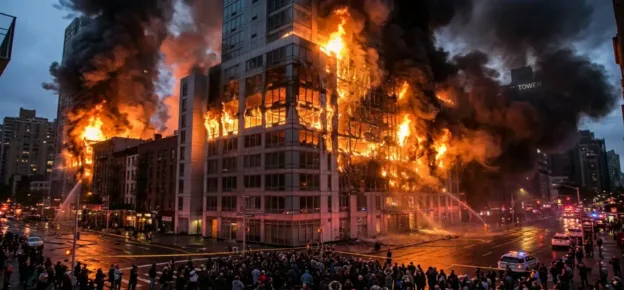
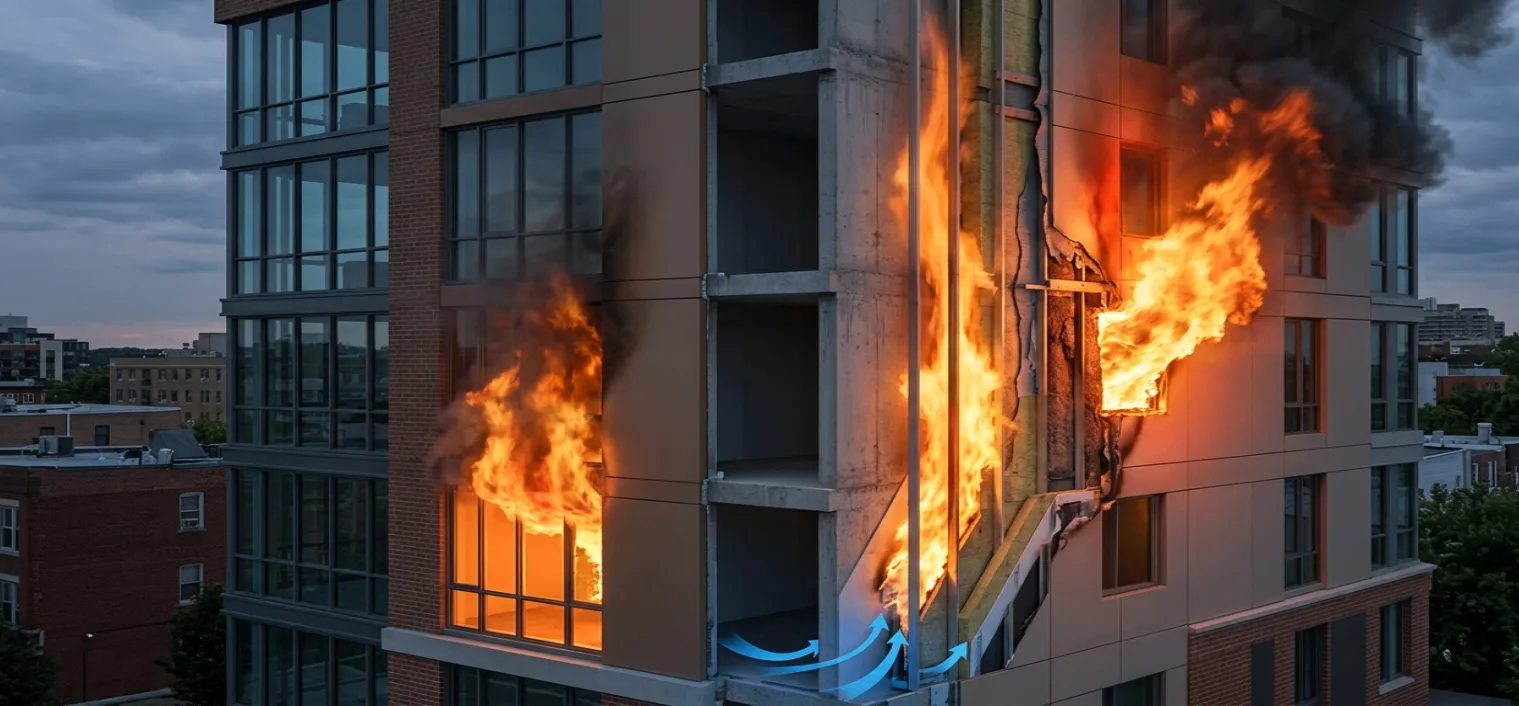
Exterior wall assembly designs have come a long way in terms of their flexibility to meet various architectural and energy requirements. In the late 1970s, the proposed use of foam plastic insulation and other combustible materials in non-load-bearing exterior walls of non-combustible buildings raised concerns about fire spreading over or through these combustible elements. Similarly, we have seen non-ventilated and ventilated façade systems being incorporated into the exterior assembly. One such critical non-elemental feature of the exterior wall assembly is the cavity space within the overall build-up.
Geometrically, a cavity space is a narrow, continuous vertical void between the parallel planes of a building’s inner structural wall and its outer exterior wall. Architecturally, this air gap serves as a protective climate-control zone designed to manage moisture by draining water away from the interior while allowing ventilation to dry out the assembly. However, because this tall, thin volume naturally creates a chimney effect, it poses a significant fire-spread risk if combustible materials line its interior surfaces without adequate fire-stopping.
The availability of technical know-how on the physical properties created within a cavity space of an exterior wall assembly during a fire scenario is very limited. The study of the dynamics created within the cavity space of an exterior wall assembly is something that would add immensely to a better understanding of the overall behaviour of an exterior wall assembly under fire exposure. The dynamics within the cavity space of an exterior wall assembly have a direct impact created by the reaction-to-fire properties of each component used in the build-up of the exterior wall assembly.
Having access to material-level information with regard to heat release rates, critical heat flux, ignition temperature, etc. will definitely add to the analysis of the exterior wall assembly behaviour.
However, the dynamics created by the overall system when these components come together to form an assembly are something that cannot be predicted solely by having material-level information.
For today’s architects and fire safety engineers, switching from elemental material testing to a comprehensive understanding of cavity fire dynamics offers significant advantages. By adopting this comprehensive approach, building safety standards are raised, and the predictive insights required to support creative architectural concepts are provided.
The Physics Of The Void: Fluid And Fire Dynamics Within The Cavity
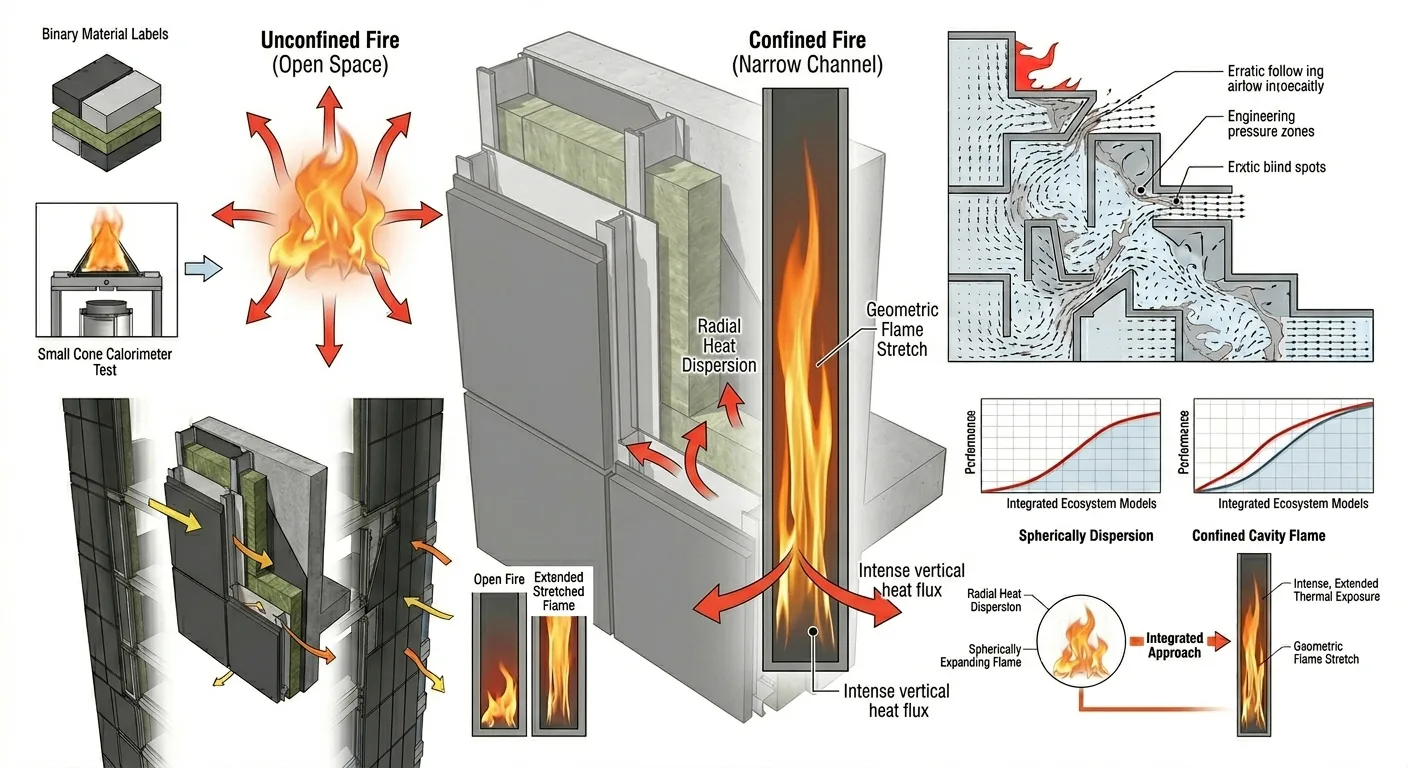
Basic fluid dynamics, thermodynamics, and combustion physics control how fire behaves in an architectural cavity. A flame’s behaviour differs significantly from that of an open fire when it enters a confined vertical channel. Three interrelated physical mechanisms — the chimney effect, air entrainment constraints, and geometric flame stretch — contribute to this occurrence.
The Chimney Effect (Stack Effect)
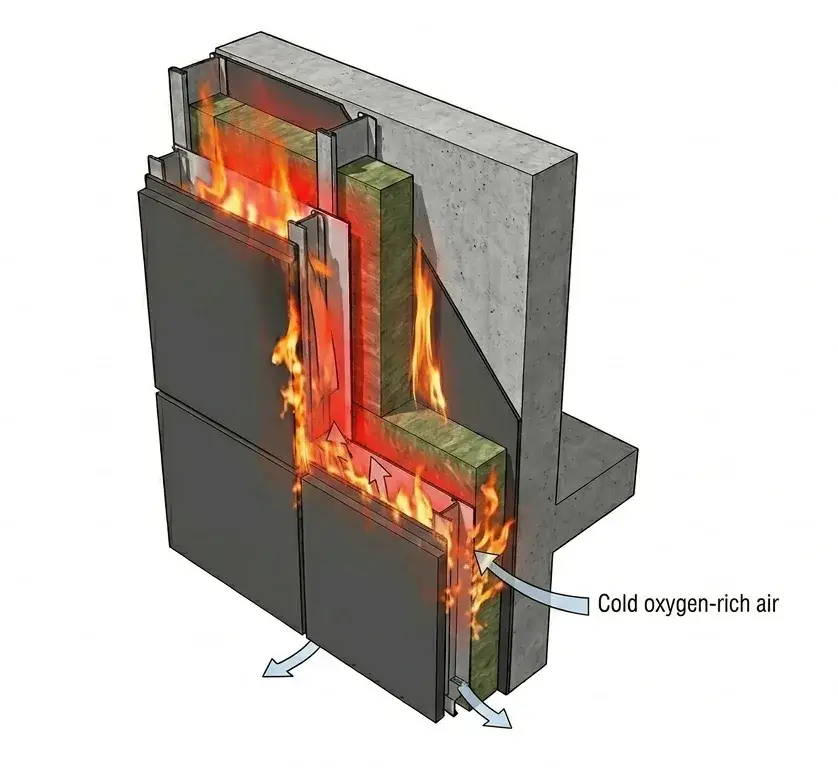
The chimney, or stack, effect is the main factor causing a fire to spread quickly within a wall assembly. This phenomenon depends on the buoyancy of gases, which is determined by the ideal gas law, which states that a fluid’s density decreases with increasing temperature.
The confined air column gets heated when a fire starts inside a small vertical chamber. This heated air rises quickly because it becomes much less dense than the surrounding air outside the container. This heated air column forms a localised low-pressure zone at the cavity’s base as it travels upward. As a natural pump, this pressure differential pushes cold, oxygen-rich outside air firmly into the bottom of the channel. This constant supply of fresh oxygen fuels the combustion zone, resulting in a very hazardous feedback loop that dramatically increases the vertical velocity of flame spread.
Air Entrainment Limitations
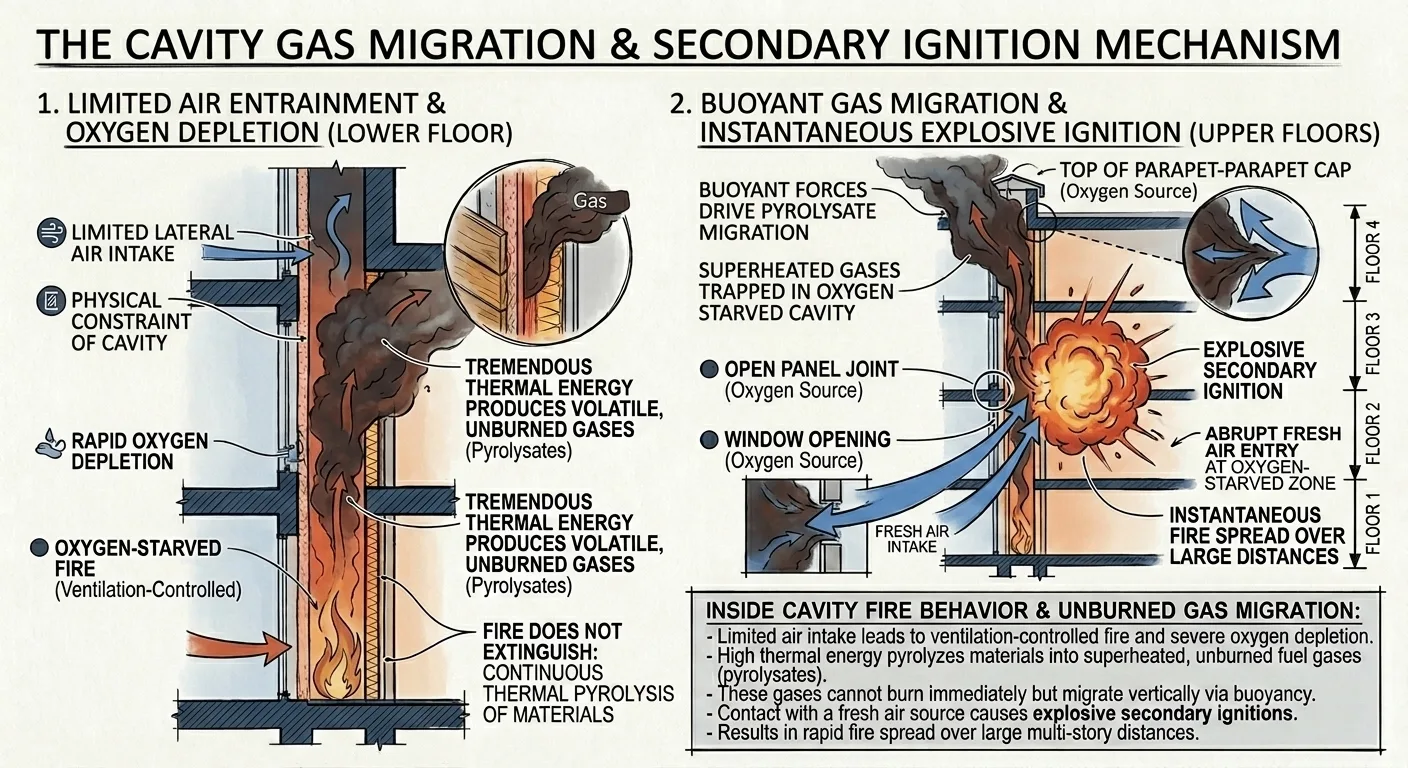
A fire easily entrains surrounding oxygen in outdoor settings in order to sustain a balanced combustion process. However, this lateral air intake is limited by physical constraints inside a confined wall cavity, which causes significant oxygen depletion.
The fire becomes “ventilation-controlled” or choked as the available oxygen is used up. The tremendous thermal energy continues to pyrolyse surrounding materials, converting them into volatile, unburned fuel gases rather than extinguishing them. These extremely combustible, superheated pyrolysate gases cannot burn right away because the cavity is oxygen-starved. They move higher along the vertical channel thanks to buoyant forces.
These unburned gases eventually come into contact with an oxygen source as they move upward, such as the top of the parapet, an open panel joint, or a window opening. Instantaneous, explosive secondary ignitions are caused by the abrupt entry of fresh air, which enables the fire to spread quickly over large distances.
Flame Stretch
A cavity’s geometric constriction makes an otherwise typical flame physically “stretch”. A flame expands radially and spherically in an open space, dispersing volume and heat in all directions.
The solid borders of the inner wall and cladding prevent radial expansion when restricted within a narrow channel. The flame is driven into a vertical, one-dimensional direction in order to emit the same volumetric energy. Higher portions of the wall assembly are directly exposed to constant, intense heat from the extended flame length, quickly preheating and igniting distant objects well ahead of the main fire front.
Material Realities And The External Interface
Relying solely on binary “combustible or non-combustible” performance parameters when assessing a wall assembly’s fire safety fails to account for the real behaviour of materials under stress. Certain thermodynamic measurements, strong localised radiant feedback loops, and fluid-structure interactions that take place on the building’s facade, as well as inside the cavity, control the actual risk.
The HRR Matrix
We must examine the Peak Heat Release Rate and the Total Heat Release in order to evaluate fire propagation effectively. Minor components are frequently disregarded, while major components such as cladding or insulation receive the greatest regulatory attention.
Cone calorimeter bench-scale experiments and other conventional open-air testing methods underestimate how materials deteriorate in a real-world fire. Radiant energy disperses into the surroundings in an open space. The cavity space serves as a high-efficiency radiant oven inside a narrow wall assembly. The radiant heat that is released when a weather barrier or combustible core ignites cannot escape; instead, it strikes the rear of the external cladding panel and reflects back into the cavity. The internal components are exposed to an excessive heat flux due to this focused, intense thermal radiation. The materials’ Mass Loss Rate is accelerated by this process, resulting in pyrolysis, melting, and off-gassing at rates exponentially quicker than those seen in isolated laboratory material-level testing.
This risk is made worse by the geometric arrangement of thin materials inside the cavity space. Materials with a very high surface-area-to-mass ratio include weatherproofing membranes. They are comparatively unable to absorb or sink heat due to their low thermal mass. Their surface temperature rises immediately to the ignition point when they come into contact with a flame front. As a result, even a membrane that is only a few millimetres thick can function as a high-Velocity fuse, quickly igniting stronger nearby materials and spreading flame throughout the cavity’s internal volume.
The External Interface: Concurrent Flame Patterns And Radiation [The External Plume Interaction]
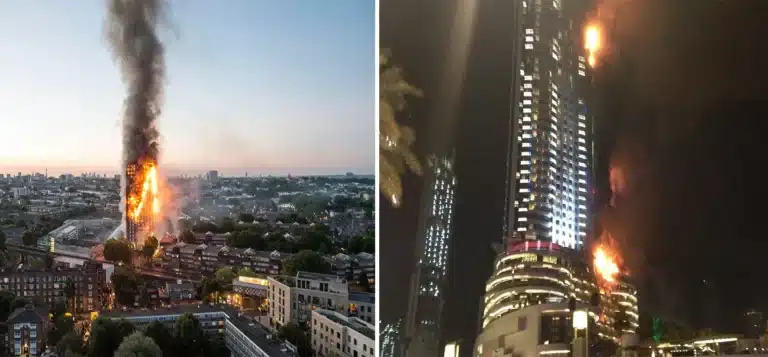
Eventually, when the fire inside the cavity grows stronger, it breaks through the external cladding or leaks out through architectural discontinuities such as window openings. The developing flame plume leapfrogs onto the building’s exterior façade rather than extending outward perpendicularly into the open air. This produces an immediate flame pattern in which the destructive thermal core of the fire remains continuously in direct contact with the exterior of the building due to the vertical velocity of the rising plume.
This interaction with the exterior Plume initiates a destructive “twin-front” attack on the building. Strong thermal energy is radiated backwards by the external flame as it embraces the exterior façade, penetrating the cladding panels higher up the structure.
At the same time, the internal fire keeps rising quickly through the cavity’s chimney effect. The materials inside the wall assembly are trapped in a thermal assault: the radiant heat flux of the exterior plume attacks them from the outside in, while the internal cavity fire violently attacks and preheats them from the inside out. The architectural envelope fails catastrophically across multiple storeys as a result of this dual-front damage, quickly overwhelming fire-barrier devices.
Architectural Complexity: When Geometry Challenges Engineering
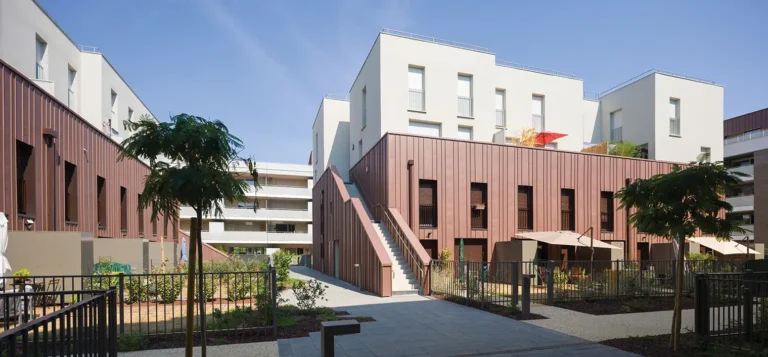
Modern building envelopes are rarely flat. The thermodynamics of fire behaviour are drastically changed by architectural elements intended for aesthetics or energy efficiency, such as recessed windows, geometric projections, and intricate façades.
Corners And Re-Entrant Angles
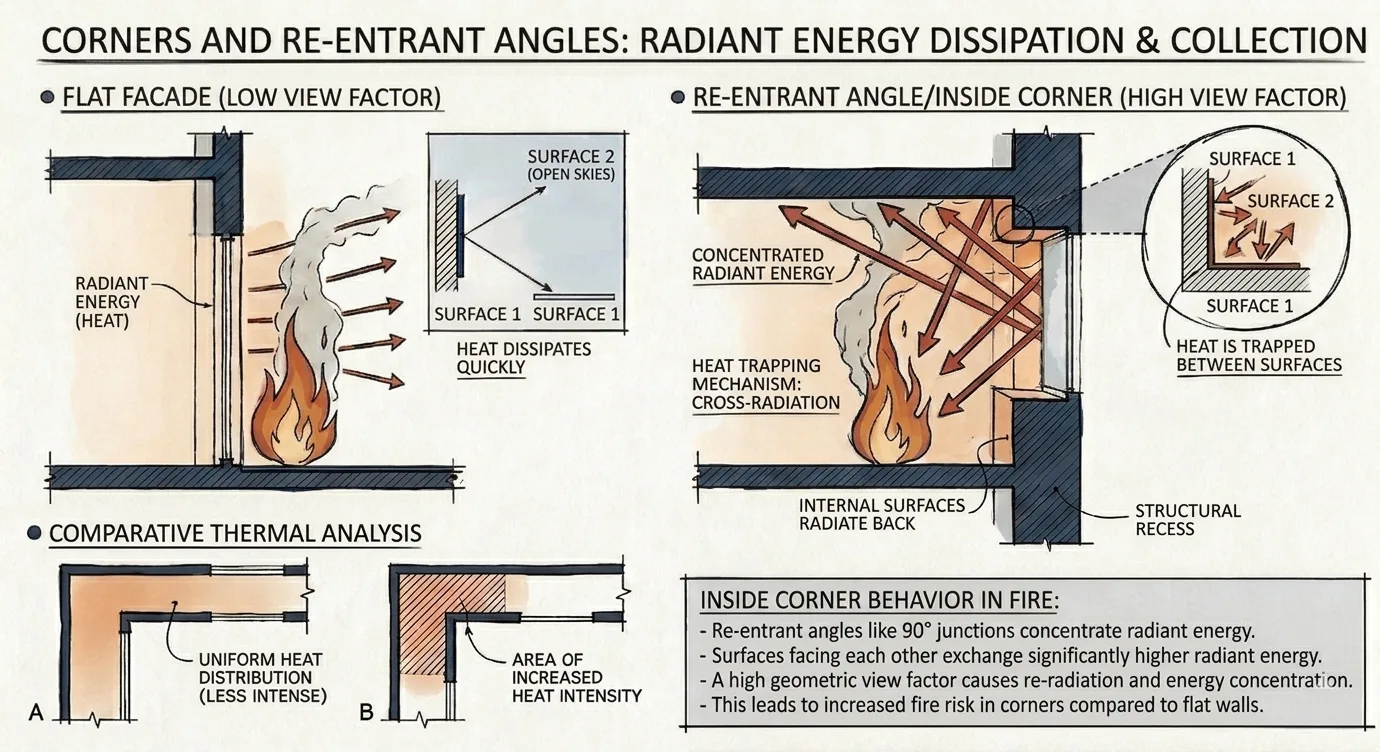
Deep window reveals, structural recesses, and 90° building junctions are examples of inside corners that function as extremely effective thermal traps. The geometric relationship between two adjacent surfaces determines how much radiant energy they exchange in a fire scenario; this is known as the view factor in thermodynamics.
A burning material emits a significant amount of its heat outward into the open atmosphere on a flat façade, where it dissipates harmlessly. However, the view factor significantly increases inside an inward-facing re-entrant angle. The blazing façade essentially “shines” its radiant heat back onto the opposite surface because the two intersecting walls face each other directly. Heat dissipation is inhibited by this localised concentration of reflected energy, which causes surface temperatures to rise quickly and the localised Heat Release Rate to increase exponentially. An intense, self-sustaining thermal hotspot can develop rapidly from a small ignition source.
Soffits, Overhangs, And Projections
An external fire plume’s natural upward trajectory is disturbed by horizontal architectural projections such as sunshades, balconies, roof overhangs, and deep decorative fins. These horizontal obstacles are encountered by a flame as it ascends vertically along a façade.
The plume is forced to spread horizontally beneath the barrier rather than continuing upward. This pocket creates a high-temperature zone on the underside of the overhang by trapping the rising thermal energy. The trapped, horizontally moving flames are propelled straight back into the interior of the structure or into the façade cavity at an upper level if the projection is situated directly beneath a window reveal or an architectural joint.
Discontinuous Cavities
Stepped façades, sloping forms, and uneven geometric transitions are common elements of contemporary, non-linear architecture. These designs produce internal cavities that are irregular in volume, depth, and direction.
The steady, consistent air currents present in straight vertical channels are disrupted by this geometric disorder. Instead, it produces highly unpredictable and turbulent airflow patterns inside the wall assembly. These unpredictable pressure differences can propel flames into unanticipated areas of the building shell or push them horizontally when a fire enters a discontinuous cavity. Because the fluctuating geometry produces blind areas where conventional barriers cannot effectively confine or firmly seal the flame front, engineering effective fire-stopping in these conditions becomes extremely challenging and important.
Systemic Thinking For Future Skins
Façade fire safety cannot be solved by a spreadsheet of isolated component performance data. The chaotic reality of how materials interact within a live system is ignored when materials are treated as independent variables. A shift from binary material labelling to comprehensive, full-scale assembly testing that acknowledges the significant influence of architectural geometry is necessary for true compliance.
An integrated approach consisting of computational fluid dynamics (CFD) modelling, complete wall assembly fire compliance testing, and material-level performance data can be used by engineers to model how intricate features such as overhangs, cavities, and corners affect airflow and increase radiant heat feedback. To reliably forecast fire behaviour and design durable building skins, we must assess materials and physical geometry as a single, interconnected ecosystem.