



A few years ago, a premium high-rise project in Mumbai required an acoustic assessment. The developer had done what was believed to be the right thing. Every apartment had double-glazed sliding windows. On paper, this was a solid acoustic specification. However, in an effort to tighten the bottom line, aluminium profiles were extruded in-house and the windows fabricated internally. The assumption was simple: acoustics is all about the glass.

It was not. Residents were complaining about the traffic noise that had no business being inside a premium apartment. On-site assessment, the profiles showed poor sealing details, the meeting rails leaked sound, and the overall system performed well below what the glazing alone should have delivered. The glass was fine. Everything around it had failed. Full replacement had to be recommended. As expected, that conversation did not go well.
This story captures something observed repeatedly across two decades of acoustics consulting in India. The industry has become reasonably aware that glass matters for sound insulation. Architects specify Rw values, and developers market double glazing as a feature. Yet noise often enters through everything else: the weak points that nobody discusses, details, or checks on site.
The Glazing Tunnel Vision
When most design teams think about façade acoustics, they think about glass. That is a reasonable starting point. However, focusing on glass alone creates a dangerous blind spot. A façade is a system. It is only as good as its weakest acoustic element. The best double-glazed unit money can buy may be specified, but if sound leaks through profile joints, the AC opening, or the adjacent ventilation duct, the glazing specification becomes meaningless.
In international practice, this is well understood. Façade acoustic consultants assess the entire envelope as an integrated system. In India, the industry is still catching up. The acoustic conversation often begins and ends with the glass supplier’s data sheet.

The Usual Suspects
So where does the noise actually get in? After hundreds of site assessments across residential, commercial, and hospitality projects, the same culprits appear repeatedly.
Sliding Window Meeting Rails And Seals
Sliding windows are common in Indian residential construction. They are practical, space-efficient, and affordable. However, they come with an inherent acoustic weakness: the meeting rail. Where the two sashes overlap, there is a joint that relies entirely on the quality of the weatherstrip and the compression of the interlock. In practice, particularly with cost-driven fabrication, these seals are often inadequate, worn out within a couple of years, or simply missing. The meeting rail becomes a continuous line of sound leakage running the full width of the window. On a quiet night, the difference can sometimes be heard simply by running a hand along the joint and feeling the air movement.
AC Sleeve Openings
India runs on split air conditioning. Every bedroom, living room, and hotel room typically has a wall-mounted indoor unit, which means each room has a hole through the façade for the refrigerant piping and drain line. In a well-detailed project, this penetration is sleeved, sealed with acoustic-grade sealant, and properly finished on both sides. In reality, openings are often packed with newspaper, loosely filled with polyurethane foam, or left with visible daylight around the pipes. Each of these becomes an open acoustic path from the street straight into the room. On a busy road, even a 50 mm unsealed gap around an AC pipe can undermine everything the glazing is intended to achieve.
Ventilation And Exhaust Ducts
Bathrooms and kitchens require exhaust ventilation, and in most Indian residential buildings, this is achieved through small ducts or façade openings. These are rarely treated acoustically. A typical bathroom exhaust duct is essentially a tube connecting the interior of the apartment to the outside air, with a small fan in between. Sound travels through it with very little resistance. In buildings near highways or metro lines, measurements have shown cases where the bathroom was the noisiest room in the apartment, not because of the window, but because of the exhaust duct.
Balcony Doors And Thresholds
Balcony sliding doors are usually the largest openable element in the façade and deserve the same acoustic attention as windows. They rarely receive it. The threshold detail is particularly problematic. Floor-level tracks for sliding doors are designed for smooth operation and water drainage, not for acoustic sealing. The gap at the bottom of a closed balcony door can be several millimetres, running the full width of the opening. Combined with the meeting rail issue (as most balcony doors are also sliding), this creates a large, acoustically compromised element in the centre of the living room façade.
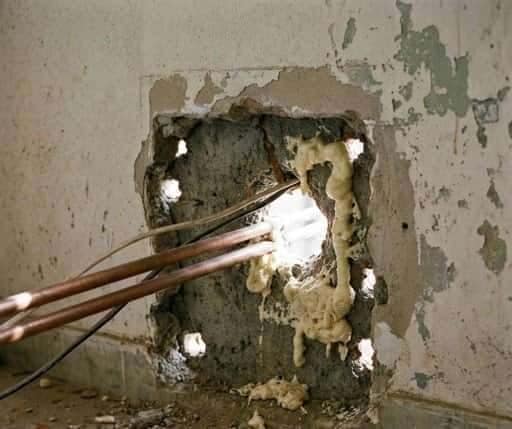
Electrical And Plumbing Penetrations
Every façade has penetrations for services: electrical conduits, plumbing stacks, fire system piping, and others. Each is a potential flanking path. The issue is not their existence, but that they are rarely sealed acoustically. On most Indian sites, the gap between the pipe and the wall is filled with whatever is convenient during construction: cement mortar if fortunate, expanding foam if not. Neither is an acoustic solution. The penetration must be sealed with a material that is both airtight and flexible enough to accommodate building movement.
Floor Slab To Façade Junction
In curtain wall and aluminium façade systems, the junction between the floor slab edge and the façade framing is a known weak point internationally. Sound can travel vertically from one floor to the next through this gap. In Indian construction, the firestop zone at this junction is often treated purely as a fire safety requirement, using mineral wool and intumescent sealant. While these materials offer some acoustic benefit, they are not optimised for sound insulation, and installation quality on site is inconsistent. Firestop installations are frequently seen with visible gaps, uneven compression, or missing entirely in certain bays.
The Indian Context
Several factors make these issues more acute in India than in many other markets. The culture of natural ventilation means operable windows and balcony doors are not optional; they are essential. This results in more joints, more seals, more moving parts, and therefore more acoustic weak points compared to a fully sealed façade. The near-universal use of split AC systems means every room has a façade penetration that does not exist in markets where centralised HVAC is standard. Cost pressures in Indian construction, particularly in the large residential sector, mean that detailing and workmanship at these critical junctions are often the first casualties when budgets are reduced.

The National Building Code (NBC 2016) does address sound insulation requirements, but enforcement and site-level compliance remain inconsistent. There is no widespread culture of acoustic site inspections during construction, meaning even well-specified details can fail in execution.
Getting It Right Early
The solution is not complicated, but it requires a shift in thinking. Façade acoustics is not a glass specification exercise. It is a whole-system design issue that requires attention from the early stages of a project.
An acoustic consultant involved during design development can identify these weak points before they are built in. A simple façade audit checklist that goes beyond glazing performance to cover seals, penetrations, junctions, and ventilation paths can prevent the kind of expensive failures described at the start of this article. Critically, these details must be checked on site during construction, not just on drawings.
The principle is straightforward: a façade is only as quiet as its weakest element. Get the glass right, certainly. But do not overlook everything beyond it.