
WFM: Are you doing any projects in India?
Jürgen Mayer H. (JMH): We are doing a project in India in collaboration with Mumbai-based architectural firm – Collaborative Architecture, headed by Architects Mujib Ahmed and Laita Tharani. We shall reveal the details of the project later. Intense discussions are going on for the finalisation of this Indian project. I have travelled to India 5 times and have seen many projects here. My trips were always very interesting and exciting, and I look forward to working here in India.
WFM: Could you please tell me about your ongoing projects?
Jürgen Mayer H. (JMH): We do projects from very small-scale ventures to large-scale projects. Large-scale projects include high-rise buildings, especially those done in Germany. All these projects have a relationship with the skyline, their elevation and the urban fabric around them, and they activate downtown parts. All these projects are very innovative and interesting. It will ensure an advantage to our clients in giving them something very different. At the same time, we want our projects to be economically successful too.
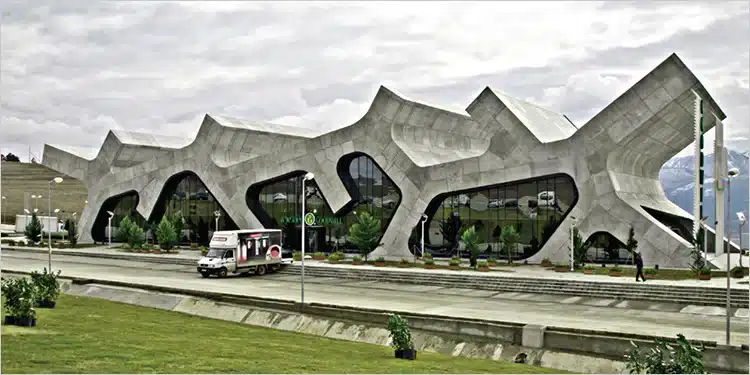
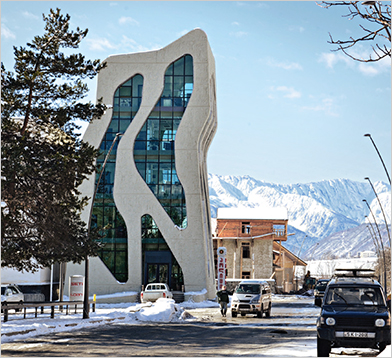
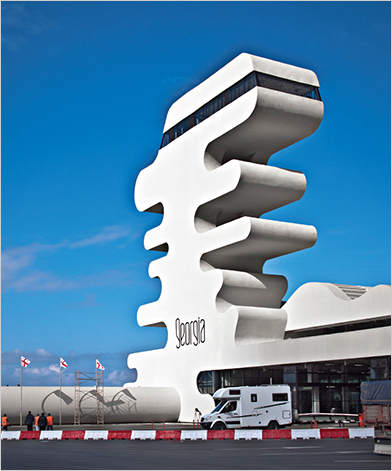
I am working on an infrastructure project in Georgia, also doing two highway rest stop projects coming up. It is important to show that infrastructure projects are very much a part of Architecture.
We are doing residential projects – a villa in Georgia and another one in Russia, on the outskirts of Moscow. We are doing a few artistic projects too. For example, a facade project in Miami, in the design district. This is a concept for the facade of a parking garage. It is a highly developed project. It is 16 floors. It has commercial space in the ground floor and four to 5 floors of parking above. The visual concept for the garage was called a Collage Garage. It is a large-scale high-rise project which is breaking it down in terms of, let’s say, ‘‘architectural voices’’. It gives a different kind of scale to the urban context. It is a very unique organic facade with super graphic art. It certainly pays to the urban surroundings, which is otherwise mundane and give a sculpture quality to that part of town. Moreover, this freestanding building is being built near two museums.
WFM: By now, you might have visited a few cities in India. How can you compare the design of building facades in India to those in other countries?
Jürgen Mayer H. (JMH): The facades for high-rises in India are like everywhere else. I do not see any specific language. The relation or the link between the innovative part of building typology and the culture and tradition of this country is missing in them, though many projects are well designed. I think there is a lot of potential to push a little more to create something that is more related to urban development or the urban fabric. It may be easier to make facades with glass. But there is a lot of potential to think beyond that, even if it is a high-rise.
WFM: One can find extensive use of glass in facades in India, too. Do you agree with it?
Jürgen Mayer H. (JMH): This trend is found not only in India, but this phenomenon is also seen everywhere, whether it is Iran, Dubai or Far East countries. There are different technologies that are applied to glass facades. It is not just about the material. Glass has different reflections, R values, coatings, surface qualities, thickness, etc. There are Green layered glass available for construction. They have super-insulating qualities and are used in many buildings in Germany. We use thinner or thicker glass based on the surroundings and weather at the location. The intensity of the sun would be much higher in Saudi Arabia than in Frankfurt. So the type of glass used varies.
There are double skin facades and triple skin facades for a better internal environment. We like double skin facades because of it creates a different kind of fineness from outside and push the thermal qualities more towards inside. It has more substance, more than an element that separates inside from outside.
A facade is not just a sheet of glass separating the inside from the outside. It is a whole space that negotiates the conditions inside the building. It could even generate energy in future. Or in some cases, it needs to be explored more for more uses than just as a building element separating inside from outside.
WFM: Talking about materials for buildings, how do you choose them for your projects?
JMH: We develop a concept for the building and find the right material that supports the atmosphere. For example, one of our projects, an 18-storey, smaller high-rise project, has timber on its facade! This is quite unique considering the height of the building. We design facades and decide on material looking at nuances like fire and security. Many of the facades are built with exposed concrete or glass. We are quite open to all kinds of materials, and we explore them. The important aspect is that the material should support the design of the project.
WFM: What are the key factors you consider when you design a facade for a building?
JMH: Facade design is not the starting point. The starting point is to think about the programme, to think about the economic reference of the project, the context, and see what is specific to the context, etc., and from all these we conclude on the look of the project or the facade design. We go step by step.
Of course, the first thing we see of a building and hence a lot of emphasis is given on the design of the facade.
WFM: The public space – Metropol Parasol – you created was very interesting. How did you arrive at that design?
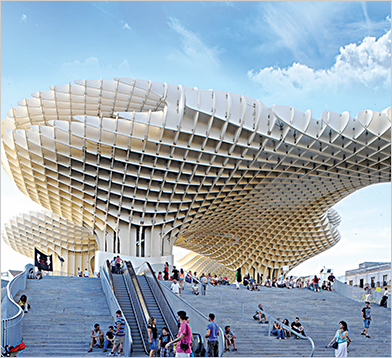
JMH: The shedder was the main element of design, and it was built in a very hot area and in an open area. We have created a roof with different geometries in order to make it look relaxed in the urban context. The project “Metropol Parasol” – a redevelopment project at Seville in Spain has become a new icon for the place. Since the place is of archaeological importance, we had to place the foundations at very specific places.
WFM: When you go for a glass facade, we have to look at certain quality control aspects like the thermal insulation, acoustics, etc. Could you please explain this?
Jürgen Mayer H. (JMH): One project where we have used a lot of different forms of glass for the facade is the shopping mall project at Berlin named Volt. We have used stained glass or coloured glass that has a print on it. This makes the glass opaque, providing protection from inside and privacy from outside without having a blind on it to cover. We had set a few areas which need to be more colourful, and again transparent at night, but during the day, it would provide enough protection from sunlight. We worked on different levels of transparency, heat protection and insulation, and the colour quality of glass.‘
WFM: Please tell us about the thermal insulation and acoustics of your projects.
Jürgen Mayer H. (JMH): In our projects, acoustics are usually handled by sealing and wall panels. We may add a perforated layer in front of the facade, which will reduce the noise penetration. In terms of insulation, we do not need separate insulation since the glass used itself is quite thick (about 8cm thick). This is one of the latest technologies in glass.
WFM: Could you talk about some of the technologies you have used that can be adopted in India?
Jürgen Mayer H. (JMH): I think the timber technology in construction used in a few of my projects could be used in India too. The same method can be followed in India. The lamination and coating used on timber give it all-weather protection. Hence, it is a very good idea to go for such construction technologies.
WFM: Talking about fenestration, in India, we culturally go for open windows. What is your view on these kinds of designs?
Jürgen Mayer H. (JMH): It is very right. There are some parts in this world where the climate is extreme and where we cannot have open
doors and windows, but for saving electricity or energy, countries like India should design fenestrations intelligently in order to have maximum comfort inside and, at the same time, save resources. Fenestration should provide a more flexible indoor-outdoor relationship. The facades should not cut off exteriors from interiors, but rather provide an extension of space. Good insulation and close circulation systems with fresh air would be very suitable for the Indian climate.
WFM: What advice do you have for the young architects in India?
Jürgen Mayer H. (JMH): Indian architects should work in collaboration with architects from abroad to learn more on technology. We learned a lot in Germany, inviting a number of international architects, especially in Berlin, after the reunification. The transformation was great. Learning from technologies applied in other countries and transferring it here in India would improve the quality of architecture.
India has a great history and fantastic monuments. The architectural culture from history is not reflected in contemporary architecture. There are fantastic contemporary architects in India, and they should go for more projects like mass housing, with the help of expert architects from abroad. Such collaborations will help greatly.