

As India’s cities grow and climate challenges intensify, building envelopes must do more than enclose space — they must conserve energy, harness daylight, regulate thermal comfort, and reflect identity. The building façade today is a critical design interface where architecture meets engineering, and aesthetics merge with performance.
Across typologies, from commercial towers to healthcare facilities, façade design has emerged as a primary driver of operational energy efficiency. With evolving codes like ECBC 2017 and an increasing focus on net-zero targets, projects that respond to their environmental context using passive and integrated envelope strategies are setting the benchmark for responsible design.
One such example is the upcoming project, SAHI Healthcare Building in Vizag — a modern institutional facility designed, which not only redefines façade expression through vertical fins and glazing strategies but also records measurable energy performance, achieving a 36.78% energy saving and securing Super ECBC (6-Star) compliance.
The Sahi Façade: Passive Principles In Action
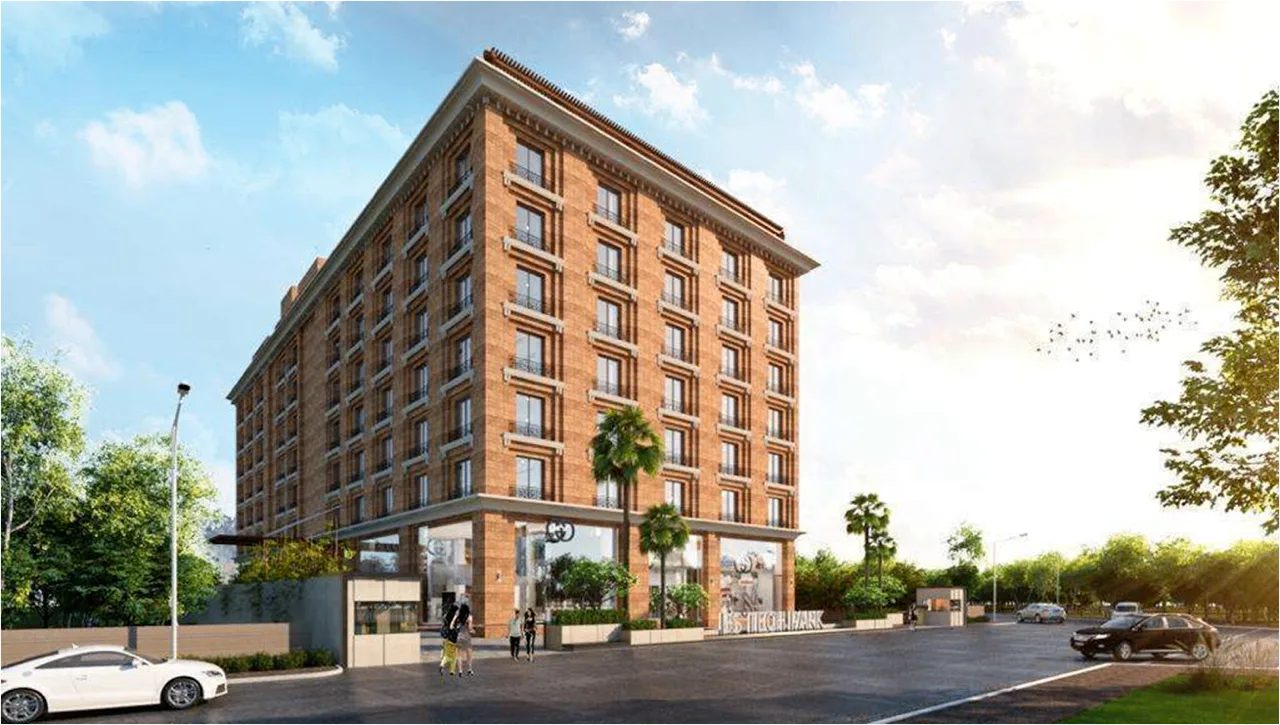
SAHI is a ground-plus-three-floor hospital located in a warm-humid climatic zone. The building’s design champions an integrated architectural-engineering approach with a layered envelope system that is both visually compelling and functionally optimised.
Key Façade Strategies
- Vertical Fins: Reinforced AAC fins provide continuous solar shading, reducing glare and heat gain while creating visual rhythm.
- High-Performance Glazing: 13 mm double-glazed units with an SHGC of 0.27 and a U-value of 2.2 W/m2K allow ample daylight while minimising thermal ingress.
- Layered Wall Assembly: AAC block layers with 120 mm of glass wool insulation achieve a wall U-value of 0.18 W/m2K.
- Cool Roof Design: Roof sections feature high-reflectivity finishes and 150 mm insulation, resulting in a U-value of 0.20 W/m2K.
- Optimised WWR (Window-to-Wall Ratio): Though the design embraces a bold WWR of 75.7%, passive controls and performance glazing maintain compliance.
Together, these strategies ensure the building envelope is airtight, thermally efficient, and visually transparent where needed — all while significantly reducing the building’s energy demand.
The following charts and data, drawn from the official ECBC compliance report for the SAHI project, reveal compelling insights into its superior façade and energy performance:
Performance Validation Through Simulation
The project followed the Whole Building Performance method under ECBC 2017, using Design Builder simulation software to compare the proposed design against a baseline ECBC-compliant model.
Key Simulation Results
These figures not only confirm performance compliance but also reflect deep integration of passive design, efficient HVAC (COP ≥ 4.7), smart lighting, and renewables.
Lighting, Daylighting, And Controls
- Lighting Power Density (LPD): Reduced from the ECBC baseline of 9.7 W/m2 to just 2.2 W/m2 using energy-efficient LED fixtures.
- Daylight Compliance: Achieved 61.4% Useful Daylight Illuminance (UDI) across the building — doubling the ECBC requirement (30%).
Controls Installed:
- Occupancy sensors and daylight dimmers.
- Automated shut-off based on schedules.
- Manual overrides in individual spaces.
These measures ensure maximum use of natural light while keeping artificial lighting loads to a minimum.

Façade As Symbol And System
Beyond compliance, the SAHI façade expresses the mission of a progressive healthcare institution. The verticality of the fins suggests upward growth and care. The transparent glazing invites openness and community. The integration of form and performance demonstrates leadership in climate-sensitive architecture.
This façade breathes and responds not just to the sun and wind, but to the social context it serves. It becomes a symbol of architecture that heals — in both form and function.
Conclusion
Building for a Resilient Tomorrow, this article explores the critical role of intelligent façade design in enhancing building performance, energy efficiency, and sustainability in India’s evolving urban landscape. Using the SAHI Healthcare Building in Vizag as a case study, it demonstrates how passive strategies – such as vertical fins, high-performance glazing, and thermal insulation – combined with ECBC compliance and simulation-based design, can deliver measurable energy savings and architectural impact.
The future lies not just in how buildings look but in how they perform, adapt, and endure.
Quick Facts:
|