
Post Date: September 7, 2026 |
Last Edited: September 7, 2026
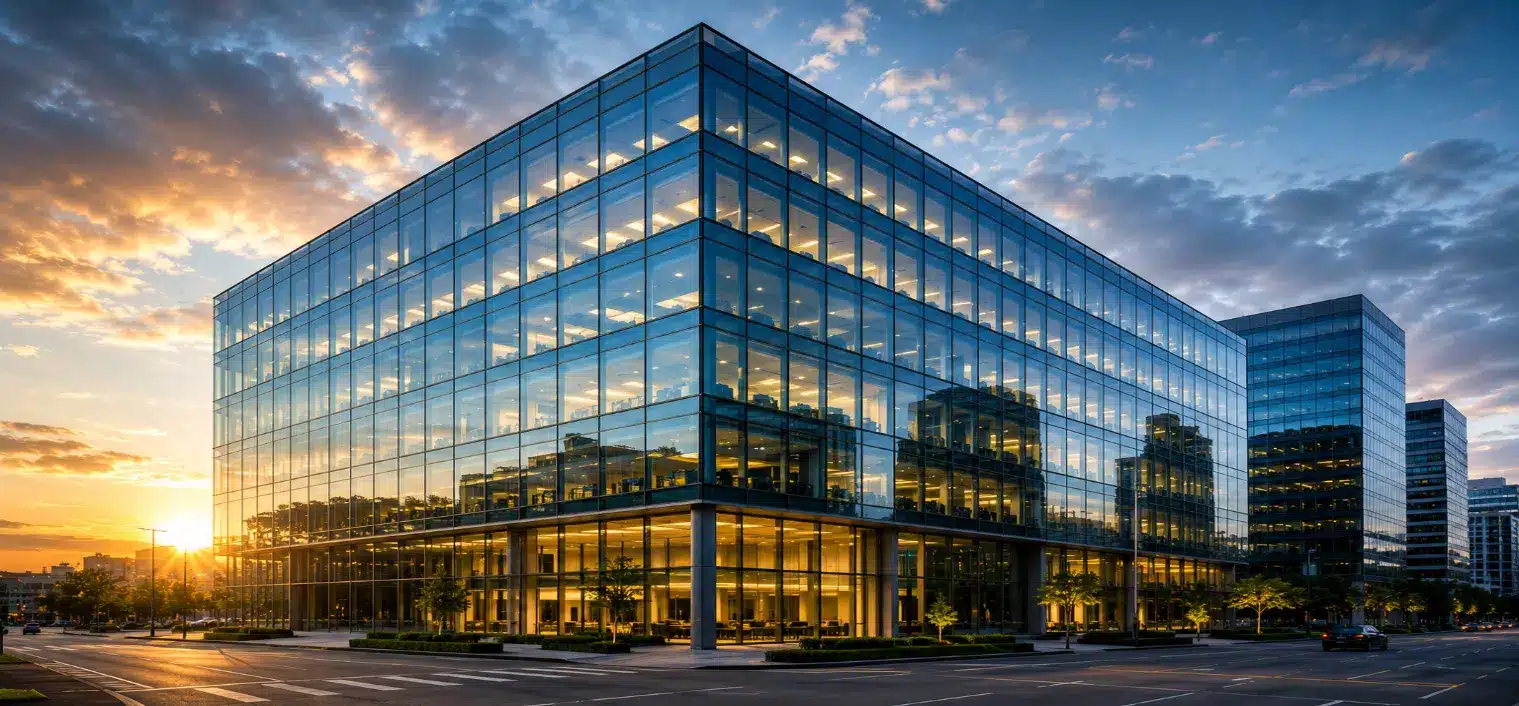
Why The Right Glazing Strategy Defines Building Performance
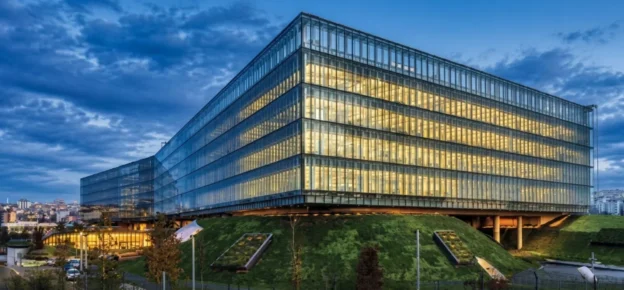
As India’s skylines become increasingly glass-dominated, glazing selection has evolved from an architectural choice into a critical performance decision influencing energy efficiency, occupant comfort, and long-term sustainability.
Key Highlights
|
The Most Expensive Façade Mistake Is Often Invisible
A building can feature an iconic façade, advanced HVAC systems, premium construction materials, and world-class architecture, yet still struggle with excessive heat, rising energy bills, and uncomfortable indoor spaces. Surprisingly, the cause is often not the HVAC system, the façade structure, or the building design itself. It is the glass.
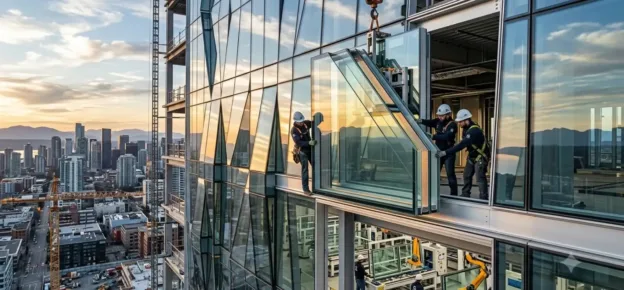
In today’s construction industry, glazing is no longer merely a transparent material that allows daylight into a building. It has evolved into a high-performance component that directly influences energy consumption, thermal comfort, acoustic quality, occupant well-being, and long-term operating costs.
As India’s skylines become increasingly glass-dominated, one question is becoming more important than ever: Is the glass helping the building perform-or making it work harder?
What appears identical from the outside can behave dramatically differently in terms of solar control, insulation, daylight transmission, safety, and energy efficiency.
In an era of rising energy costs and sustainability-driven design, selecting the right glass is no longer an architectural preference. It is a performance decision.
“The difference between an energy-efficient building and an energy-intensive building often lies in a few millimetres of glass.”
From Aesthetics To Performance: The Industry Shift
For many years, glazing decisions were primarily influenced by appearance and cost per square foot. Developers focused on achieving a particular architectural expression, while performance considerations were often addressed later in the design process. Today, that approach is changing.
Rising energy costs, stricter building codes, green building certifications, and growing awareness of occupant well-being are pushing project teams to evaluate glazing through a performance lens.
Architects and façade consultants are increasingly focusing on measurable parameters such as SHGC, U-Value, Visible Light Transmission (VLT), acoustic performance, and lifecycle energy savings. Today, performance is becoming as important as appearance.
Why Glass Matters More Than Ever
Glass is one of the few building materials capable of simultaneously influencing daylight, thermal comfort, energy consumption, acoustics, safety, and visual appeal.
In India’s predominantly warm climate, uncontrolled solar heat gain through glazing can significantly increase cooling loads and operational costs. As buildings incorporate larger glazed areas, the impact of glass selection becomes even more pronounced.
A well-designed glazing system can improve occupant comfort while reducing HVAC demand and long-term operating expenses.
When Safety And Comfort Must Work Together
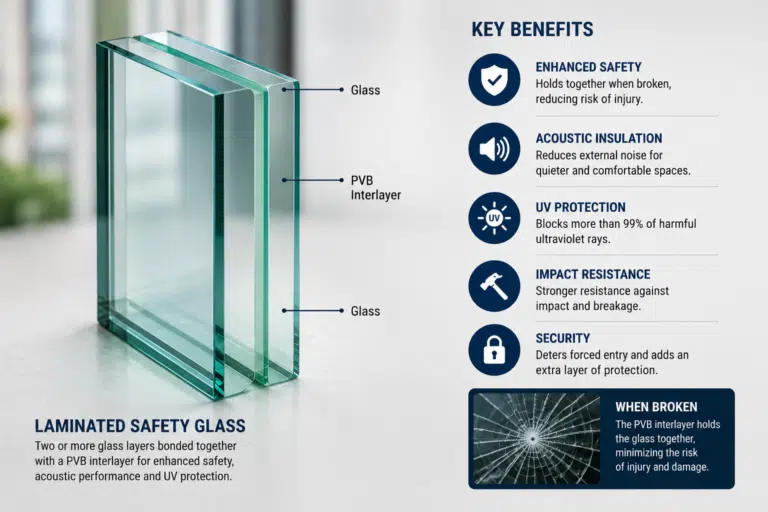
Laminated glass remains one of the most versatile glazing solutions available today.
Manufactured by bonding two or more glass panes using an interlayer such as PVB or SentryGlas®, laminated glass remains largely intact when broken, reducing injury risk and improving security.
Key Benefits Of Laminated Glass:
- Enhanced occupant safety
- Superior acoustic insulation
- UV protection exceeding 99%
- Improved impact resistance
- Better security performance
For hospitals, educational institutions, airports, hotels, and premium residences, laminated glass often provides the ideal balance between safety and comfort.
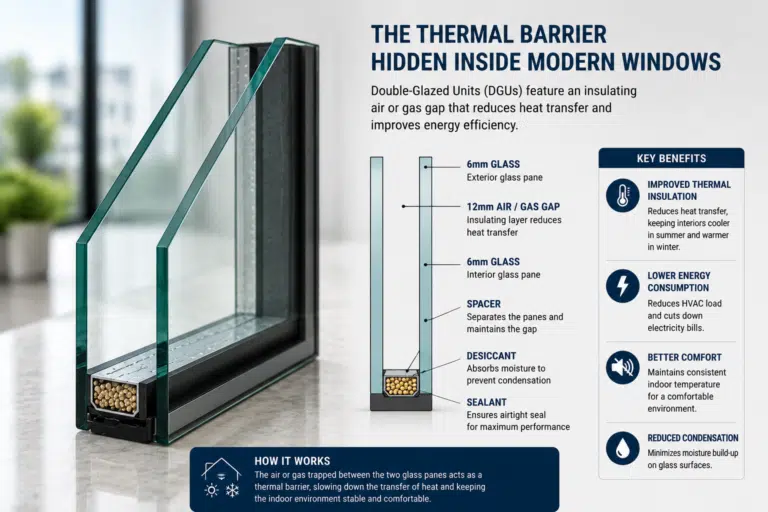
The Thermal Barrier Hidden Inside Modern Windows
Double-Glazed Units (DGUs) have become one of the most effective solutions for improving thermal efficiency.
A typical DGU consists of:
6 mm Glass + 12 mm Air Gap + 6 mm Glass
The insulating cavity acts as a thermal barrier, reducing heat transfer between indoor and outdoor environments.
Benefits of DGU Systems:
- Improved thermal insulation
- Reduced HVAC loads
- Better occupant comfort
- Lower energy consumption
- Reduced condensation risk
DGUs are increasingly becoming a standard specification in modern buildings.
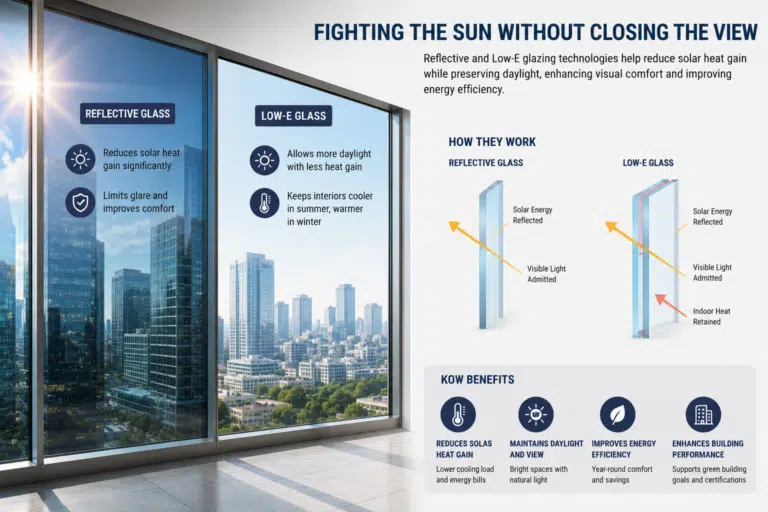
Fighting The Sun Without Closing The View
Reflective glass uses metallic coatings to reflect a portion of incoming solar radiation before it enters the building. The result is a façade that combines aesthetics with solar control.
Key benefits:
- Reduced solar heat gain
- Lower cooling demand
- Improved visual comfort
- Reduced glare
- Enhanced daytime privacy
However, excessive reflectivity can create glare concerns for neighbouring developments, making careful specification essential.
The Smart Coating Revolution
If laminated glass focuses on safety and DGUs focus on insulation, Low-E glass represents the next evolution of glazing technology. Low-Emissivity (Low-E) glass incorporates an ultra-thin metallic coating that selectively controls heat transfer while allowing visible daylight to enter the building.
Low-E Glass Has Become The Industry Benchmark For The Following Reasons:
- Lower SHGC values
- Reduced cooling loads
- Improved thermal comfort
- Better daylight utilization
- Enhanced sustainability performance
Today, Low-E glazing is widely specified in airports, healthcare facilities, commercial developments, educational institutions, and green-certified buildings.
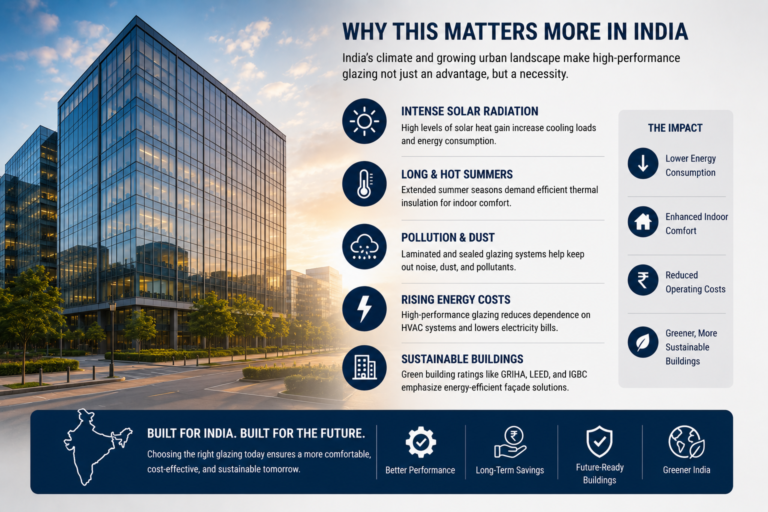
Why This Matters More In India
India presents unique challenges for glazing design. High solar radiation, extended cooling seasons, rising electricity costs, and increasingly glazed building envelopes place significant demands on façade performance. A glazing solution that performs adequately in a temperate climate may not deliver the same results in cities such as Delhi, Jaipur, Ahmedabad, Hyderabad, Chennai, Mumbai, or Bengaluru. For this reason, glazing selection must be based on climate-responsive design principles rather than appearance alone.
Performance By Numbers
| Glass Type | VLT (%) | SHGC | U-Value (W/m2K) |
|---|---|---|---|
| Laminated Glass | 70–80 | 0.65–0.75 | 5.5–5.8 |
| Clear DGU | 65–75 | 0.55–0.65 | 2.6–3.0 |
| Reflective Glass | 20–45 | 0.30–0.45 | 5.0–5.8 |
| Low-E DGU | 40–70 | 0.20–0.35 | 1.6–2.2 |
Understanding The Metrics
- Visible Light Transmission (VLT): Percentage of natural daylight entering the building.
- Solar Heat Gain Coefficient (SHGC): Measure of solar heat entering through the glazing.
- U-Value: Measure of heat transfer through the glazing assembly. Lower values indicate better insulation.
Myth Vs Reality
| Myth | Reality |
|---|---|
| Thicker glass always performs better. | Performance depends on coatings, cavities, and interlayers. |
| Reflective glass is ideal for every hot climate. | Low-E glazing often delivers superior thermal performance. |
| Double glazing automatically solves acoustics issues. | Laminated glass generally provides better sound insulation. |
| All façade glass performs similarly. | Performance characteristics vary significantly. |
Choosing The Right Glass
| Project Requirement | Recommended Solution |
|---|---|
| Noise Reduction | Laminated Glass |
| Energy-Efficient Office Building | Low-E DGU |
| Green Building Certification | Low-E DGU |
| Premium Hospitality Projects | Laminated + Low-E DGU |
| Coastal Developments | Laminated + Low-E Glass |
| High Solar Exposure | Reflective or Low-E Glass |
| Educational Institutions | Laminated Glass |
| Airports & IT Parks | DGU with Low-E Coating |
No single glazing solution is suitable for every project. The most successful specifications balance safety, thermal performance, acoustics, daylighting, and aesthetics.
Looking Ahead
The future of façade engineering will not be defined by larger glass panels alone. Emerging technologies such as smart glass, electrochromic glazing, triple-glazed systems, integrated photovoltaic glass, and advanced spectrally selective coatings are reshaping the industry. Future glazing technologies will further improve building performance and sustainability.
Conclusion
Architects often describe glass as the skin of a building. In reality, glass is far more than that.
It is a thermal barrier, an acoustic shield, a daylight regulator, an energy-management tool, and increasingly, a sustainability asset.
The most successful buildings will be those designed with performance in mind. They will be the buildings where every square metre of glass has been selected with purpose. The future of construction will not be defined solely by how buildings look on the day they are completed. It will be defined by how efficiently they perform throughout their lifecycle. Because in modern buildings, glass is no longer something we simply look through. It is one of the most important factors determining how a building performs.
References
|