
Post Date: April 28, 2023 |
Last Edited: May 17, 2024
Exterior Form
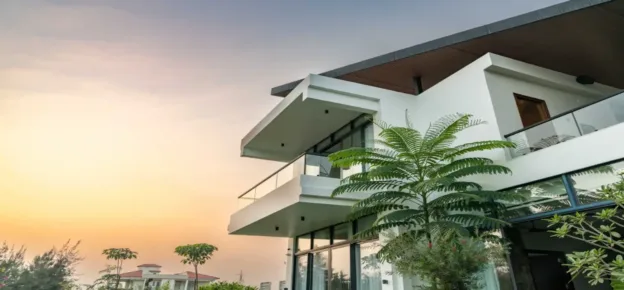
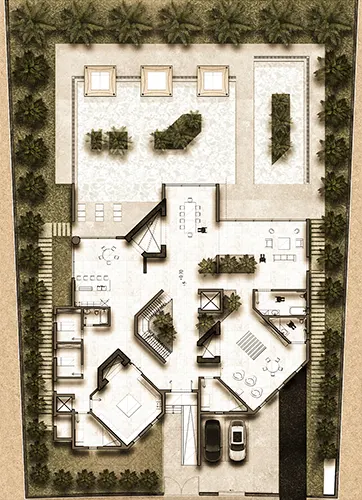
The family house- designed for the Dubai Sea House competition was intended to act as a meeting point for the four natural elements predominating the site in service of the house’s inhabitants. It is situated and molded to combine the sun, the wind, the local sandstone and mudbrick, and the desalinated seawater. The plan, therefore, started with two colliding grids at a 45-degree angle from one another.
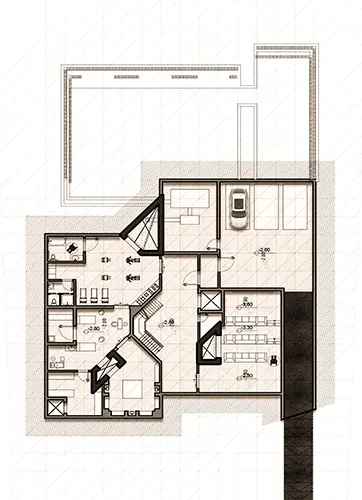 One grid follows the prevailing wind direction in the area while the other follows the direction of the view of the coast, maintaining that the north-south axis bisects the angle between the two grids in an attempt to minimize the effect of the different angles at which the rooms are placed and thus even out the amount of solar exposure every southern room- for example, receives in spite of the 45-degree difference in orientation, and the same goes for every group of rooms on each of the three other cardinal directions. After the grids were laid, each space was situated in its respective apt location and direction in correspondence to its function and needs from sunlight, daylight, view, and air. Consequentially, the exterior form of the project came to be as a result of the situation of the interior spaces.
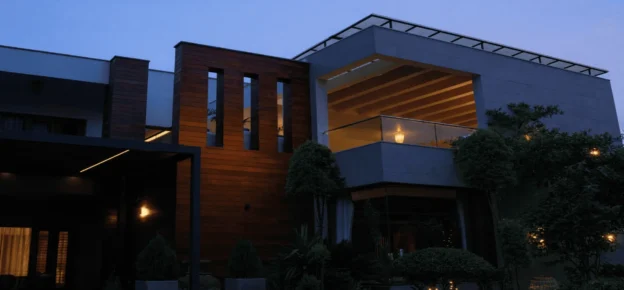
The project was designed from the inside out. The house’s silhouette and envelope were not predetermined nor were they considered during the course of the process, but rather appropriated after the spaces were assembled. And as for the fenestration, an ancient local tradition of distributing narrow openings along the southern, eastern, and western façades was implemented in order to block unwanted heat and glare.
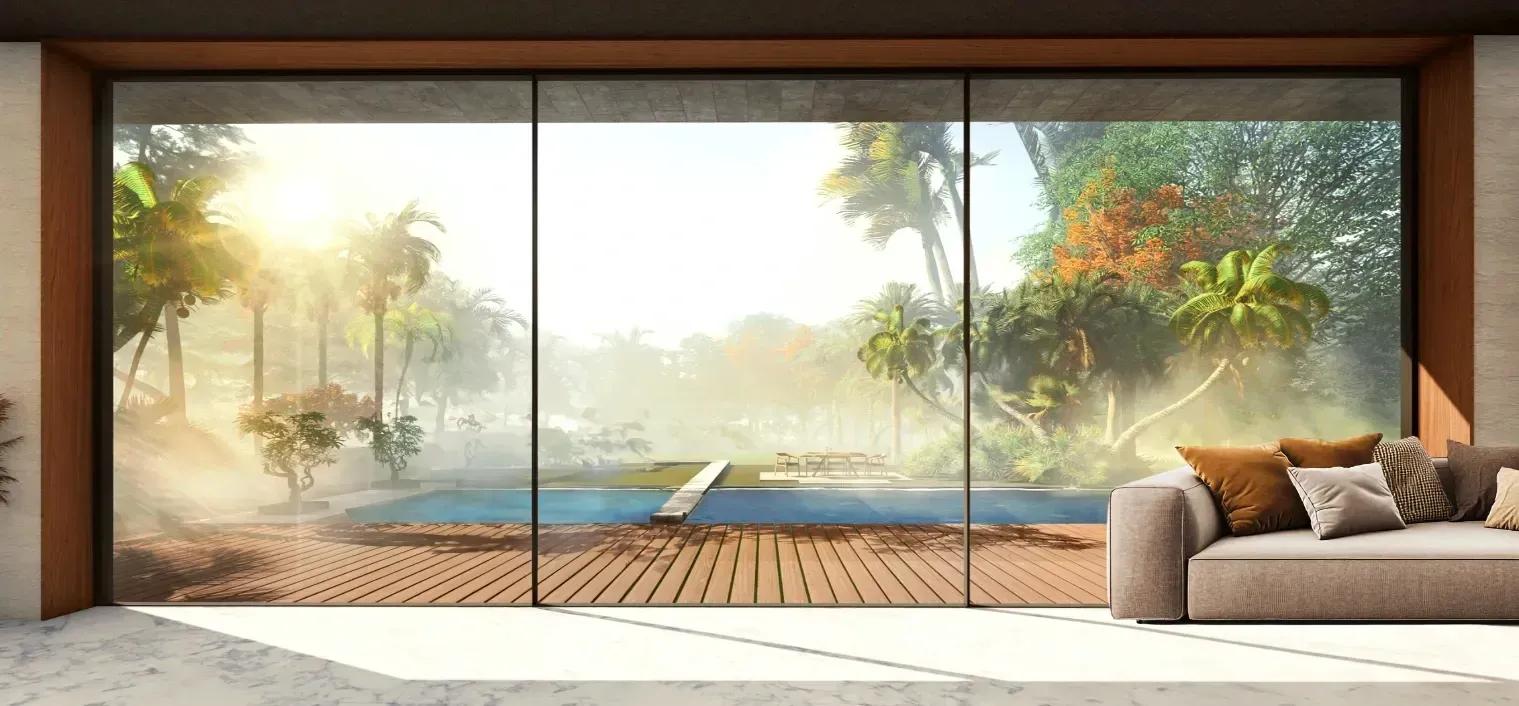
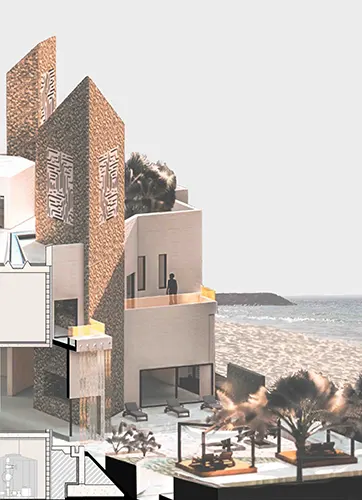 These windows were also placed in accordance with the needs of the interior spaces with the exclusion of any visual expectation on the exterior. The northern façade, where direct sunlight is absent throughout the whole year, is fully glazed on the ground floor in order to fully immerse the residents in the wondrous showcasing of the coast leading to the seamless merger of the sea and the clear sky of Dubai.
Wind Towers
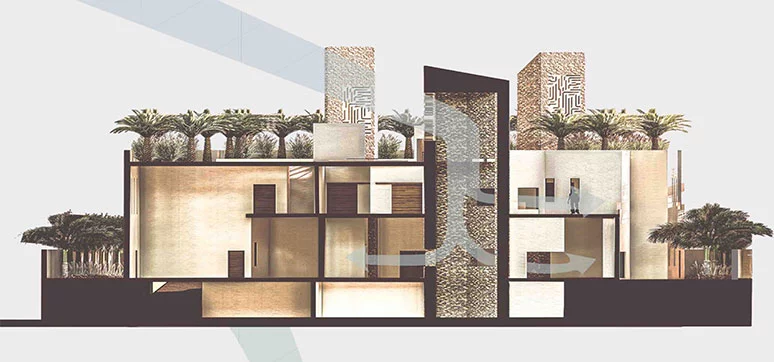
Not only are the wind towers the most visually imposing elements in the project, but they also are the focal elements of its concept. They are the primary contributor to the combination of the natural elements of the site, as they combine earth, air, and water in an intricate passive cooling system. The idea of this system is a personal invention that took the traditional wind towers predominantly utilized throughout the area’s history- as a precedent, and then evolved it into a more effective ensemble of various mechanical, electrical, and naturally static components.
 The wind tower is a 23 meters long shaft that serves three floors and towers around 10 meters high above the surface of the roof. The last 4 meters of the tower are sloped towards the sky at an orientation best fit to catch as much desirable wind as the rooms on the three stories below require. The tower’s envelope is a 50-centimetre-thick sandstone wall. This stone wall at such thickness would act as an efficient thermal insulator, creating a microclimate inside its boundaries where the wind is harvested before it is distributed and released, passively, into the rooms in which it is required.
The filters through which the wind enters the tower are made of locally harvested and baked mudbrick tiles (4m x 3m) that are of the same thickness as the stone wall (50cm). The patterns on the mudbrick tiles are abstracted from the scaled grid system used for the design of the house, for a purely stylistic purpose. This material was chosen as it would also aid in preserving the temperature of the cooled air entering the wind towers.
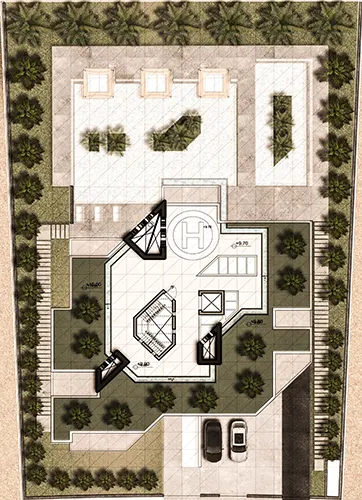 The house utilizes three wind towers, two minor towers on the southern side with one wind-receiving mudbrick filter on each, and one major tower on the northern side of the house that is bigger in size and contains two mudbrick filters- one of which receives northern wind while the other receives southeastern wind. For this major wind tower, a mudbrick panel was needed to cut between the two filters inside the wind tower in order to force the wind down to the rooms and inhibit air loss.
To further cool the air, a circulatory evaporative cooling system was proposed. The system takes the excess water collected from the drains around the swimming pool to a water reservoir placed in the basement level, then pumps it up to the roof. The water is pumped through a 40-centimetre tube placed inside the major northern wind tower to a concrete water canal on the top of the roof level.
This water would then circulate within the boundaries of this canal from the inside of the major wind tower all the way around the roof surface and through the two remaining towers, due to the effect of a minor slope that dictates the movement of the water in that sense. This would cool the roof surface as a whole- under which the bedrooms are, and would also cool the air as it enters the mudbrick filters.
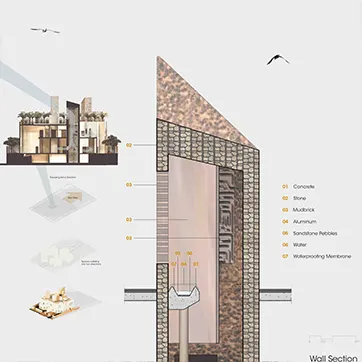
This air would be trapped in the micro-environment inside the boundaries of the 50-centimetre sandstone walls that would preserve the cool temperature of the humidified air while absorbing some of its undesired humidity, as the island upon which the site lies has a humid climate. After the water has circulated around the roof it falls into the pool again in the form of a waterfall, and again to the drains on a loop.
The air circulating through the wind towers would then be distributed to the rooms in which it is desired, by means of an opening that can be operated manually.
FACT FILE
• Location: Conjunction Sea House
• Location: Dubai, Jumeirah Bay
• Competition: Dubai Sea House by YAC
• Lead Architect: Yousof Diab (B.Arch) [design – drafting]
• Other Consultants: Nadim Fawwaz (B.Arch) [3D modelling – rendering], Taliah Sultan Al Ajami (B.Arch) [detail drafting]
• Materials used for facade & fenestration: Sandstone, mudbrick, concrete, plaster