
Post Date: June 18, 2026 |
Last Edited: July 23, 2026
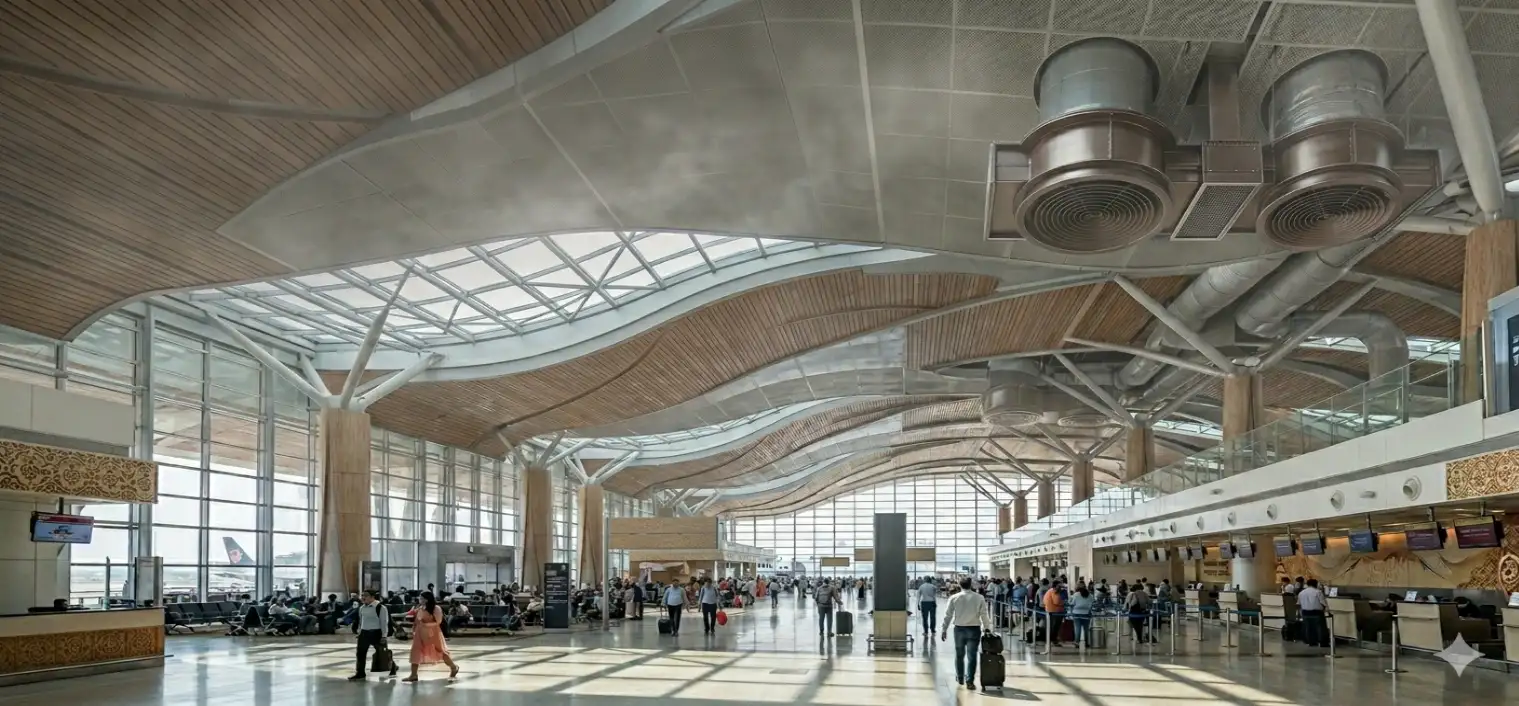
The world was seeing a steady boom in the travel industry, which was then majorly disrupted by the COVID-19 pandemic. Now, in the post-COVID era, the growth in the travel industry is back. We are seeing a lot of action and progress in the field of transportation infrastructure globally and nationally in terms of rail and air projects.
In the pre-COVID era, globally we saw 4.5Bn passenger movement, and today that number stands at approximately 10.2Bn. Nationally, for India, that figure has been 200Mn and was significantly reduced by the pandemic, and has now seen a steady rise, returning to pre-COVID levels.
Indian Airports Expansion (Next 5 Years To 2031)
- Approximately 50 new airports are planned over the next five years.
- Expansion driven by regional connectivity (UDAN), PPP greenfield projects, and metro capacity upgrades.
- Long-term national ambition: expand the airport network significantly by 2047.
Today, the way airports are planned is not just limited to the land parcel of the airport; developers are creating business and entertainment zones around it, such as aerocities. This creates a multi-use land parcel for development and encourages greater expenditure by users per square inch. In this manner, airports are more than just a hub of transport and are becoming a destination in themselves.
Considering the large volume of passengers, airport designers work tirelessly to make them more attractive, efficient, safer, and easier to navigate. Fire and life safety design plays a key role. These days, the majority—if not all—airports are enveloped in glass and roofed over, compared to the concrete structures we used to see from the 1950s to the early 2000s.
Smoke management plays a critical role in designing safer airports because smoke inhalation poses a far greater threat than flames. Securing life safety in a complex, open-volume airport terminal relies on advanced smoke management. Modern Indian airport designs strictly adhere to the National Building Code (NBC) of India (Part 4: Fire and Life Safety) for overarching compartmentation and evacuation strategies. Engineers look to the globally recognised EN 12101/IS 21927 set of standards to guarantee the rigorous performance of smoke control equipment.
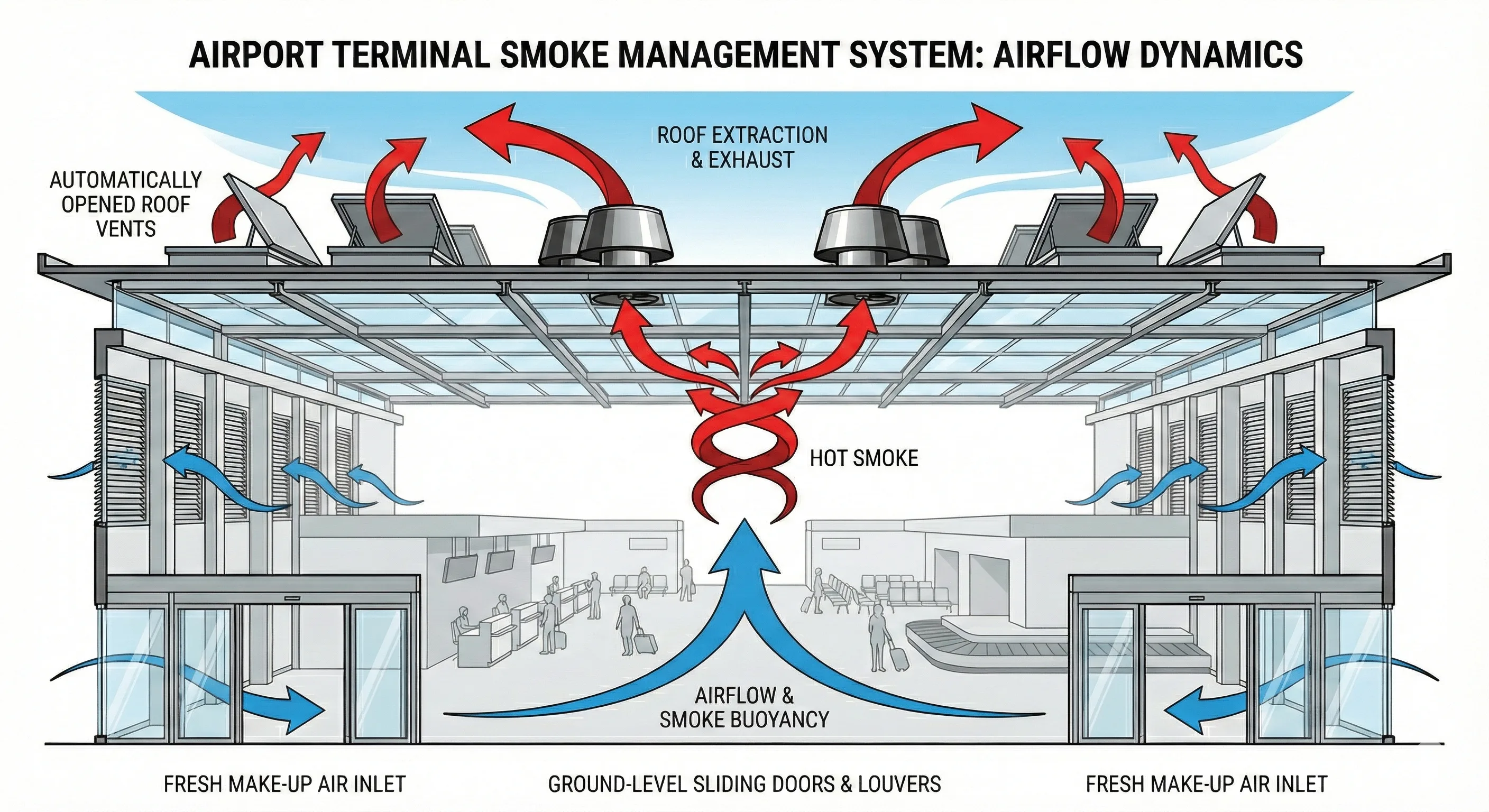
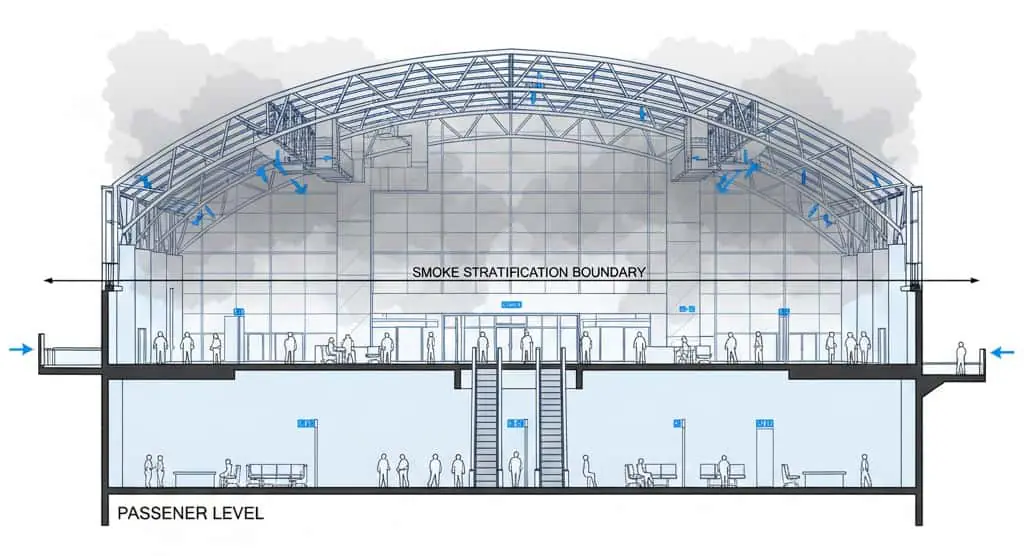
Effective smoke control achieves an aerodynamic balance through three synchronised mechanical components:
- Make-up Air Vents – To prevent negative pressure and efficiently push buoyant smoke upwards, fresh air must seamlessly replace exhausted smoke. Ground-level automated louvres and synchronised sliding doors serve as make-up air inlets. Compliant with EN 12101-2 (Natural Smoke and Heat Exhaust Ventilators) on the vertical glass façades, these vents actuate reliably upon fire detection within 60 seconds, introducing low-velocity air without disturbing the dangerous stratified smoke layer above.
- Roof Smoke Extraction – NBC guidelines outline specific volumetric extraction rates to maintain tenable conditions in large public assemblies. To meet this, either high-capacity mechanical fans, certified under EN 12101-3 (Powered Smoke and Heat Exhaust Ventilators), are deployed across the terminal roof, or alternatively, a more cost-optimal approach is to use Automatic Smoke Roof Vents certified under EN 12101-2 with a defined Geometric Free Area (GFA) to be met. Controls for such fans and vents must be certified to EN 12101-10 (Power Supplies).
- Technical Extraction In High-Risk Zones – Compartmentalised, high-risk operational areas like Baggage Handling Systems (BHS), retail kitchens, and electrical substations require localised technical extraction. Utilising fire-rated ductwork and dampers compliant with EN 12101-7 (ducts) and EN 12101-8 (dampers), these dedicated systems purge smoke directly at the source, preventing toxic migration into the main passenger concourse.
Performance-Based Design (PBD)
Lastly, as we advance further in the field of fire safety design, we must opt for PBD for smoke management as the way forward for safer designs.
PDB reflects actual architecture, optimised system sizing, improved safety validation, and better integration with active/passive systems.
For complex infrastructure like modern Indian airport terminals, PBD provides scientifically validated, cost-efficient, and safer smoke management solutions aligned with contemporary architectural design.
| Prescriptive | Performance-Based Design |
| Rule Based | Objective-based design |
| Fixed fire load assumptions | Project-specific fire strategies |
| Generic ventilation/exhaust rates | Modelled smoke movement |
| Conservative and sometimes oversized | Optimised & Validated designs |
Conclusion
By harmonising the NBC’s guidance on life-safety parameters with EN 12101/IS 21927-certified systems, modern Indian airports achieve a more resilient, multi-tiered smoke management system, equipped to protect thousands of passengers during critical emergencies.
Examples of where one or more such EN-certified systems have been specified and installed in Indian airports:
- Kempegowda International Airport, Bengaluru
- Rajiv Gandhi International Airport, Hyderabad
- Manohar International Airport, Goa
- New Delhi Airport’s Terminal 1, New Delhi
- Navi Mumbai International Airport, Navi Mumbai
- Noida International Airport, Noida
- Chaudhary Charan Singh International Airport, Lucknow
- Alluri Sitarama Raju International Airport, Vizag
| Case Study -1: Noida International Airport Limited, Jewar, India Case Study -2: Manohar International Airport, North Goa, India Case Study -3: Navi Mumbai International Airport, Navi Mumbai, India |