Post Date: July 24, 2026 |
Last Edited: September 17, 2026
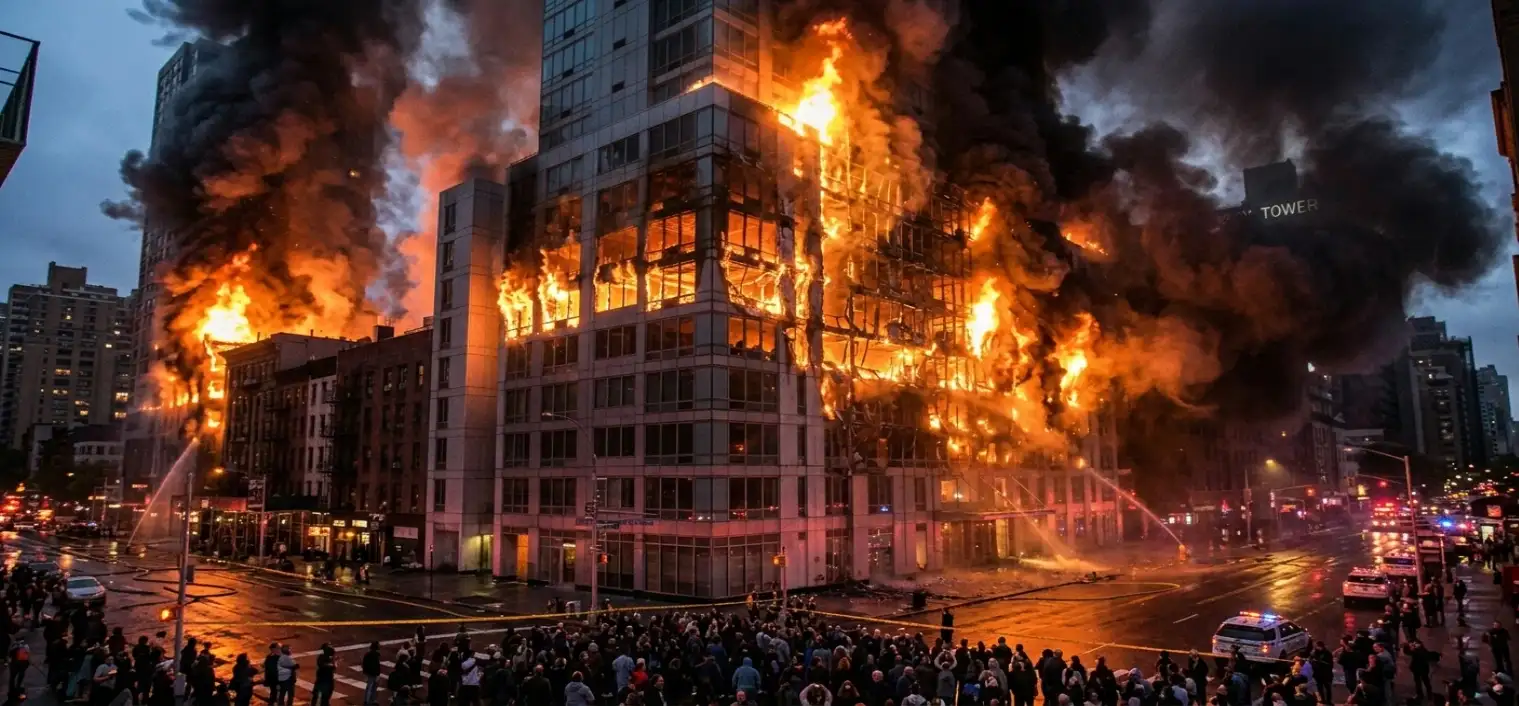
The façade has long been architecture’s most visible statement — but in the wake of catastrophic global fire incidents, it has also become its most scrutinised. As buildings grow taller, more complex, and more reliant on innovative materials, fire safety has moved from a compliance footnote to a central design discipline. The question is no longer whether fire safety belongs in the conversation about facade design, but how deeply it must be embedded from the very first sketch. To examine this transformation, we spoke to leading fire safety engineers whose insights form this edition’s cover story.
Integrating Fire Safety Into Façade Design
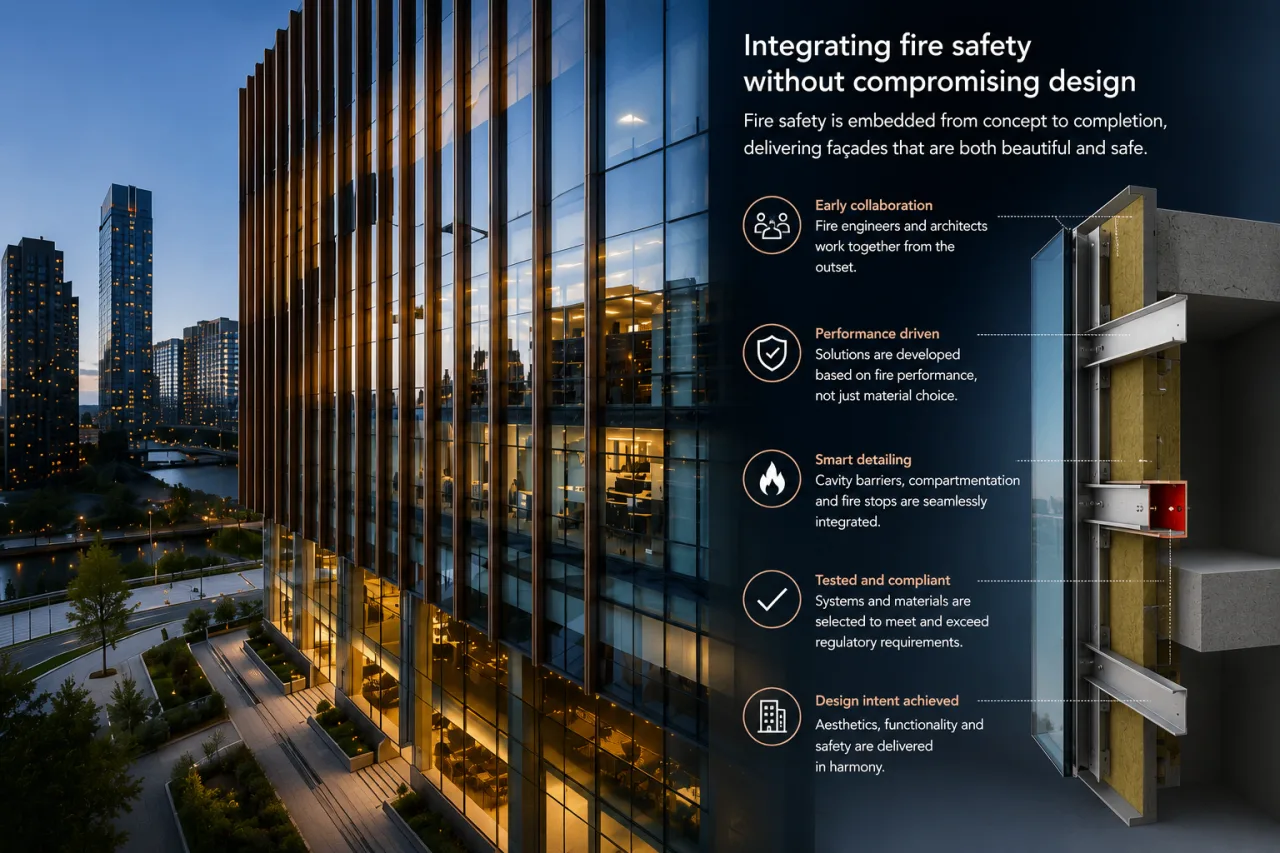
Fire safety that arrives late in the design process rarely serves anyone well — not the architect, not the client, and certainly not the building’s future occupants. Across the industry, a clear consensus has formed: the only effective approach is one that brings fire engineering into the room from the very first conversation.

Awwal Salisu, Founder & Director, TFF Engineering Consultancy Ltd, believes that successful façade fire safety design begins with early collaboration between architects, façade consultants, and fire engineers. He is clear that fire safety should not be treated as a late-stage compliance exercise, as this frequently results in compromises to either the architectural vision or the project budget. His preferred approach is performance-led and system-based, recognising that modern façade assemblies are highly complex, involving cladding materials, insulation, cavity barriers, glazing systems, fixings, and ventilation cavities. Each component influences fire performance and must therefore be considered holistically. He firmly believes that good fire engineering should enable architecture, not restrict it. Through careful material selection, strategic compartmentation, robust detailing, and early coordination, it is possible to achieve visually striking façades whilst maintaining appropriate levels of fire resilience and regulatory compliance.

Duncan Winsbury, Fire Safety Engineer, sees fire safety as an integral part of the design process rather than a constraint applied at the end. In his experience, the most successful façade designs emerge when architects, façade engineers, and fire engineers collaborate from the earliest stages of a project. He notes that good fire safety design does not necessarily mean compromising architectural ambition. Instead, it involves understanding how materials, cavity barriers, compartmentation, fixing systems, and façade geometry interact with the overall fire strategy. By engaging early, design teams can often achieve the desired aesthetic through compliant alternatives rather than redesigning late in the process. The goal, he says, should always be a façade that is visually compelling, technically robust, and demonstrably safe.

Faimeen Shah, Managing Director & Founder, Vortex Fire emphasises that fire safety and architectural intent do not need to be competing objectives. As a fire engineer, his role is typically to review and assess the proposed façade design rather than to design it. The key, he explains, is early engagement with the architect, facade consultant, and the wider design team so that potential fire safety issues are identified before the design becomes too far progressed to change cost-effectively. On a recent project in Dubai, early engagement allowed his team to retain a highly glazed façade treatment the architect was committed to, whilst introducing cavity barriers and revised detailing that satisfied the fire safety requirements. That kind of outcome, he observes, is only possible when fire safety is brought into the conversation from the outset.

For Mukesh Tomar, Head of Fire Engineering, Jacobs, the most successful solutions are those that do not treat fire compliance as a constraint layered on top of the design, but rather as a design driver integrated from the concept stage onwards. His approach is holistic and collaborative from the outset. He advocates for the strategic use of non-combustible or limited-combustibility materials and, where combustible elements are viable, managing the residual risk through a combination of fire barriers, careful detailing, and robust system testing evidence. The underlying principle is that early integration leads not only to safer outcomes, but to more coherent and buildable designs.

According to Juda K. Franklin, Sr. Fire Safety Engineer, ASL Fire Safety Consultancy LLC, the answer lies in coordinating façade fire requirements with architectural aesthetics early in the design process. His guiding principle is to ensure compliance without compromising the building’s architectural integrity, achieved through disciplined early-stage coordination across the full design team.

Muhammad Ahmad Zubair, Senior Fire & Life Safety Engineer, Egis, frames integration as an exercise in simultaneous consideration. Fire safety, in his approach, is considered from the earliest stages of façade design rather than as a compliance exercise appended at the end. By integrating fire engineers, façade consultants, and architects into the design team from the outset, it becomes possible to align safety objectives with the project’s architectural vision. He notes that advances in façade technologies and non-combustible materials now allow architects to achieve sophisticated visual expressions, transparency, and texture whilst meeting stringent fire safety requirements and maintaining overall design integrity.

Octavian Lalu, Principal Fire Engineer, Materials & Structural Fire Engineering, approaches the integration of fire safety into façade design through a performance-based methodology, seeking to understand how the entire building system behaves rather than relying on prescriptive solutions alone. His focus is on ensuring that fire engineering decisions are embedded within the design narrative, supporting rather than impeding architectural ambition.
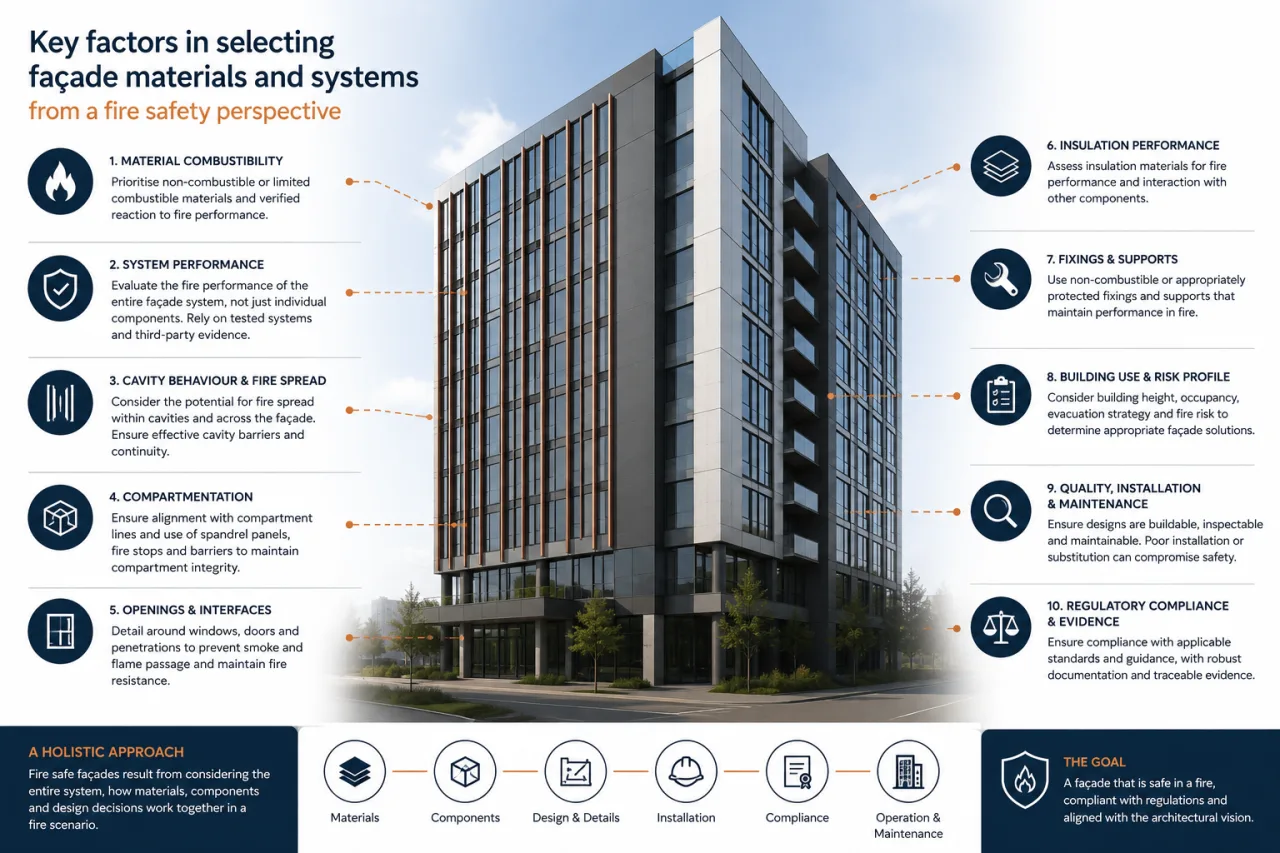
Key Factors In Façade Material And System Selection
Selecting a façade material is no longer simply a question of aesthetics or individual product performance. The industry has learnt, often through hard experience, that a façade behaves as a system — and every component, junction, and cavity within it carries consequences for how fire will spread.
Salisu is clear that material selection must go beyond individual product classifications. Whilst reaction-to-fire ratings are important, the overall behaviour of the façade system under realistic fire conditions is far more critical. Key considerations in his practice include combustibility, smoke production, flame spread characteristics, cavity behaviour, interface detailing, and compatibility between system components. He pays close attention to how materials perform as part of a tested assembly rather than in isolation. The role of constructability and quality assurance on site is equally significant, as even well-designed systems can become vulnerable if installation quality is poor or if substitutions occur during procurement. Insurance requirements and third-party accreditations, such as UL and FM Global, also feature prominently in his assessments.
Winsbury looks at the façade as an entire system rather than a collection of individual components. Material combustibility, he says, is only one part of the equation. Key considerations include reaction-to-fire classification, fire propagation potential, cavity behaviour, detailing around openings, compartmentation, the performance of insulation systems, and how cavity barriers are integrated and maintained. The interaction between materials is critical, particularly in rainscreen systems where concealed cavities can significantly influence fire spread. He also factors in the building’s height, occupancy profile, evacuation strategy, and overall risk profile. Evidence-based performance is essential, encompassing testing regimes, system certification, large-scale testing where applicable, and ensuring that substitutions during procurement do not undermine the original design intent.
Shah’s point is always the performance of the façade as a complete system, rather than individual products in isolation. A façade comprises many components — cladding, insulation, membranes, cavity barriers, support systems, and fixings – and all of these contribute to how the system behaves in a fire. Key considerations in his assessments include the combustibility of materials, the potential for fire and smoke spread, cavity detailing, fire-stopping arrangements, and the availability of appropriate test evidence. In the UAE context, this means ensuring alignment with Dubai Civil Defence requirements and confirming that the fire test evidence reflects the actual system configuration being proposed, rather than a proxy assembly. His guiding principle is that the weakest component or detail often determines the performance of the entire system.
Tomar approaches material and system selection through a structured assessment of how the façade will manage ignition, fire growth, and fire spread — both across surfaces and within cavities — under realistic fire scenarios rather than controlled test conditions. His evaluation framework is comprehensive: reaction to fire and material combustibility, full system performance rather than individual components in isolation, insulation choice and behaviour, cavity design and fire propagation risk, cavity barriers and fire-stopping strategy, fixings, substructure and support systems, fire spread via openings and interfaces, smoke production and toxicity, durability and ageing, and the buildability and installation risk inherent in the proposed system. Each factor, he notes, contributes to an understanding of how the assembly will perform as a whole.
Franklin’s checklist for façade material selection reflects a systems-thinking approach: combustibility and reaction-to-fire characteristics of materials, full-scale façade system testing and certification, provision of cavity barriers and firestopping systems, and the use of approved and listed products. Each factor contributes to an overall understanding of how the system will perform rather than how any single product might behave in isolation.
According to Zubair, the primary consideration is the reaction-to-fire performance of the material, including combustibility, flame spread, smoke generation, and contribution to fire growth. Equally important is understanding how the entire façade assembly performs as a system. Compliance with local regulations, international standards, and project-specific fire strategies is essential, alongside durability, maintenance requirements, and environmental performance. Particular attention is given to insulation materials, cavity barriers, fixing methods, and junction details, as these elements significantly influence the façade’s ability to resist fire spread and protect occupants.
The Influence Of Increased Façade Fire Focus On Design Strategies
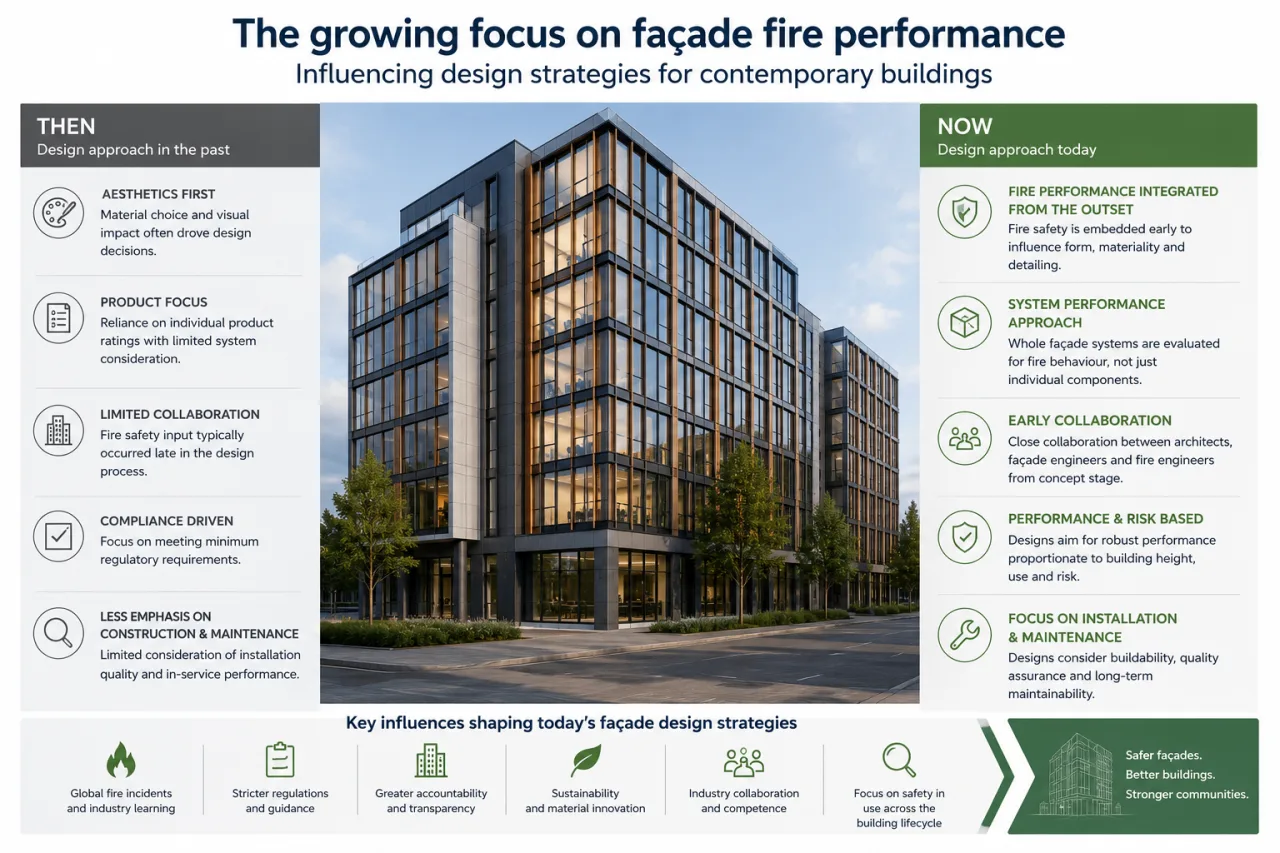
The growing global focus on façade fire performance has done more than introduce new regulations — it has fundamentally altered the rhythm of design. From when decisions are made to how disciplines collaborate, fire safety is no longer a finishing touch but a foundational force shaping contemporary buildings.
Salisu reflects that the increased global focus on façade fire performance has significantly changed how projects are approached. Fire safety considerations are now being integrated much earlier in the design process, particularly for high-rise and complex developments. He has observed these changes rapidly taking hold in the UK, Gibraltar, and the UAE, and is now seeing a similar rise in Saudi markets. There is greater emphasis on holistic risk management rather than relying solely on prescriptive compliance pathways. Design teams are increasingly considering evacuation strategies, external fire spread, façade cavity behaviour, and system testing during concept development stages. In Salisu’s view, this increased attention on façade fire safety has ultimately improved design accountability and encouraged more resilient and better-coordinated building envelope solutions.
Winsbury notes that increased scrutiny surrounding façade fire performance has undoubtedly changed the way buildings are designed and assessed. Modern design strategies increasingly prioritise simplicity, robustness, and transparency in façade composition, with greater use of non-combustible materials, more conservative detailing, and a stronger focus on inspection, quality assurance, and installation standards. Equally important is the shift towards performance-based thinking: rather than simply asking whether something is technically permissible, the question is increasingly whether the solution is demonstrably safe within the context of the whole building. This, he says, has encouraged more meaningful collaboration between architects and fire engineers and, in many cases, has improved overall design resilience.
Shah notes that the industry has become far more focused on façade fire safety over the past decade, and he considers this shift to have been genuinely positive. The post-Grenfell era, in particular, changed expectations across the entire industry — not just in the UK but globally. There is now a much stronger emphasis on understanding how complete systems perform under fire conditions, backed by evidence from full-scale tests such as BS 8414 or equivalent large-scale testing protocols. In practice, this means more detailed assessments, greater scrutiny of test evidence, and closer coordination with façade consultants and suppliers throughout the design process. The conversation, he notes, has shifted from simply asking whether a product complies to understanding how the entire façade assembly will actually perform under fire conditions.
Tomar describes the post-Grenfell shift as fundamental, observing that façade design has moved away from being aesthetics-led with compliance checks bolted on, towards being risk-led with design integration at its core. In practice, this has changed not only what is designed, but how and when key decisions are made. Fire strategy, he notes, now drives façade design from day one. There is a pronounced shift towards non-combustible materials, and the overall approach has become markedly more system-centric. The placement and coordination of cavity barriers and fire-stopping are no longer afterthoughts — they are considered in parallel with the façade design itself.
Zubair describes the shift as a move towards a more holistic and performance-driven design approach. Fire safety considerations are now integrated alongside energy efficiency and sustainability, and occupant comfort from the earliest design stages. There is greater reliance on tested façade systems, robust detailing, and comprehensive risk assessments. Architects are also paying closer attention to material compatibility and the behaviour of complete façade assemblies under fire conditions. This shift, he concludes, has strengthened collaboration between architects, engineers, and manufacturers, resulting in façades that achieve both high design standards and enhanced levels of fire safety.
Challenges In Balancing Innovation With Fire Safety Regulations
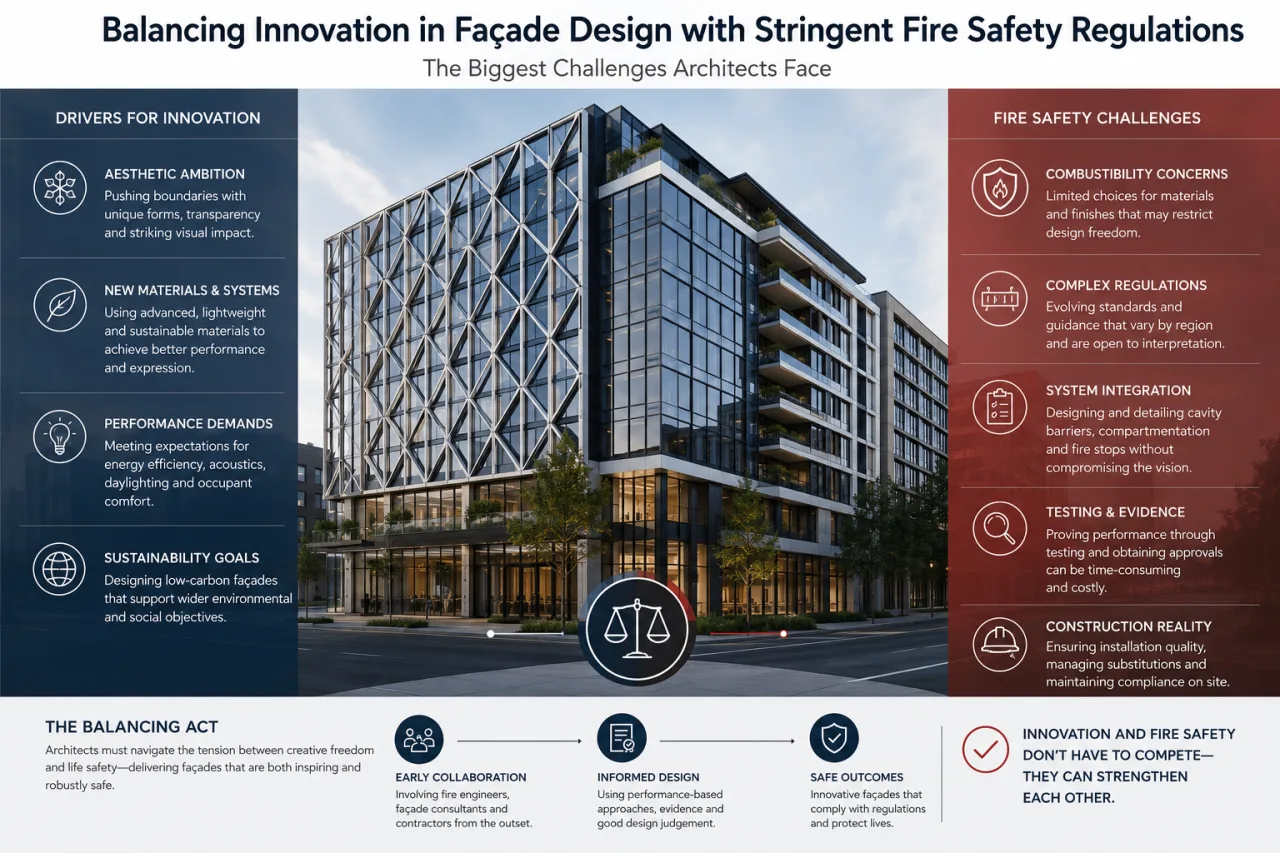
Architects have never faced greater demand to innovate — and never faced tighter constraints on how they do it. As regulations tighten and new materials outpace available test evidence, the challenge of delivering bold, sustainable façades within robust fire safety frameworks has become one of the defining tensions of contemporary practice.
Salisu acknowledges that architects face constant pressure to create innovative forms, deploy lightweight materials, achieve sustainability targets, and deliver visually distinctive building envelopes — all of which can introduce additional fire safety considerations. He characterises this tension as going to the core of engineering itself. Another significant challenge is the variation in regulations and testing approaches across different jurisdictions. He cites the example of a project in mainland Europe for a US-headquartered client that required compliance with FM Global requirements — a standard familiar in some parts of the world but challenging in Europe, where most products are tested to BS/EN standards with limited equivalency to UL/FM Global. His conclusion is that the solution lies in earlier collaboration, clearer accountability, and greater industry-wide competency in façade fire engineering.
Winsbury identifies the navigation of increasing regulatory complexity whilst delivering creative and commercially viable architecture as one of the greatest challenges facing architects today. Architects naturally seek innovation through materiality, geometry, transparency, and sustainability; however, modern façade regulations have introduced necessary scrutiny that can sometimes feel restrictive. The difficulty often lies in translating technical fire requirements into practical design solutions without losing architectural identity. There can also be tension between cost pressures, sustainability ambitions, thermal performance requirements, and fire safety objectives. Another challenge is the pace of regulatory change, which requires designers to remain continuously informed and adaptable.
Shah recognises that architects are constantly challenged to create buildings that are distinctive, sustainable, and commercially viable whilst navigating increasingly complex regulatory requirements. He sees the tension as real and present on almost every project. One of the most pressing challenges he currently encounters is the push towards low-carbon and sustainable materials — such as timber, bio-based insulation, and recycled cladding systems — which do not always have well-established fire performance data or clear compliance pathways. This creates genuine uncertainty for design teams, particularly on high-profile or high-rise projects. In his experience, the solution is almost always found through early collaboration, when architects, façade specialists, contractors, and fire engineers work together from the start.
Tomar is direct in his assessment: in the post-Grenfell context in the UK, and across global practice more broadly, the tension between façade innovation and fire safety compliance is one of the defining challenges in contemporary architecture. From his experience, these challenges are less about outright conflict and more about constraints reshaping how innovation can happen.
He identifies a web of interconnected pressures: stricter regulations, a growing gap between innovative design intent and available test evidence, the rigidity of tested systems versus the flexibility architects require, the complexity of integrating cavity barriers without compromising design intent, late-stage design disruption when fire issues are raised too late, commercial and procurement pressures, and ongoing regulatory ambiguity in evolving guidance. Interface complexity — the junctions, edges, and transitions where most fire risks actually sit — remains one of the most technically demanding areas to resolve.
Franklin points to three interconnected challenges: achieving unique architectural forms whilst maintaining code compliance, ensuring innovative designs remain within tested assembly configurations, and coordinating multiple disciplines throughout the design process. These pressures, he notes, require sustained attention from all parties across the entire project lifecycle.
Zubair frames the central challenge as achieving architectural innovation within increasingly rigorous regulatory frameworks. Architects often seek to create distinctive façades using new materials, complex geometries, and advanced construction techniques, but these solutions may lack sufficient fire performance data or testing history. Navigating evolving regulations across different jurisdictions adds further complexity. Balancing fire safety requirements with sustainability goals, budget constraints, and project timelines requires careful coordination. The key, he believes, is adopting a collaborative design process that encourages innovation whilst ensuring that safety remains a fundamental and non-negotiable aspect of façade development.
The Influence Of Global Fire Incidents On Façade Specification
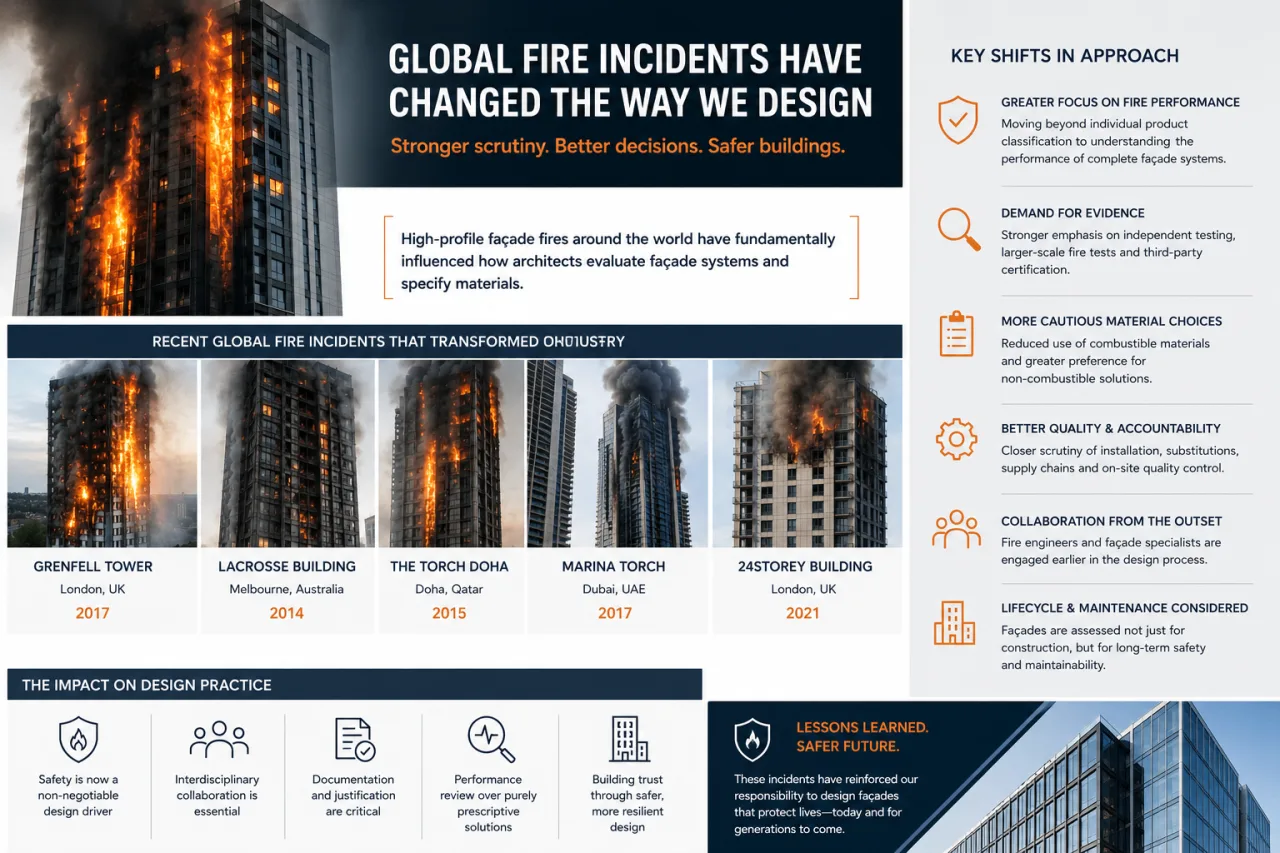
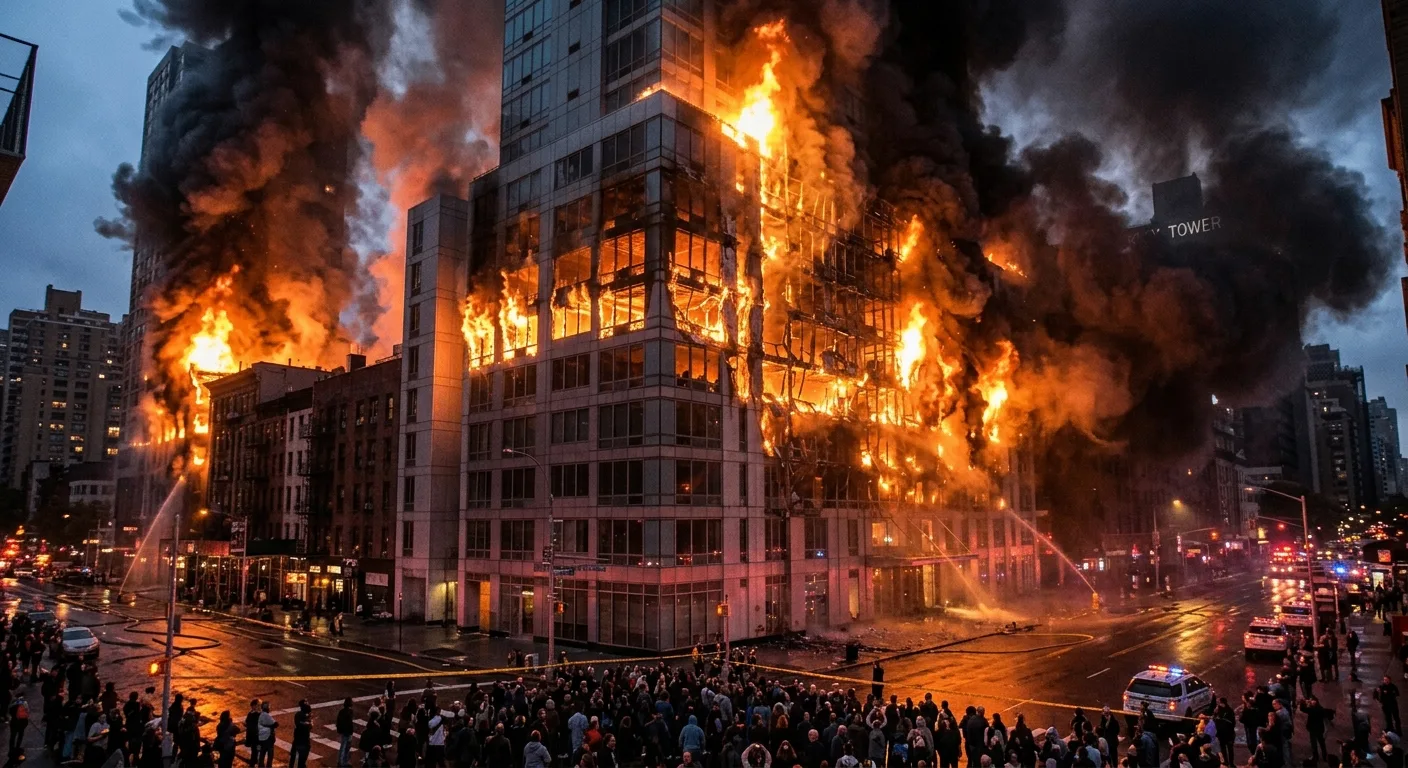
No single force has reshaped façade specification more profoundly than the major fire incidents of the past decade. From Grenfell to the towers of Dubai, these events have moved the industry from passive compliance to active scrutiny — changing not just what gets specified, but how rigorously and why.
Salisu is unequivocal: recent global fire incidents have had a profound impact on how façade systems are evaluated across the industry. There is now significantly greater awareness of external fire spread risks, combustible materials, installation quality, and long-term façade management responsibilities. He frames this as being driven by three pillars of the fire safety industry: fire regulations, insurance requirements, and societal tolerance. Architects, developers, regulators, and insurers are all applying greater scrutiny to façade specifications and tested system performance. Importantly, the industry is moving away from focusing solely on individual products and towards understanding façade systems as integrated assemblies. In the UK, he notes updates to Building Regulations, whilst in the UAE, Dubai Civil Defence has led efforts to ensure façade design keeps pace with the latest changes in global fire safety best practice.
Winsbury states that high-profile façade fires internationally have fundamentally changed industry attitudes towards external wall systems. There is now much greater caution around combustible materials, concealed cavities, and system substitutions during construction. Architects and design teams are asking more detailed questions regarding evidence of performance, certification, installation quality, and long-term maintenance. The industry has moved away from assessing products in isolation and towards understanding how complete façade systems behave under fire conditions — a shift he considers significant and positive.
In the UK, regulatory reform and heightened accountability have reinforced the need for rigorous design review, competency, and documented justification for façade decisions.
Shah is emphatic on this point. Grenfell in 2017 was a turning point for the industry worldwide and, closer to home, incidents such as the Torch Tower fires in 2015 and 2017 and the Address Downtown Dubai fire on New Year’s Eve 2015 brought the issue into sharp focus for clients and design teams across the region. What has changed most noticeably, he says, is the level of scrutiny being applied to combustible materials, insulation products, cavity detailing, and system testing. Clients, architects, and contractors are now asking far more informed questions and seeking genuine confidence that systems have been properly assessed as integrated assemblies. He also highlights a point that is sometimes underappreciated: the critical role of quality assurance during procurement and construction. Fire safety is not determined solely by design intent — it depends equally on ensuring that the approved design is correctly implemented on site, with no unreviewed substitutions.
Tomar confirms that the answer is unambiguously yes. He observes that major incidents — Grenfell in 2017, Dubai, Shanghai, and more recently Valencia — have effectively reshaped the entire decision-making framework for façade design, shifting it from a compliance-driven check to a risk-informed, evidence-based discipline. The recognition that façade fires are system failures, not product failures, has driven a clear shift towards system-level compliance. Design teams no longer assess individual products and assume the assembly will perform — they assess the assembly itself, under conditions that reflect how buildings actually burn.
Franklin notes a clear shift in industry attitudes: increased awareness of external fire spread risks, a stronger preference for non-combustible façade systems, and a more rigorous review of fire test reports and certifications are now standard expectations that major incidents have firmly embedded in practice.
Zubair observes that recent global fire incidents have significantly influenced the industry’s approach to façade design and specification. These events highlighted the importance of understanding the fire performance of complete façade assemblies rather than focusing solely on individual materials. Architects are now conducting more rigorous evaluations of product certifications, test data, and compliance documentation before making specification decisions. There is also greater scrutiny of installation quality, maintenance considerations, and long-term performance. As a result, fire safety has become a central component of the decision-making process, driving more informed material selection and encouraging higher standards of accountability throughout the project lifecycle.
Looking Ahead: Strengthening Fire Safety Standards In Façade Design
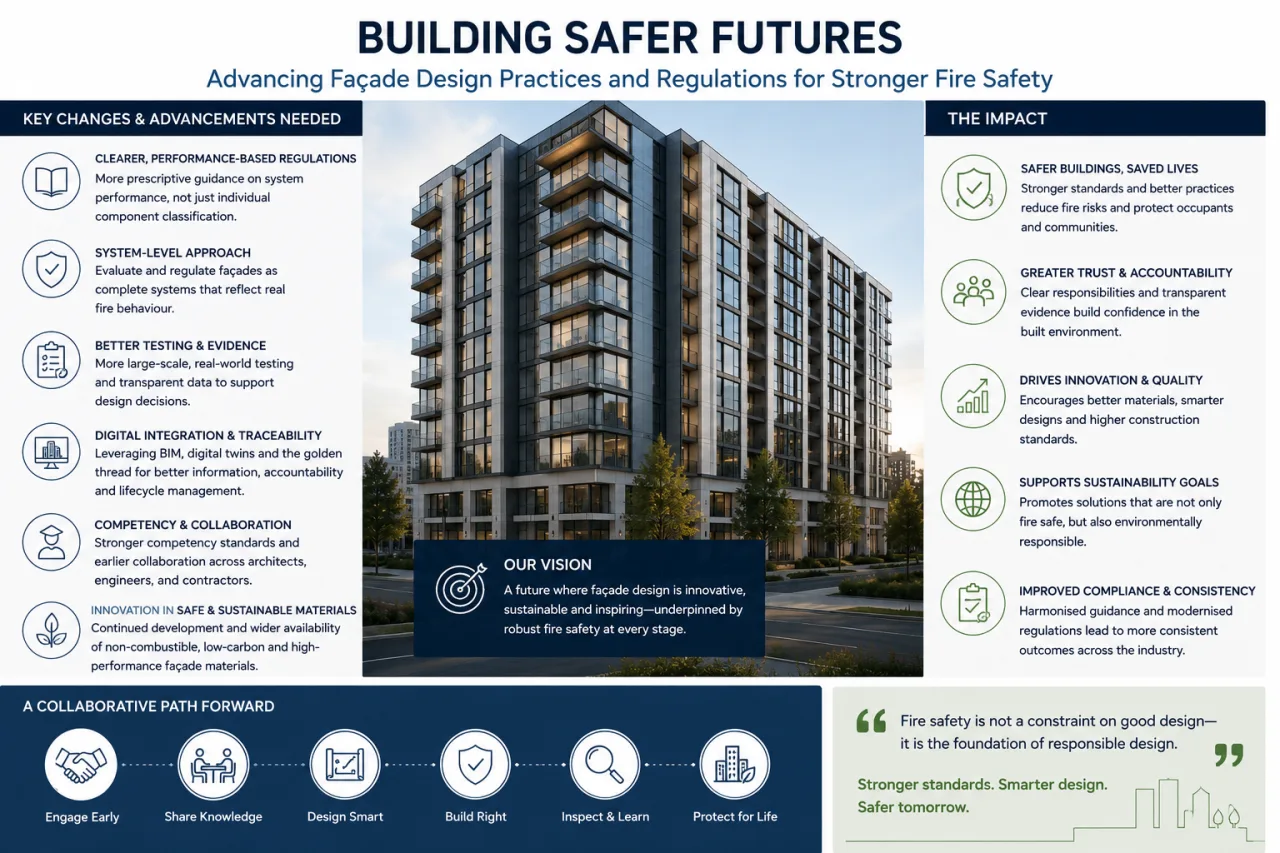
Progress has been real, but the work is far from done. As the industry looks ahead, the conversation is shifting from what has changed to what must change next — spanning regulation, technology, competency, and the culture of collaboration that ultimately determines whether buildings are truly safe.
Salisu believes the industry needs greater global consistency in façade fire safety expectations, testing methodologies, and competency standards. Whilst significant progress has been made, there remain major differences in how façade risks are interpreted and managed across regions. He would like to see fire safety standards organisations — including BSI, ICC, NFPA, EN, and UAEFLSCP committees — establish a working group to bridge these gaps and develop a mechanism for measuring compliance equivalency. He would also like to see a stronger emphasis on lifecycle fire safety management rather than focusing primarily on design-stage compliance. Buildings evolve over time, and façade safety must continue to be monitored during occupation, refurbishment, and maintenance. He believes the future of façade design must successfully balance fire resilience, sustainability, and architectural ambition simultaneously.
Winsbury would like to see greater consistency and clarity in guidance, particularly around performance expectations for complex façade systems. He also sees an opportunity for greater digital integration, noting that the use of digital fire strategies, Building Information Modelling, and the ‘golden thread‘ concept has the potential to improve transparency, traceability, and long-term building safety management. From a technical perspective, continued advancement in non-combustible, sustainable façade materials would be welcome, particularly solutions that balance environmental performance with robust fire resistance. Ultimately, he argues, improving fire safety is not just about regulation — it is about culture. Stronger collaboration, better competency across disciplines, and earlier integration of fire engineering into architectural design will have the greatest long-term impact.
Shah highlights three priorities. First, greater consistency in façade fire safety requirements across jurisdictions, particularly given that many projects in the region involve international design teams, manufacturers, and contractors working across multiple regulatory frameworks. Second, stronger controls around product substitution during construction — in high-speed construction environments such as the UAE and GCC, the pressure to substitute specified materials with alternatives is significant, and what is reviewed, tested, and approved at the design stage must be what gets installed. Third, and most importantly in his view, is continued investment in competency and education across the entire supply chain, recognising that no regulation can substitute for the informed decisions made by designers, contractors, suppliers, inspectors, and building owners throughout the full lifecycle of a building.
Tomar’s vision for the future is not about tightening rules further, but about making the system more intelligent, more evidence-based, and more closely aligned with how buildings actually perform in fire. He sees a stronger shift to true system-level regulation as the single most important advancement still to be completed — a direction the industry has begun to move in, but which remains unfinished. Beyond that, he calls for greater digital integration, improved transparency in testing and certification, and a closer alignment between fire safety practice and the realities of how contemporary façades are procured, built, and maintained over their full service life.
Franklin calls for continued collaboration between authorities, architects, and fire safety professionals. In his view, this ongoing dialogue between all parties remains the most fundamental driver of safer, more accountable façade design and regulation.
Zubair would like to see greater harmonisation of façade fire safety regulations across regions to create clearer and more consistent standards for the industry. Increased adoption of large-scale system testing, digital modelling, and performance-based design methodologies would provide a deeper understanding of façade behaviour under fire conditions. Enhanced transparency in product testing and certification processes would also support better decision-making. Furthermore, continued innovation in non-combustible, sustainable materials can help address both environmental and safety objectives. Strengthening collaboration between regulators, designers, manufacturers, and contractors will, he concludes, be essential to achieving safer and more resilient building envelopes.
Conclusion
What emerges from these conversations is not a tension between safety and ambition, but rather a maturing understanding that the two are inseparable. The most compelling façades of the next decade will not be those that merely comply, but those that are demonstrably, verifiably, and thoughtfully safe — from system selection through to the end of their serviceable lives. As one contributor aptly put it, fire safety should enable architecture, not restrict it. That principle, more than any single regulation or test standard, may prove to be the most enduring legacy of this era of façade engineering.