Post Date: July 8, 2015 |
Last Edited: February 23, 2026
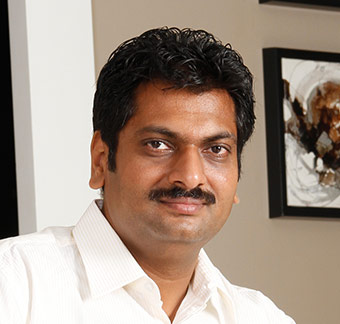
“Mighty spirited in progressing from a 2-member team setup, in a small rental office premises to a team of 230 highly talented group of Architects, Interior Designers, Engineers and Professionals in a spacious office premises of 50,000 sq. ft. floor space.
He has recently received several prestigious awards and recognition in multiple categories, HSBC Sponsored International Asia Pacific Property Awards 2012, Bloomberg Property Awards 2012 for best residential high-rise design in the world, CNBC Award: Best In Ultra Luxury Segment 2013, Artists in Concrete Awards Asia Fest: 2013-14 for best Educational Institute Design where his work was selected from amongst the top architects of the country.
Felicitation by The Times of India, followed by a four-page coverage to celebrate the Architectural brilliance of Ar. Vivek Bhole and his contribution to transforming the Mumbai skyline are another feather in the cap.”
Let us just go through the success mantra of Mr Bhole’s sheer hard work, dedication, ingenious vision and out-of-the-box thinking. Here are some excerpts from the exclusive interview with him.
Tell us how everything started, about the transition and past (history)?
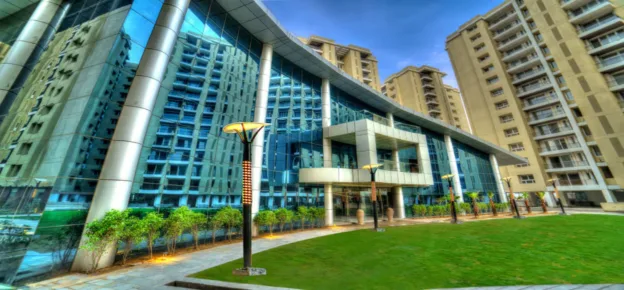
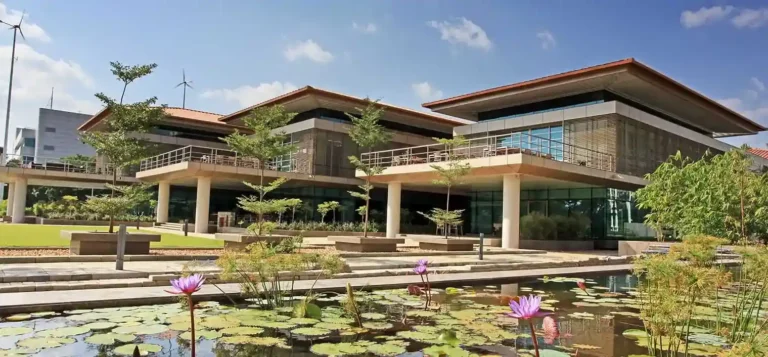
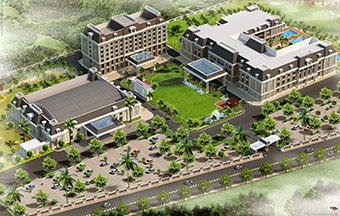
Mr Bhole: I have been in this industry for almost 18 years now, and it all started in a small rented apartment in a remote western suburb in Dahisar, Mumbai. From then to now, from a team of 2 to more than 200, this has been a great journey. We initially began with local redevelopment projects, and now we have diversified into Hospitality, Resorts, Malls, Townships, Commercial, Mixed-use developments, Healthcare, Institutional, Luxury Villas and Infrastructure projects. We are proud to be associated with prestigious brands like Marriott, Radisson, Shangri-La and many standalone hotels and luxury resorts in exclusive locations. (Fig. 1). We are also concentrating on urban planning projects, with the largest being spread over 6800 acres of land. At present, we are working on 12 railway stations and infrastructure projects. So basically varied clients, exquisite locations and creating a varied experience.
So, how did you land in malls? How did this break (breakthrough) happen?
Mr Bhole: It was all transitional based on the clients’ faith. One of my clients insisted I design his jewellery showroom despite the fact that I had not designed any interiors until then. This gave us the opportunity to design interiors. The project was widely acclaimed, and since then, we have designed more than 20 jewellery showrooms all across India in the past 15 years.
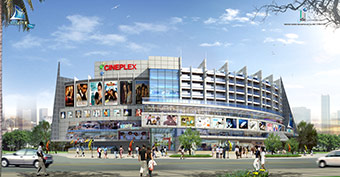
Similarly, another client took over a mall project and insisted that I design it for him. Due to a lack of exposure and experience, I declined, but the client persisted and persuaded me to plan his mall. He took me to Dubai and China for various case studies, and then there was a time when people used to know us as “Mall Specialists”.
Therefore, the journey continued, and we have now successfully completed more than 40 malls all over India. The first Mall Project that we built was the Prime Mall in Vile Parle, followed by Moksh Plaza, Dreams ‘D’ Mall in Mumbai and many others. We also designed the Marg Junction in Chennai, 3 Malls in Madhya Pradesh, 3 in Rajasthan, and then in Kerala, also in tier 2 cities like Nashik, Jalna etc. and the numbers are still growing. Along with malls, hotels came in, and that is how mixed-use developments started taking place. Big enterprises wanted us to build their hotels along with malls. By then, the hotel business had started growing. So we were into hospitality architecture and subsequently started hospitality interiors.
How do you see the line of difference in the development of façade and fenestration designs or doors and windows from small-time residences to high-rise towers and commercial projects?
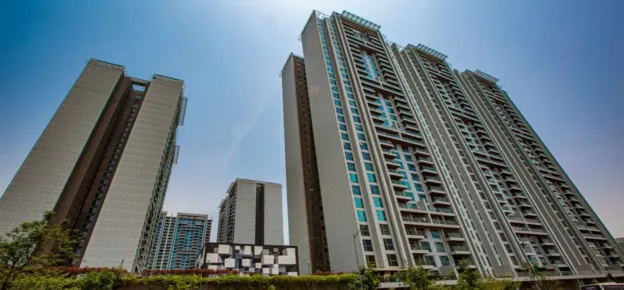
Mr Bhole: There is an array of options and possibilities for every type of façade, depending upon the requirements for varied wind pressures, size of panel design intents, etc. For instance, if we talk about affordable housing projects, even for a 30-storey building, the fenestration would need to be cost-effective. We are designing a housing scheme of 76,000 apartments on the outskirts of Mumbai. In the first phase, we completed 30 towers of 14 stories, 22 stories in the second phase, and are now planning 30 stories for the third phase. The project will be completed in phases over a span of 15 years.
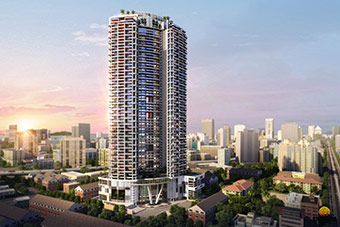
We are also doing 64 storied twin tower Currey Road, where we wanted to have a mullion width of 25 mm. Our fabricator, façade consultants and suppliers are from Dubai. Everyone except me was firm that it is not possible to reduce the mullion width to 25mm, and initially provided a system with 78 mm mullion and frame width. After a lot of reviews, the minimum they agreed on was 38mm. We met the extrusion people (Gulf Extrusion) and got a system that can reduce the mullion width to 21mm. It was possible because, in the system, the glass is used as a structural material with structural sealant and not just a burden on the aluminium profile. And we finalised this very high-end window system.
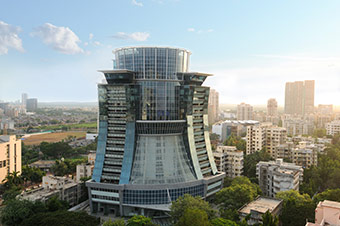
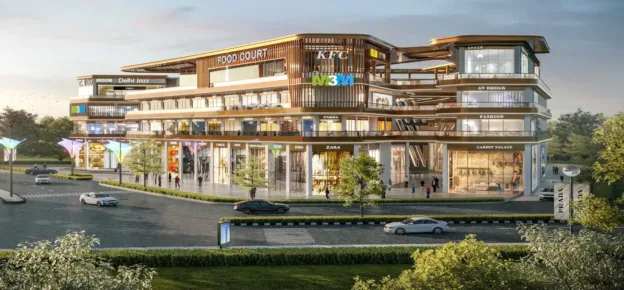
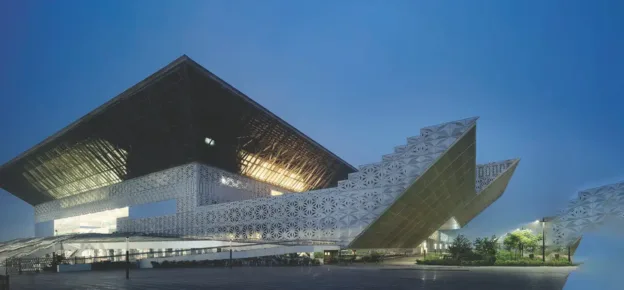
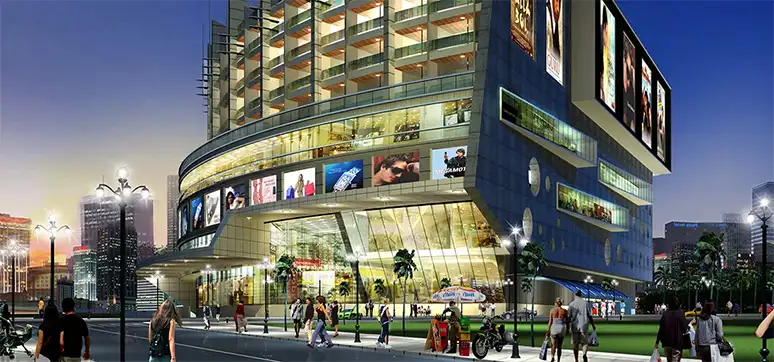
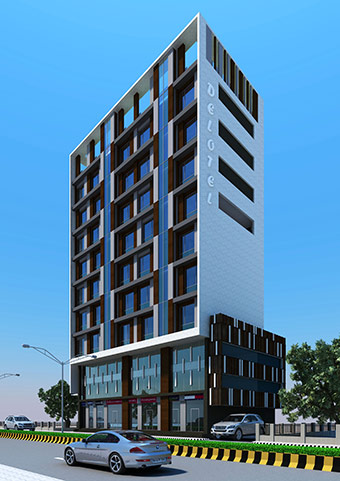
However, for commercial projects, the exterior façade becomes one of the most important elements for functionality, and it also defines the character of the building (Fig 3).
Each project has a different set of requirements, such as environmental, technological, cultural, etc., that affect facade aesthetics.
For instance, if you talk about window patterns, unlike in Asian countries, sliding windows aren’t suitable for the UAE because of the different weather conditions. So in such locations, 80% of the glass is fixed, and only 20% is openable. We designed a residential complex in Jumeirah South Village, Dubai, in the French Chateau concept as per the weather conditions there.
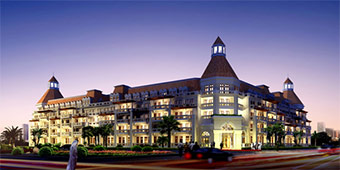
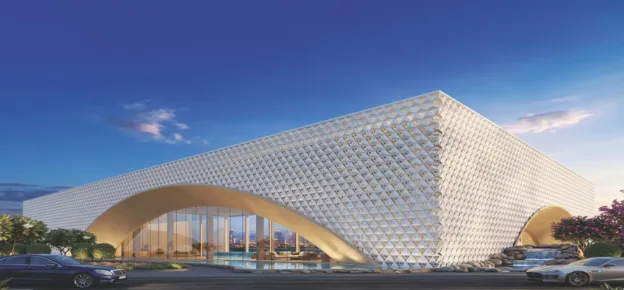
In contrast, we have recently completed a hotel cum club project at Nagpur for Grand Bhagwati. (Fig 5)which is designed for destination marriages spread across 35 acres, with an entirely different concept. It is designed in a Victorian style with a 33% opening.
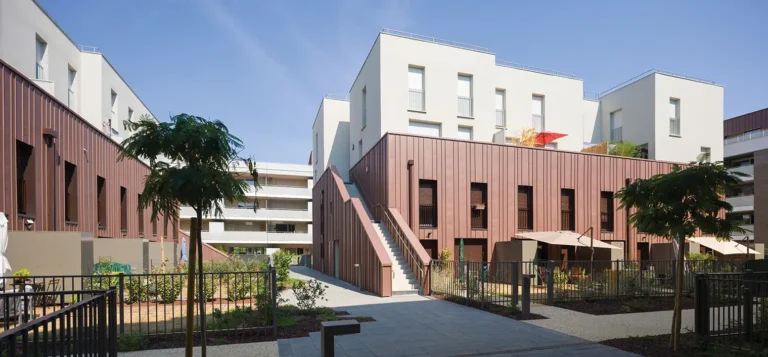
We created another interesting façade using 5 mm compact tile, spread irregularly in a random fashion, transforming a simple façade into a beautiful Mondrian pattern. We also added a few elements with a wooden finish to give it a different character.
Personally, I like aluminium better, and I do not endorse uPVC. This is because, to match the acoustics and other requirements and achieve my desired finesse, aluminium is more suitable.
What is your constant source of inspiration? When we look at your buildings, they are all different from each other, they do not follow a pattern, unlike mainstream structures where all the structures definitely show a recognition/ signature of a builder or a particular group.
Mr. Bhole: Well, our structures are also monotonous. But yes, we constantly try to incorporate varied media. The medium of drawing changes the architecture. Earlier, we were habituated to manual drawing, and then came CAD, which changed our architecture.
So in the span of 15 years, we have explored 3D Sketch, ArchiCAD, and Rhino, and therefore, the architecture keeps changing because of the capabilities of the new software. Although the basic principle remains the same, the output changes. We try to change the aesthetic preferences as per the requirements of the client. This year’s work is always different from the previous year. Flower beds with glass railings are a fixed pattern for Mumbai, which might not be the case for the character in Madhya Pradesh. For instance, in Indore, the flower bed width is permissible up to 1/3 of the open space. Hence, the decks are huge. It gives a different character to the buildings, unlike Mumbai. So again, everything depends on the requirements.
So, coming back to the question, why no UPVC?
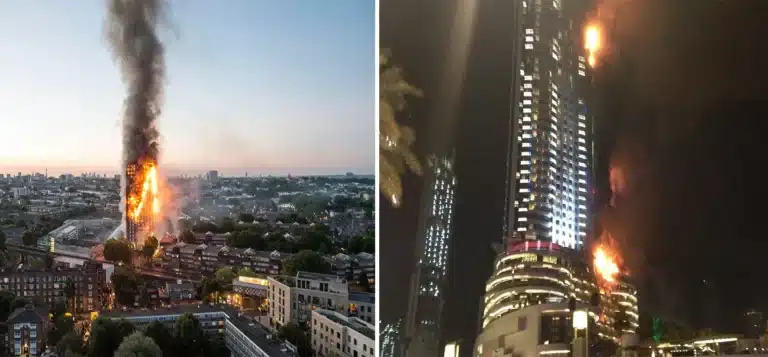
Mr Bhole: Despite being a virgin plastic, UPVC windows become brittle over a period of time and are not considered fireproof. Also, when it comes to high wind pressure, UPVC windows give a rattling sound and are not watertight. This is the primary reason for preferring Aluminium over uPVC, and hence I do not recommend it. Otherwise, if you ask me, I am expecting a much better and new material in future which would be a composite of aluminium and resin. The main structural element is aluminium supported by resin.
In terms of coating, what do you prefer – anodised or powder coating?
Mr Bhole: Clearly, powder coating more. Otherwise, it is like selecting low-grade granite for flooring where only limited dark shades are available. So for vibrancy, colour options, expected finesse, creativity and appeal, I prefer powder coating over anodised.
Talking about windows, a pattern of fixed window panels remains the basic law, or why can’t we have a fully openable window panel in hotels?
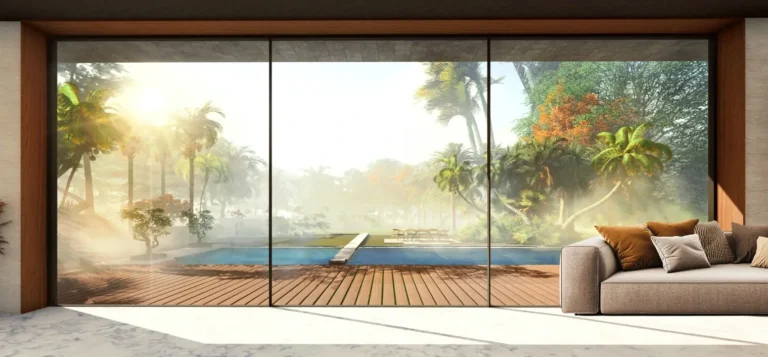
Mr Bhole: See, there are various challenges with a fully openable window panel. Firstly, even if the view is simply awesome, say at a beach or jungle, and you want your guests of the resort or the hotel to open it completely, the AC and the environment outside would not permit you to do that. Also, there is a constant risk of insects, dust and AC automation to deflect. We even tried a mockup of sliding and folding to achieve 100% opening, but because of the rattling sound, we resorted to a conventional system. Another interesting combination that we tried doing was dividing the panels in x/2 and x/4 to achieve 50% window opening, where the permutations and combinations allow all the sliding panels to stack either on sides or in the middle, giving an unobstructed, bigger panel view when the window is closed. Hence, as of now, the best possible combination we offer is a partially fixed and partially sliding window for cleaning and maintenance purposes.
Finally, what are the challenges you faced or are facing in terms of the expected finish and cost constraints?
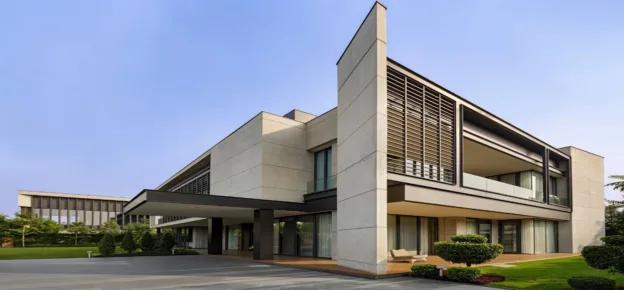
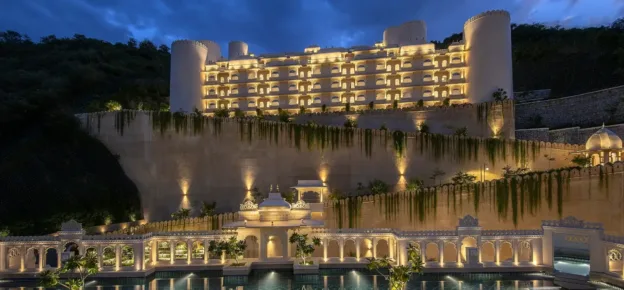
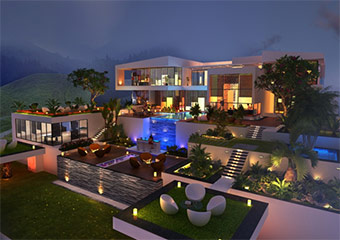
Mr Bhole: If you talk about a few years ago, yes, we used to face some challenges in terms of quality and finish. But now it has reduced, and I can say absolutely no issues. We also suggest using PVDF, but cost reluctance becomes an important factor. There is certainly a huge cost difference between powder coating and PVDF. For external use, we prefer PVDF. We are doing a project of 450 premium villas in the Aamby Valley City(Fig -7), and there we are using PVDF. The window size is also a big span of 5.8 meters with shutters weighing 300 kgs, with stainless steel ball bearings, so no lift and slide mechanism is required. So when there are no financial constraints, we take the liberty to use superior quality products and systems.
What is your message/ advice to the industry friends?
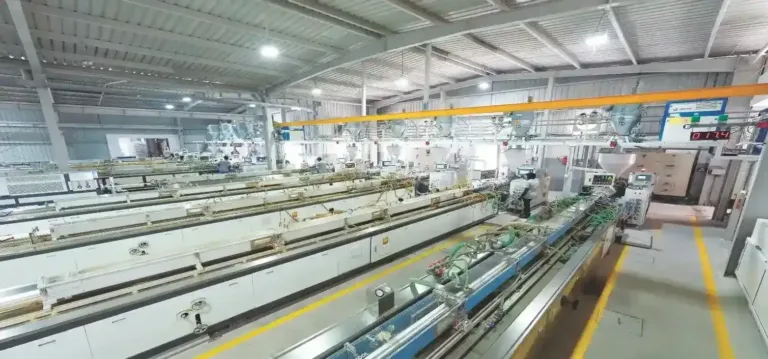
Mr Bhole: If you ask me, there are various techniques not available in India, like Wind Tunnel testing for facades. Despite having so many extrusion companies, we have yet to achieve the expected precision. Another mindset of our industry is that we prefer the experience over experiments, so we always end up following a system from overseas. With the increasing global focus on the Indian market, there is a need to start manufacturing and supplying with greater precision. We would have to bring down our dependence on international players and start manufacturing indigenously. In my opinion, ‘We need to achieve Independence again!’