
Post Date: June 10, 2026 |
Last Edited: June 10, 2026
Key Highlights
|
India’s aviation sector is undergoing one of the most significant infrastructure transformations in its modern history. With the rapid expansion of airport networks, new terminal developments, regional connectivity initiatives, and large-scale modernisation programmes, airport architecture is no longer being evaluated solely through the lens of capacity enhancement or iconic form-making. It is increasingly being measured by how intelligently each component of the built envelope contributes to operational resilience, energy optimisation, passenger comfort, and long-term sustainability.
Within this broader architectural and engineering evolution, façade and fenestration systems have emerged as highly strategic performance assets rather than merely exterior enclosure elements. In contemporary airport design, façades function as dynamic environmental regulators—high-performance interfaces that mediate climate, structural forces, daylight, acoustics, and safety requirements, while simultaneously shaping the identity of national aviation infrastructure.
Façade Engineering Beyond Aesthetics: Designing For Environmental Intelligence
The contemporary airport facade can no longer be reduced to an architectural skin designed for visual impact. It now represents a complex engineered system where material science, environmental response, and digital performance modelling intersect.
In large airport terminals, particularly within India’s diverse climatic zones, façade systems must negotiate sharply contrasting environmental conditions. Terminals located in humid coastal regions such as Mumbai and Chennai demand façade assemblies capable of managing high moisture exposure, corrosion risks, and solar heat gain, while northern and inland geographies require thermal balancing against seasonal extremes.
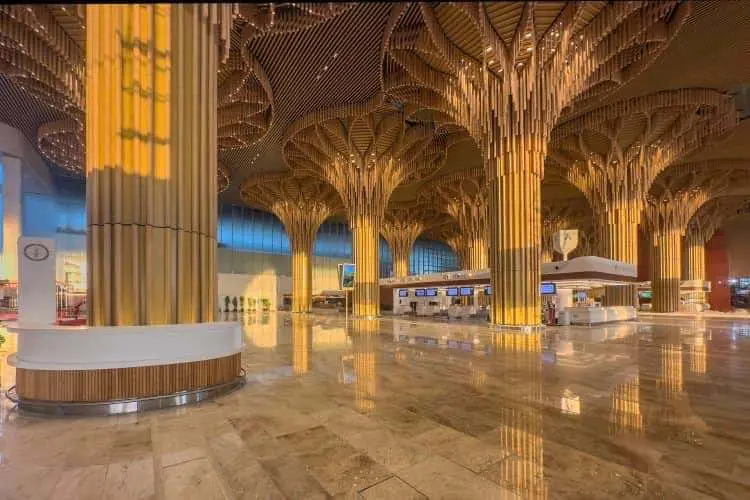
The challenge lies in achieving expansive daylight penetration across deep terminal interiors without compromising thermal performance. Excessive solar ingress increases cooling loads dramatically—an operational concern of particular significance in Indian airports, where HVAC remains one of the largest contributors to lifecycle energy expenditure.
As A Result, Advanced Façade Specifications Increasingly Prioritize The Following:
- Double and triple-insulating glazing systems.
- Low-emissivity coated glass assemblies.
- Thermally broken aluminium framing systems.
- High-performance curtain wall assemblies.
- Solar control glazing with optimised visible light transmittance.
These systems collectively reduce internal heat gain, mitigate glare, improve occupant comfort, and enhance envelope efficiency while maintaining architectural transparency.
Fenestration As A High-Performance Operational System
Fenestration in airport infrastructure has evolved into a precision-driven engineering discipline. Large-span glazed surfaces now serve operational purposes extending far beyond visibility and openness.
Today’s airport glazing systems are calibrated to achieve multiple simultaneous objectives:
- Thermal regulation across fluctuating occupancy zones.
- Acoustic attenuation in high-noise aviation environments.
- Visual comfort in waiting lounges, boarding gates, and circulation spaces.
- Structural flexibility under wind and vibration loads.
This complexity demands sophisticated simulation workflows early in design development, where glazing performance is assessed not only architecturally but also computationally.
BIM As The Core Integrator Of Airport Envelope Intelligence
One of the most transformative developments in airport façade delivery has been the integration of Building Information Modelling into multidisciplinary planning workflows.
BIM has fundamentally redefined how façade consultants, architects, MEP engineers, structural teams, and construction specialists coordinate within airport projects.
For façade-intensive terminals, BIM enables the following:
- Parametric façade modelling for complex geometries.
- Clash-free coordination with steel structures and services.
- Performance validation before procurement.
- Quantity certainty for procurement planning.
- Digital sequencing for installation logistics.
In high-stakes airport projects, where façade interfaces involve thousands of unique components, BIM reduces risk by allowing pre-construction decision-making with unprecedented precision.
More importantly, BIM supports digital lifecycle intelligence, allowing façade assets to be managed beyond construction into maintenance and operational phases.
Smart Glass And Responsive Envelope Technologies
Airport façades are now entering an era of adaptive intelligence through responsive glazing technologies.
Dynamic glass systems capable of electronically adjusting tint based on solar intensity represent one of the most advanced shifts in airport environmental design.
These systems:
- Reduce glare dynamically.
- Lower cooling demand.
- Maintain daylight continuity.
- Improve passenger comfort without dependence on mechanical shading
When integrated with sensor-based environmental monitoring systems, façade behaviour becomes data-responsive. Temperature, solar radiation, wind pressure, and internal thermal loads can now inform façade performance in real time, allowing building envelopes to respond rather than merely resist environmental stress.
For India’s climate diversity, such responsive systems offer particularly high long-term operational value.
Structural Safety: The Non-Negotiable Dimension Of Façade Design
Airport façade engineering operates within one of the most demanding safety frameworks in the built environment.
Large Glazed Spans Must Withstand:
- High wind pressures.
- Thermal movement.
- Seismic loading.
- Impact resistance requirements.
- Blast load considerations.
Accordingly, laminated safety glass and toughened assemblies have become standard within passenger terminal applications.
In regions subject to seismic activity, façade anchorage systems must acc ommodate structural drift while preserving glazing integrity.
Blast-resistant façade design has also become increasingly relevant in aviation infrastructure, where controlled force dissipation and energy absorption characteristics are engineered into façade assemblies through specialised testing protocols.
Fire Performance And Regulatory Compliance
Fire-rated glazing systems are equally critical in airport design. These assemblies support:
- Protected Evacuation Routes.
- Smoke Compartmentation.
- Fire Spread Control Across Terminal Zones.
Compliance is governed by stringent international and local codes, requiring façade systems to perform not only structurally but also under extreme thermal conditions.
Airtightness, Watertightness, And Urban Durability
In dense Indian urban environments, façade durability extends beyond structural resistance.
High-performance sealing systems are essential to protect interiors from:
- Air leakage
- Dust infiltration
- Rain penetration
- Pollution ingress
This is particularly significant in high-traffic metropolitan regions, where operational cleanliness and interior air quality directly affect passenger experience and maintenance costs.

Passenger Experience As A Measurable Design Outcome
Modern airports are increasingly judged by how passengers psychologically experience space.
Façades directly influence this perception through environmental quality.
Well-designed airport envelopes contribute to:
- Enhanced natural daylight exposure.
- Reduced dependence on artificial lighting.
- Visual openness and spatial calm.
- Improved acoustic comfort.
- Reduced travel stress.
Natural light has measurable psychological benefits, particularly in high-density transit environments where passenger anxiety levels are naturally elevated.
Additionally, façade articulation offers an opportunity for cultural identity, with Indian airports increasingly integrating local narratives into a globally contemporary design language.
Sustainability And The Future Of Airport Envelope Design
As sustainability targets intensify, façades are becoming one of the most decisive contributors to airport energy strategy.
Advanced façade systems now enable:
- Reduction Of HVAC Demand.
- Solar Load Control.
- Renewable Energy Integration.
- Material Circularity.
Emerging applications such as photovoltaic glazing allow façades to function simultaneously as energy-generating surfaces.
Integrated shading systems further optimise thermal performance without compromising visual quality.
The use of modular façade construction also reduces site waste, improves installation speed, and supports long-term maintenance efficiency.
A Futuristic Vision For Indian Airport Infrastructure
India’s future airports will increasingly rely on intelligent envelopes capable of responding dynamically to environmental variation, operational demand, and sustainability goals.
The next generation of airport façades will not merely enclose terminals – they will behave as active infrastructure systems.
Responsive façades capable of adapting to sunlight, temperature shifts, wind direction, and occupancy conditions will become central to high-performance terminal architecture.
As passenger volumes continue to rise, airport envelopes must simultaneously deliver the following:
- Durability
- Safety
- Energy Intelligence
- Passenger Well-Being
- Lifecycle Efficiency
The future of airport architecture belongs to systems where engineering sophistication and digital intelligence work invisibly in service of resilience.
In this evolution, façade design is no longer peripheral; it is central to how airport infrastructure performs, endures, and defines national progress.
The future of airport façade engineering will increasingly depend on evidence-led design, digital simulation, and material intelligence, where every envelope decision is validated not only by aesthetics but also by measurable operational outcomes.